Call Compliance in India: Sort Your Calls, Then Audit 20
Call compliance for an Indian sales team starts with sorting every call as promotional, service, transactional or enquiry follow-up under telecom regulator rules, then auditing 20 recent calls.

By Tej Pandya, Founder · Updated 19 Nov 2026
Key takeaways
- Call compliance in India depends on the type of call. Promotional calls need consent or a Do Not Disturb check, service, transactional and enquiry follow-up calls follow narrower rules, and your call log is the proof.
- A follow-up to a customer's enquiry has a basis for seven days, but only if the enquiry was made in writing or digitally and you kept the record.
- An operator bars a sender's lines after five unique complaints in ten days or AI flags on five or more of its numbers, and from 17 December 2026 after three complaints plus one flag. The first proven violation bars all outgoing lines for 15 days.
- Tell callers at the start that a call is recorded and why, then run the 20-call check below before your next campaign.
In this article
- 1What does call compliance mean for a small sales team in India?
- 2Do you need to register to make promotional calls, and which number series do they use?
- 3Which type is each of your calls: promotional, service, transactional or enquiry follow-up?
- 4What gets a sales team's phone lines barred in India?
- 5Do you have to tell customers you are recording a call?
- 6How do you run a 20-call compliance check on your own call log?
- 7Frequently asked questions
A delivery update that ends with "we also have a new plan for you" is not a service call. Under the rules of the Telecom Regulatory Authority of India (TRAI), one sentence of pitch makes the whole call a promotional call. The type of a call, not your intention in making it, decides which rule applies.
That is how small teams get into trouble: through ordinary calls that drift, not through cold-calling at scale. A lead noted without a date gives you no seven-day basis to call back, and a customer who said stop gets called again the following week. TRAI calls the business making the call the "sender", and the obligations sit with that sender.
This page sorts your calls into four types, shows what gets a sales team's phone lines barred, and gives you a 20-call check to run on your own call log. TalkEasy publishes it; we make a business phone app for Indian teams.
What does call compliance mean for a small sales team in India?
Call compliance in India means making only the commercial calls TRAI's rules allow for each type of call, handling customer data as the Digital Personal Data Protection (DPDP) Act requires, and being able to show both from your records. Two sets of rules carry almost all of it: TRAI's Telecom Commercial Communications Customer Preference Regulations (TCCCPR), amended in February 2025 and September 2026, and the DPDP Act, 2023.
Do Not Disturb (DND) is the list people join to block promotional calls. TRAI calls it the Preference Register. Most of the work comes down to one decision: what type is each call?
Do you need to register to make promotional calls, and which number series do they use?
Yes: a business must be registered with a telecom operator before it makes commercial calls. TRAI's 2025 amendment says no sender that is not registered with an operator for commercial communication may make commercial calls, and its telecom resources may be suspended or disconnected if it does. Registration is recorded on the Distributed Ledger Technology (DLT) platform, TRAI's blockchain-based registry (PIB, 13 February 2026).
The same amendment requires commercial communication to use registered headers or number resources from series assigned for that purpose. TRAI designates the 140xx, 1600xx and 1601xx series for commercial communication (PIB, 18 September 2026).
Which type is each of your calls: promotional, service, transactional or enquiry follow-up?
Every commercial call falls into one of four types, and the type decides the rule. Sort a call by what it says, not by why you made it: TRAI's 2025 amendment treats any commercial voice call that carries promotion as a promotional call.

| Type | What counts | Rule that follows |
|---|---|---|
| Promotional | Any commercial voice call containing promotional material or an advertisement for a product or service. A pitch added to any other call makes the whole call promotional. | Delivered only to numbers that have not blocked promotional calls in the Preference Register, or whose owner has given consent. |
| Service | Information to your own customer about a product or service they hold: warranty, recall, software upgrade alerts, safety or security, periodic balance alerts, delivery updates. Nothing promotional. | No explicit consent needed. |
| Transactional | A call within 30 minutes of a transaction the customer started: a confirmation or refund information. | No explicit consent needed. |
| Enquiry follow-up | The relationship must not have been ended by either party (TRAI, 2026, definition of "relationship" in regulation 2). | The enquiry or application gives the call a basis. Without the record, it does not. |
Three mistakes turn compliant calls into promotional ones:
- The upsell at the end of a service call. A delivery update that finishes with "while I have you, we have a new plan" is a promotional call.
- The undated enquiry. A lead typed into a sheet with no date, or one that came in 10 days ago, gives you no seven-day basis.
- Calling an existing customer to sell. A customer who already bought from you is not exempt. A pitch is a pitch.
When a call sits between two types, treat it as promotional. That is our recommendation, and it matches the mixed-content rule.
What gets a sales team's phone lines barred in India?
An operator bars a sender's lines on one of two triggers: five unique complaints about the sender within ten days, or AI flags on five or more of the sender's numbers within ten days, with no complaint needed. The operator, not TRAI, acts. Complaints bring immediate suspension of outgoing services and an investigation; flags start a graded response of checks and, if misuse is found, a 15-day bar (regulations 21A(5), 25(5)(d) and 25(6), TRAI, 2026; Press Information Bureau (PIB), 18 September 2026).
As of 19 November 2026, a third trigger applies from 17 December 2026: three unique complaints within ten days when an operator's AI system has also flagged one of the sender's numbers as a "suspected high probability" source of unsolicited calls.
The count is of unique recipients. Ten angry calls from one customer are one complainant, and ten customers who each complain once are ten. In 2025 the regulator sent 7,31,120 notices to unregistered telemarketers and disconnected 1,84,482 telecom resources, and complaining is easy: 17.06 lakh of the 31.09 lakh unsolicited-call complaints came through TRAI's DND app (PIB, 13 February 2026).
What happens after an investigation. The operator sends a notice and gives the sender five business days to respond. If it finds unsolicited commercial calls, the regulation sets this ladder:
| Instance | Consequence |
|---|---|
| First | Outgoing services on all the sender's telecom resources (SIMs, and primary rate interface (PRI) and Session Initiation Protocol (SIP) trunks, the connections that carry office phone lines) are barred for 15 days, whether or not each was used. |
| Later | All those resources are disconnected for one year, the sender is blacklisted, and the devices used are blocked. One number is kept, with outgoing calls barred. |
The AI flag. Operators now flag numbers whose calling pattern looks like spam, and must tell the sender by SMS or email. If five or more of a sender's numbers are flagged within ten days, a know-your-customer (KYC) re-check follows, then a physical verification, then the ladder above. Operators must give flagged senders a way to contest the flag, so watch the contact details registered with your operator. Numbers in the 140xx, 1600xx and 1601xx series that TRAI designates for commercial communication are not flagged as spam to recipients.
Automated calls. TRAI now defines an Application-to-Person (A2P) call as one started by software without direct human dialling, including autodialling, robo-calls and pre-recorded or artificial voices. Senders must declare A2P use to their operator in advance, with the number ranges involved, and an undeclared A2P call is treated as unsolicited. If any tool in your team places calls without a person starting each one, those are A2P calls, and the declaration to your operator has been mandatory since 17 November 2026.
Dates. The 2026 amendment's main provisions applied from 18 October 2026, the A2P declaration (a 60-day provision) from 17 November 2026 and the three-complainant trigger (a 90-day provision) from 17 December 2026, counting from the 18 September 2026 notification.
Spam labels on a business number are a separate problem; our page on why business numbers get spam labels covers it.
Do you have to tell customers you are recording a call?
Yes. You can record customer calls, and where you rely on consent to record, the DPDP Act requires that a notice comes with or before the request for consent, that the consent is "free, specific, informed" and as easy to withdraw as it was to give, and that you can prove the notice and the consent (DPDP Act, sections 5 and 6). As of 19 November 2026, the Rules notified in November 2025 are still inside their 18-month phased timeline, so these duties take effect about May 2027.
A recording of a customer's voice is personal data under the DPDP Act, so its notice and consent duties apply to it. The Rules call for standalone, clear consent notices. The Act's maximum penalties are up to ₹250 crore for failing to keep reasonable security safeguards and up to ₹50 crore for breaches of its other provisions. TRAI's own 2026 amendment adds that nothing in its rules exempts a sender from DPDP liability.
Our recommendations: record only the calls you will review, limit who can open recordings, and delete them once their purpose ends.
How do you run a 20-call compliance check on your own call log?
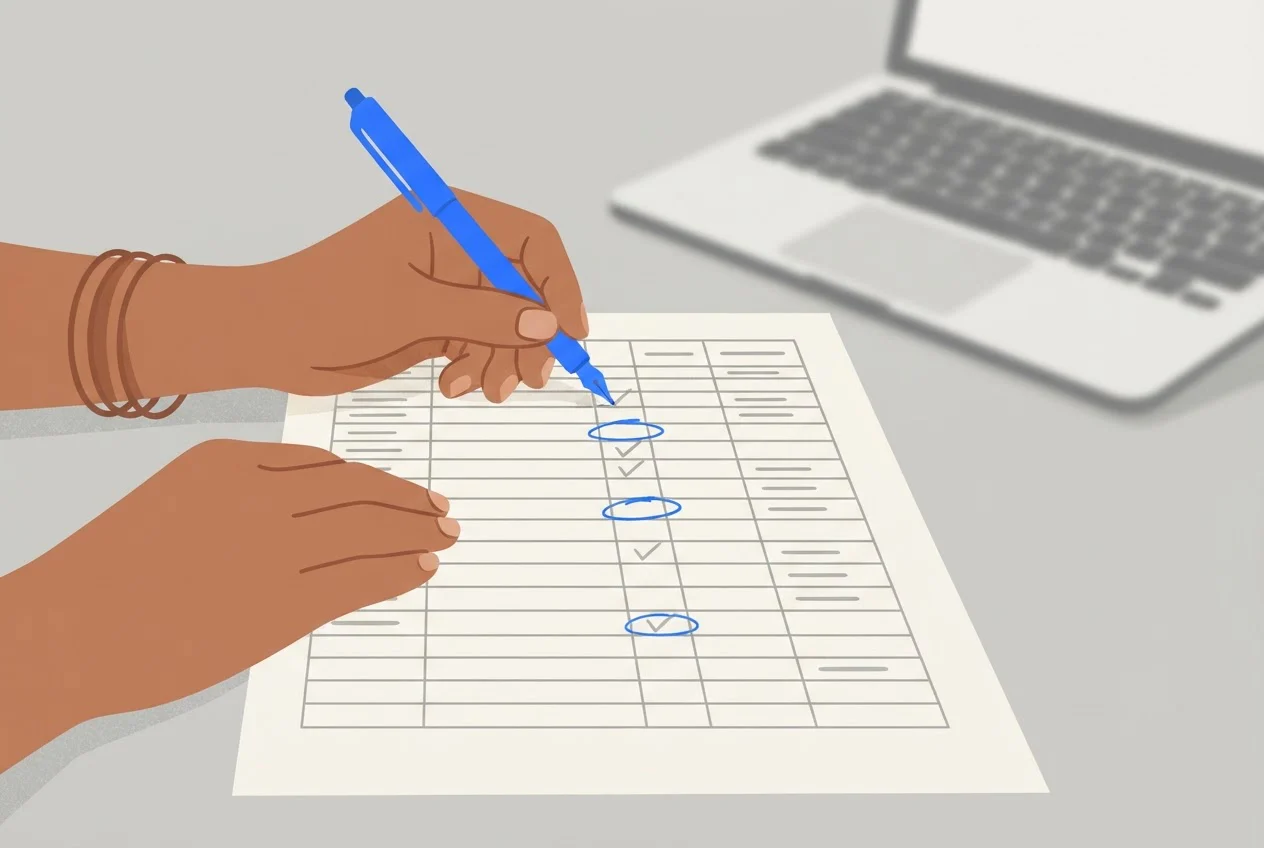
Copy your last 20 outbound calls from your call log, with number, date, time, duration and outcome, tag each by type, and run seven pass-or-fail tests. Twenty is our recommended sample: enough to show a pattern in a small team, small enough to finish in one sitting. Fix every fail before your next campaign.
| # | Test | Pass | Fail |
|---|---|---|---|
| 1 | Tag each call promotional, service, transactional or enquiry follow-up. | 20 of 20 tagged. | Any untagged call. Count it as promotional. |
| 2 | For each enquiry follow-up, find the dated written or digital enquiry. | No record, or older. Re-tag as promotional. | |
| 3 | Listen to the last minute of each service or transactional call. | No pitch, offer or upsell. | Any pitch. Re-tag as promotional. |
| 4 | For each promotional call, find a consent record or a Preference Register check made before the call. | Present for every call. | Any call without one. |
| 5 | Read the notes on each call for "stop", "do not call" or "not interested", then check the number was not called again. | No number called again after a stop request. | Any repeat call. |
| 6 | Play the first 10 seconds of five recordings. | A recording announcement on all five. | Any recording without it. |
| 7 | Ask whether any tool starts calls without a person starting each one. | Your operator confirms the declaration is made, or that the calls are person-initiated. | No answer from the operator. |
Reading the result. Failure rate is failing calls ÷ 20 × 100. Aim for zero on tests 4 and 5, because repeat calls to people who refused are what produce complaints. Then count the distinct people you called for promotion in the last ten days. Each is a possible complainant, and the trigger counts people, not calls.
How we do it at TalkEasy. Every call made through our Business Dialer is logged automatically with the contact, time, duration and outcome, so the 20 calls sit in one place. We record calls on every paid plan. Playing the announcement at the start of a call is your own script step; add it to your opening line, and test 6 checks it. AI Call Insights analyses recordings and raises compliance flags, so you know which calls to listen to first; a flag is a prompt to listen, not a verdict. Recording, call history and the analytics dashboard are on every paid plan. As of November 2026, Pro costs ₹999 + GST a month and includes unlimited users and contacts.
To read your own log properly, see how to read a call detail record. For reviewing calls without live listening, see our call monitoring guide.
Keep every call logged and ready to audit
Frequently asked questions
Sources
- 1.Telecom Commercial Communications Customer Preference (Third Amendment) Regulations, 2026, Telecom Regulatory Authority of India, 18 September 2026
- 2.Telecom Commercial Communications Customer Preference (Second Amendment) Regulations, 2025, Telecom Regulatory Authority of India, 12 February 2025
- 3.TRAI amends the Telecom Commercial Communications Customer Preference Regulations (TCCCPR), 2018 to strengthen the framework against unsolicited commercial communications, Press Information Bureau, 18 September 2026
- 4.Over 7 lakh notices, 5.6 lakh restrictions: TRAI tightens grip on spam telemarketers in 2025, Press Information Bureau, 13 February 2026
- 5.The Digital Personal Data Protection Act, 2023, Ministry of Electronics and Information Technology, 11 August 2023
- 6.Government notifies DPDP Rules to empower citizens and protect privacy, Press Information Bureau, 14 November 2025