
Comparison
TalkEasy vs Quo: OpenPhone Alternatives for India
OpenPhone alternatives for Indian teams start with the number: Quo, as OpenPhone is now called, sells only US and Canadian numbers, while TalkEasy gives a shared +91 number priced in rupees.

By Tej Pandya, Founder · Updated 14 Nov 2026
TalkEasy
Shared +91 business number priced in rupees, India
Best for: Teams that call Indian customers
Quo (OpenPhone)
US and Canadian business numbers, priced per user
Best for: Teams that need US or Canadian numbers
On this page
- 01At a glance
- 02How each looks
- 03Which to choose
- 04Detailed comparison
- 05Introduction
- 06Key takeaways
- 07What are the best OpenPhone alternatives for a team that calls Indian customers?
- 08Why choose TalkEasy over Quo for calls in India?
- 09What does calling India cost on Quo compared with TalkEasy for a five-person team?
- 10How can you test both products with ten calls before you commit?
- 11How we compared
- 12Frequently asked
The short answer
For a team that calls Indian customers, we recommend TalkEasy. For 78 hours of calling India a month, five Quo seats come to about ₹37,800 to ₹55,100 at an assumed ₹94 per US dollar, against TalkEasy Pro at ₹999 + GST with 3 hours of talktime a day included.
At a glance
Number
- TalkEasy
- One shared +91 (India) business number
- Quo (OpenPhone)
- US or Canadian number, local or toll-free, one per user
Pricing currency
- TalkEasy
- Rupees
- Quo (OpenPhone)
- US dollars
Entry plan
- TalkEasy
- ₹999 + GST (Goods and Services Tax) a month
- Quo (OpenPhone)
- Starter: $19 per user a month, or $15 on annual billing
Users
- TalkEasy
- Unlimited users and contacts
- Quo (OpenPhone)
- Charged per user
Calling Indian numbers
- TalkEasy
- 3 hours a day of talktime (the call time your plan counts) included; extra hours ₹49 + GST
- Quo (OpenPhone)
- $0.07 a minute to mobiles and landlines, $0.09 to major cities, from prepaid credits
Commitment
- TalkEasy
- Cancel anytime, no long-term lock-in
- Quo (OpenPhone)
- Lowest rate needs annual billing (Starter: $180 a year)
AI call summaries
- TalkEasy
- AI call assist included; summaries within a couple of minutes
- Quo (OpenPhone)
- From the Business plan: $33 per user a month, or $23 on annual billing
Source: Both companies' plan and rate pages, Nov 2026
How each looks
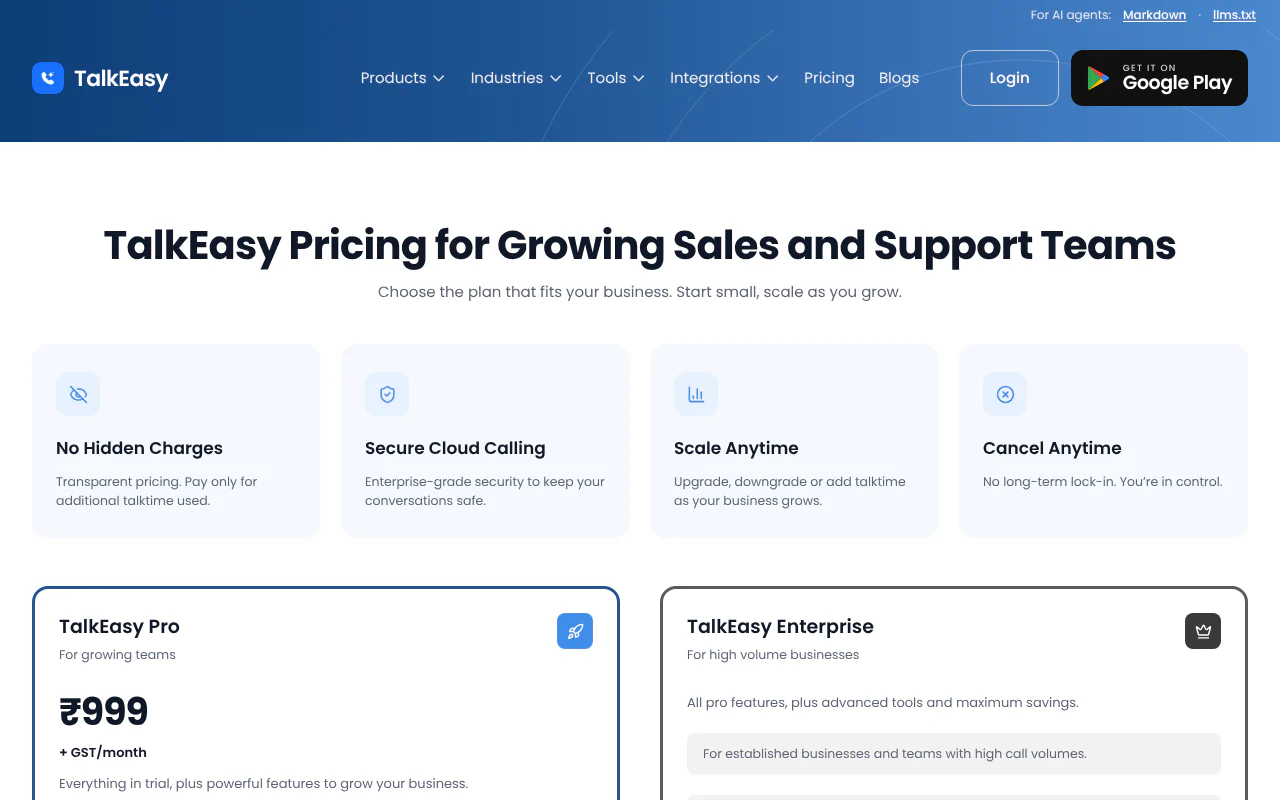
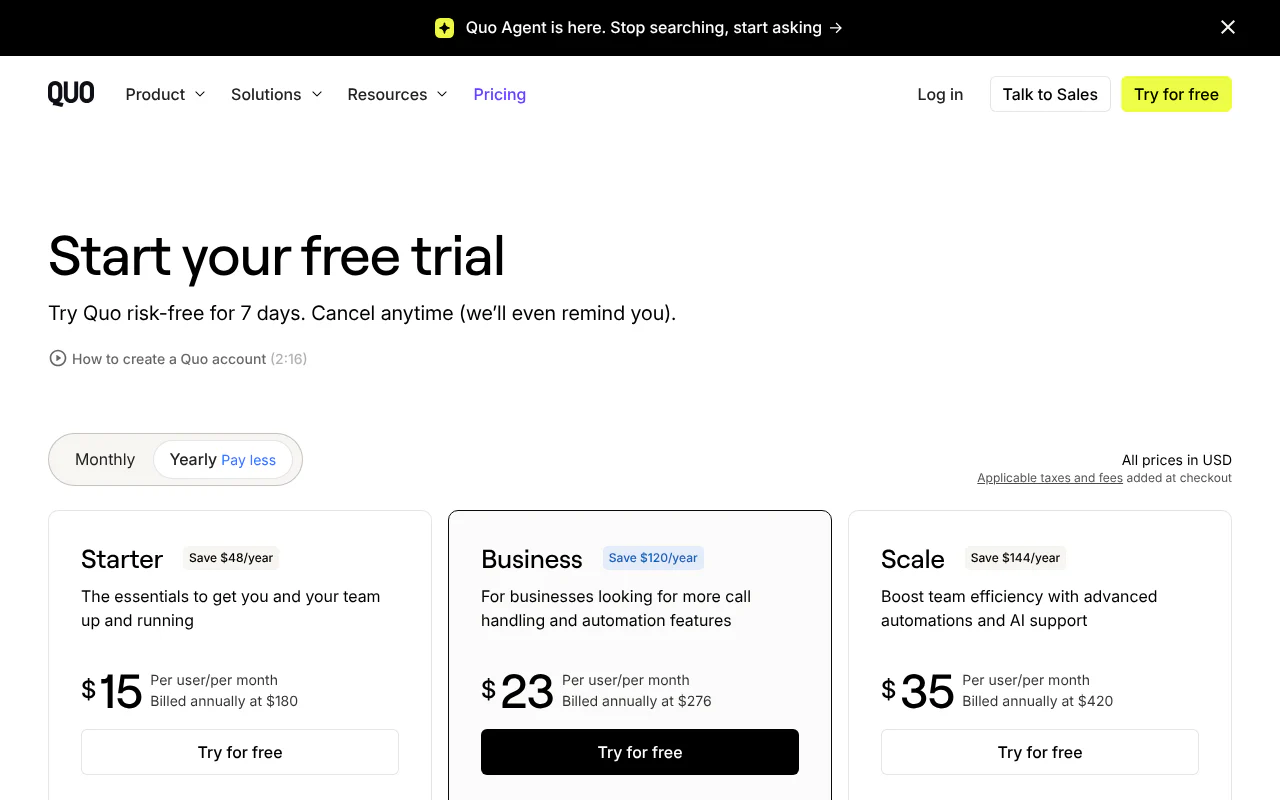
Which should you choose?
Choose TalkEasy if
- Your customers are in India and you want a +91 number your whole team shares
- You want to pay in rupees through UPI, card or netbanking and keep a saved invoice for every purchase
- You want one plan for the whole team instead of a seat for each person
- Your team spends hours a day calling Indian mobiles and wants daily talktime included
- You want AI call summaries without moving to a higher tier
Choose Quo (OpenPhone) if
- You need a US or Canadian business number, local or toll-free
- Your customers are in the US or Canada rather than India
TalkEasy vs Quo (OpenPhone), point by point
A check marks the stronger side on that point. Points without a check are even, or depend on what you need.
| What matters | TalkEasy | Quo (OpenPhone) |
|---|---|---|
| Numbers and billing | ||
| Extra numbers | Stronger hereOne shared +91 number for the whole team | One number per user; each extra number costs $5 a month |
| Payment methods | Stronger hereUPI, card and netbanking; every purchase gets a saved invoice | Plans and calling rates in US dollars |
| Team features | ||
| Call recording | Stronger hereCall recording and history on every paid plan | Automatic call recording starts at Business |
| Analytics | Stronger hereTeam management and analytics on paid plans | Analytics and reporting start at Business |
| AI follow-up data | Stronger hereAI call summaries give a transcript, summary, intent and follow-up information within a couple of minutes on Pro | AI call tags need Scale: $47 per user a month, $35 on annual billing |
| Trying it first | ||
| Trial and testing | Stronger hereNo long-term lock-in, so you can run the ten-call test on a paid month and cancel anytime | Seven-day trial cannot place international calls; credits must be bought first |
Numbers and billing
Extra numbers
- TalkEasyStronger here
- One shared +91 number for the whole team
- Quo (OpenPhone)
- One number per user; each extra number costs $5 a month
Payment methods
- TalkEasyStronger here
- UPI, card and netbanking; every purchase gets a saved invoice
- Quo (OpenPhone)
- Plans and calling rates in US dollars
Team features
Call recording
- TalkEasyStronger here
- Call recording and history on every paid plan
- Quo (OpenPhone)
- Automatic call recording starts at Business
Analytics
- TalkEasyStronger here
- Team management and analytics on paid plans
- Quo (OpenPhone)
- Analytics and reporting start at Business
AI follow-up data
- TalkEasyStronger here
- AI call summaries give a transcript, summary, intent and follow-up information within a couple of minutes on Pro
- Quo (OpenPhone)
- AI call tags need Scale: $47 per user a month, $35 on annual billing
Trying it first
Trial and testing
- TalkEasyStronger here
- No long-term lock-in, so you can run the ten-call test on a paid month and cancel anytime
- Quo (OpenPhone)
- Seven-day trial cannot place international calls; credits must be bought first
Introduction
For a team that calls India all day, Quo's seat fee is the smaller part of the bill. Seat fees are easy to compare. The hour-by-hour cost of calling India is harder to see, and it decides the total.
Every minute to an Indian mobile on Quo comes out of prepaid US-dollar credits, and its seven-day trial cannot place those calls.
A useful alternative therefore has to be a shared business number that your whole team uses, with call history, recordings and AI (artificial intelligence) summaries, paid for in rupees through UPI (Unified Payments Interface), card or netbanking.
This page sets Quo against TalkEasy on those points, works through the arithmetic for a five-person team and ends with a ten-call test you can run in one afternoon before you commit.
Key takeaways
- For a team that calls Indian customers, we recommend TalkEasy: one shared +91 number, rupee pricing and unlimited users on one plan.
- Quo issues US and Canadian numbers only. India is a calling destination there, billed per minute from prepaid credits.
- For the same 78 hours of calling India in a month, five Quo seats come to about ₹37,800 to ₹55,100 at an assumed ₹94 per US dollar, against the TalkEasy Pro plan price with 3 hours of talktime a day included.
- Cancel TalkEasy anytime with no long-term lock-in, so you can run the ten-call test on a paid month.
What are the best OpenPhone alternatives for a team that calls Indian customers?
For a team that calls Indian customers, we recommend TalkEasy. It gives the whole team one shared +91 number, charges in rupees through UPI, card or netbanking, and includes unlimited users on every paid plan.
TalkEasy gives a team one shared +91 business number with call history, recordings and AI summaries. Quo gives each user a US or Canadian number, with AI summaries and automatic recording from its Business plan.
Why choose TalkEasy over Quo for calls in India?
Choose TalkEasy when your customers are in India, because five facts line up: an Indian number, rupee billing, one plan for the whole team, daily talktime included, and AI summaries without a higher tier.
- You get a +91 number. Our virtual business number gives the whole team one shared +91 number with call routing, recordings, analytics and AI summaries. Quo offers US and Canadian numbers only, one per user, and each extra number costs $5 a month.
- You pay in rupees, the Indian way. We price in rupees and accept UPI, card and netbanking, and every purchase gets a saved invoice. Quo's plans and calling rates are in US dollars.
- One plan covers the team. Our paid plans include unlimited users and contacts, call recording and history, team management and analytics, so a manager can review calls without listening live (see call monitoring without live listening). Quo charges per user, so five people means five seats, and its analytics and reporting and automatic call recording start at Business.
- Calling hours are included. Our Pro plan includes 3 hours a day of talktime, and extra hours cost ₹49 + GST each. Quo deducts every minute to India from prepaid credits. Our talk time guide explains what counts.
- AI summaries and a clean exit. Pro includes AI call assist, and our AI call summaries give a transcript, summary, intent and follow-up information within a couple of minutes. Quo's summaries and transcripts need its Business plan, and its AI call tags need Scale ($47 per user a month, $35 on annual billing). We have no long-term lock-in, so you can cancel anytime.
What does calling India cost on Quo compared with TalkEasy for a five-person team?
At an assumed ₹94 per US dollar, five Quo seats cost ₹7,050 to ₹15,510 a month before any calling, and each hour of calling India adds about ₹395 to ₹508. TalkEasy Pro is ₹999 + GST a month for unlimited users, with 3 hours a day of talktime included.
This is our model. The rate of ₹94 is an assumption for illustration, not a quoted price. Replace it with the day's rate from the RBI (Reserve Bank of India) reference rate archive.
Seat fees for 5 users (users × per-user price × ₹94): see the table. For example, 5 × $15 × 94 = ₹7,050.
Calling India on Quo:
- One hour is 60 minutes × $0.07 = $4.20, about ₹395. At the $0.09 city rate it is $5.40, about ₹508.
- Calling 3 hours a day in total across the team for 26 working days is 78 hours, or 4,680 minutes. That is $327.60 (about ₹30,800) at $0.07 and $421.20 (about ₹39,600) at $0.09.
- Against TalkEasy's overage rate of ₹49 + GST for an extra hour, a Quo hour before GST is 395 ÷ 49 ≈ 8.1 and 508 ÷ 49 ≈ 10.4 times that.
Same usage, monthly totals:
- Quo: seat fees plus calls. The lowest case is Starter on annual billing at $0.07: ₹7,050 + ₹30,794 = ₹37,844. The highest is Business on monthly billing at $0.09: ₹15,510 + ₹39,593 = ₹55,103. So about ₹37,800 to ₹55,100.
- TalkEasy Pro: the Pro plan price, with 3 hours of talktime a day included; hours beyond that are ₹49 + GST each.
Even before any calling, five Quo seats cost more each month than TalkEasy Pro. A team that rarely calls India will feel the calling gap less, and a team on the phone for hours a day will feel it most. Because Quo's trial cannot place international calls, you only learn your real calling bill after buying credits.
- Quo plan
- Starter
- Monthly billing
- $95, about ₹8,930
- Annual billing, per month
- $75, about ₹7,050
- Quo plan
- Business
- Monthly billing
- $165, about ₹15,510
- Annual billing, per month
- $115, about ₹10,810
How can you test both products with ten calls before you commit?
Run the same ten calls to Indian mobiles on each product and score six checks. A product passes only if every check passes; the thresholds are our recommendation, not an industry standard. TalkEasy provides +91 numbers, so this test is for teams whose customers are in India.
Buy Quo credits before the test, because its trial excludes international calling. With no long-term lock-in on TalkEasy, you can run the same test on a paid month and cancel anytime.
Our Android app (Android 7.0 or later) is on Google Play. Plans and current talktime prices are on our pricing page.
- Check
- Number
- How to run it
- Look at the number customers will see
- Pass
- It starts with +91
- Fail
- It is a foreign number
- Check
- Connection
- How to run it
- Two teammates call 5 Indian mobiles each
- Pass
- 10 of 10 connect and appear in history
- Fail
- Any call missing
- Check
- Cost per hour
- How to run it
- Spend on credits or extra talktime ÷ minutes talked × 60
- Pass
- At or under the budget you set before the test
- Fail
- Over budget
- Check
- Recording and summary
- How to run it
- Open each of the 10 calls
- Pass
- 10 of 10 have a recording and a summary
- Fail
- Fewer than 10
- Check
- Shared view
- How to run it
- A third teammate who made no calls opens the history
- Pass
- Sees all 10 calls
- Fail
- Cannot see them
- Check
- Payment
- How to run it
- Buy a plan and download the invoice
- Pass
- Paid by your finance team's method, invoice saved
- Fail
- No invoice
Our verdict
TalkEasy suits teams whose customers are in India, because one shared +91 number, rupee billing and unlimited users replace per-seat US-dollar fees and prepaid calling credits.
How we compared
We compared TalkEasy and Quo (OpenPhone) on number type, pricing, the cost of calling India for a five-person team, and AI and team features, using each company's plan and rate pages as of November 2026. Rupee figures use an assumed ₹94 per US dollar. Call quality was not compared.
This page is published by TalkEasy. If anything here is out of date, tell us and we will correct it.
Sources
- 1.TalkEasy pricing page (plans, talktime, inclusions), TalkEasy, November 2026
- 2.TalkEasy virtual business number page, TalkEasy, November 2026
- 3.Reference rate archive (where to find the daily US dollar rate), Reserve Bank of India
Related pages
Frequently asked
Start with a +91 number for your team
Talk to Our Expert and we will set up the ten-call test with you, or write to support@groweasy.ai.