
Inside Sales: Inside or Field First? A Job Brief for India
Inside sales means selling by phone, messaging and video without visiting the customer. Begin there when leads arrive by phone, and write a job brief that fixes calls, talk time and rules.

By Tej Pandya, Founder · Updated 10 Nov 2026

Key takeaways
- Start with inside sales when enquiries reach you by phone or form and the buyer does not need to see anything first. Send a field visitor only to leads that qualify.
- In the 172 live postings we read on 10 November 2026, 140 name a target, 2 give a daily call number, and none gives talk time or a calling rule.
- TRAI, India's telecom regulator, has restricted normal 10-digit numbers for telemarketing. Ask your telecom provider in writing which number series each kind of call needs.
- An eight-field job brief with a pass test per field, plus a seven-column week-one log, turns a target into numbers you can read from the call log.
In this article
- 1When should a business start with inside sales rather than field sales?
- 2What do live inside sales job ads in India actually ask for?
- 3Why does a target without a call number leave the owner guessing?
- 4Which phone numbers can a sales team use for outbound calls in India?
- 5What should an inside sales job brief contain?
- 6How do you run the first week of an inside sales team from the call log?
- 7Frequently asked questions
In the 172 Indian inside sales job ads we read, most name a target, and almost none say how many calls a day it takes to reach it, how long those calls should run, or which phone numbers the team may use for selling.
That gap is where a new inside sales team goes wrong. The salesperson is told to hit a number and the owner cannot see the calls behind it. A miss could mean weak leads, too little effort or a poor pitch, and nothing tells you which.
This page is for the owner or sales head who is hiring. It settles whether to sell by phone or in person first, shows what live ads ask for, and explains the calling rules the ads skip. It ends with a job brief and a week-one call log you can use today. Job-hunters will find the ad count useful too, but the advice is for the person writing the ad.
When should a business start with inside sales rather than field sales?
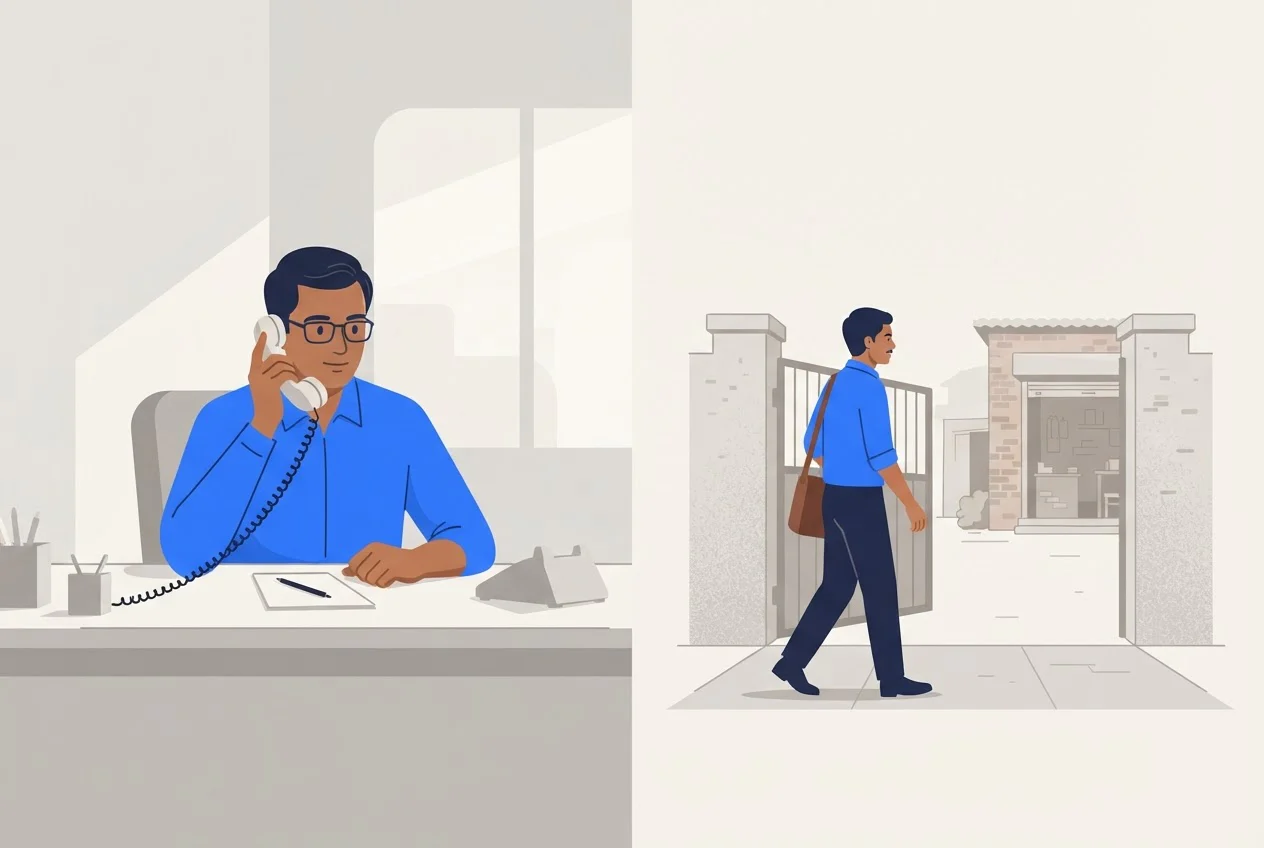
Start with inside sales when enquiries reach you by phone or web form and the buyer does not need to see a site or product first. Send a field visitor only to leads that qualify. That is our recommendation, and the table shows the cases where it flips.
Inside sales is selling from an office or home by phone, messaging, email and video. Field sales (also called outside sales) is selling in person at the customer's premises.
| Situation | Lead with | Why |
|---|---|---|
| The buyer must see the site, product or premises before deciding | Field sales, with inside sales booking the visit | The decision happens in person |
| The buyer has already phoned or filled a form and wants a price or details | Inside sales | A call can answer them the same day |
| Repeat orders from existing customers | Inside sales | The relationship exists, and a visit adds cost, not information |
| Buyers in cities you cannot visit regularly | Inside sales | Travel is the limit |
| A large order that several people at the buyer's office decide together | Field sales for the final meeting, inside sales to qualify and follow up | The last step needs a room |
In our experience, many small businesses end up with both. The inside team qualifies and chases, and field visits go to the leads that pass. The handover is where leads get lost, so make the rep write what was said on the call before anyone travels.
What do live inside sales job ads in India actually ask for?
They ask for a target, follow-up and CRM use, and almost never for a call volume. In the 172 postings we read on 10 November 2026, 140 mention a target and 2 give a daily call number. None gives talk time, names a dialer, or mentions the Do Not Disturb (DND) registry, consent or TRAI.
How we counted: on 10 November 2026 we took Internshala's inside sales listing (116 vacancies shown; pages 1 to 3 in default order gave 114 postings) and the first 100 results of LinkedIn's public search for "inside sales executive" in India, also in default order. We read the 83 Internshala postings and 89 LinkedIn postings whose text was still readable and left out the rest. We searched each posting for these words:
- target or quota
- follow-up or follow up
- CRM
- cold call or outbound
- inbound
- a number followed by "calls", or "calls per day"
- talk time or talktime
- dialer
- DND, consent, TRAI or "do not disturb"
A zero means none of those words appeared, so an ad that describes the same thing in other words is not counted. The counts come from a snapshot taken on 10 November 2026, and the live pages change daily, so a re-run may differ. Keyword matching shows what an ad names, not what the job involves.
| The ad mentions | Internshala (83) | LinkedIn (89) | Together (172) |
|---|---|---|---|
| A target or quota | 57 | 83 | 140 (81%) |
| Follow-up | 56 | 69 | 125 (73%) |
| Customer relationship management (CRM) software | 53 | 68 | 121 (70%) |
| Outbound or cold calling | 39 | 53 | 92 (53%) |
| Inbound calls | 16 | 46 | 62 (36%) |
| 8 | 18 | 26 (15%) | |
| A stated number of calls a day | 0 | 2 | 2 (1%) |
| Talk time | 0 | 0 | 0 |
| A dialer | 0 | 0 | 0 |
| DND, consent or TRAI | 0 | 0 | 0 |
A dialer is software that places calls for the rep and logs them.
The two LinkedIn postings that gave a call number differ widely. One asks for 250 to 300 calls a day to decision-makers in the US, the other 50 to 80 a day in Marathi and Hindi.
Both samples lean one way. 37 of the 83 Internshala postings mention students, learners, admissions, academic work or edtech (education technology), and 45 of the 89 LinkedIn postings mention the US, UK, international, North America or global work. A local-services or trading business should treat the pay below as a rough guide.
Of the 83 Internshala postings, 67 gave an annual pay range. Across those 67, the median lower end is ₹3.1 lakh, the median upper end ₹5.5 lakh and the median midpoint ₹4.5 lakh (our calculation from the advertised ranges). Put the fixed and variable parts of pay in writing before you advertise.
Why does a target without a call number leave the owner guessing?
A missed target has at least three different causes, and each needs a different fix. A target alone cannot tell the owner which to change. Three numbers from the call log separate them: connected calls, talk time, and the share of connected calls that end with a next step. A connected call is a call answered by a person who speaks to the rep.
- Few connected calls: the problem is the lead list, the hours called or the dialling effort.
- Connected calls but short talk time: the opening is not holding the listener.
- Long talk time but few next steps: the rep is not asking for the next step.
This is our reading of how a call log behaves, not a measured result. Treat each pattern as a test to run, not a verdict on the person.
Take the call number for the brief from your own log. The two ads that gave one asked for 50 to 80 and 250 to 300 calls a day, for very different leads, so neither transfers to your team. Sales Calls Per Day shows how to work the figure out from calling minutes and connect rate.
Which phone numbers can a sales team use for outbound calls in India?
Promotional calls by any sector use 140xx numbers. Service and transactional calls use 1600xx numbers only for entities regulated by the banking, securities, insurance and pension regulators (RBI, SEBI, IRDAI and PFRDA) and for government bodies. Other sectors use the 1601 series. TRAI, the Telecom Regulatory Authority of India, also restricts senders from using normal 10-digit numbers for telemarketing, as set out in its 12 February 2025 press note.
TRAI's release of 10 July 2026, also published by the Press Information Bureau, sets out the position:
- 1600xx numbers are mandated for service and transaction calls to existing customers by financial-sector entities regulated by RBI, SEBI, IRDAI and PFRDA, and for government-to-citizen calls by government entities.
- 140xx numbers are mandated for promotional calls by entities of any sector, and those entities must register with telecom providers under the TCCCPR framework (TRAI's Telecom Commercial Communications Customer Preference Regulations).
- A customer who has blocked a sector on the DND registry will not receive 140 promotional calls from entities in that sector.
On 10 August 2026, TRAI issued a Direction creating the 1601 series for service and transactional voice calls by sectors other than banking-financial and government. The Department of Telecommunications had allocated the series on 30 June 2026. Phase I covers utilities and logistics and courier services, with onboarding and migration due within 90 days of the Direction. TRAI will notify further sectors from time to time, and numbers in the 1601 series must not be used for promotional calls. A business outside these sectors should get its provider's written answer on its current status.
Enforcement is real. TRAI's Third Amendment Regulations, 2026, published on 18 September 2026, apply in phases, with provisions starting 30, 60 or 90 days after publication. Under them, a telecom provider suspends a sender's outgoing services on five or more complaints from unique recipients within ten days. Where misuse is established, the first instance bars outgoing services on all the sender's telecom resources for 15 days. Later instances mean disconnection across providers for one year and blacklisting. A complaint made more than seven days after a call is treated as a report, not a complaint. Since the Second Amendment of 12 February 2025, customers can also complain about unregistered senders without first registering a preference.
Our recommendation is to ask your telecom provider, in writing, which series each type of call from your team needs. Whether a given call counts as promotional is a question for them or your lawyer, and this summary is not legal advice. Keep promotional and service calls apart in the log so the answer is easy to apply.
What should an inside sales job brief contain?
Fill in eight fields before you post the role, each with a test you can run. The brief replaces a target-only ad with a job whose calls, numbers and rules are written down. The pass thresholds are our recommendation. Screen candidates against it with these telecaller screening questions.
| Field | Write down | Pass test |
|---|---|---|
| 1. Lead source and owner | Where leads come from and who calls first | Every lead in yesterday's log has a named caller. Any lead without one is a fail. |
| 2. Connected-call target | Connected calls per day, from your two-week baseline | You can show the median day from your own log. A number copied from an article or ad is a fail. |
| 3. Talk-time floor | Minutes on calls per day | A floor is written down, and 4 of 5 reps met it on at least 4 of 5 days last week; otherwise fail. |
| 4. Follow-up rule | Days between touches, and touches before a lead is closed out | For any five open leads, the rep names the next follow-up date without searching. |
| 5. Calling numbers | Which number each type of call goes out on | You hold your provider's written answer on promotional calls and on service and transactional calls. |
| 6. Recording notice | The wording played at the start of a call | A test call plays the notice before the conversation. See Call Recording Announcement. |
| 7. Notes | A note after every connected call | 9 of 10 connected calls picked at random from last week have a note. Fewer is a fail. |
| 8. Weekly review | One page read every Monday: connected calls, talk time, missed inbound calls, next steps | The page exists and last Monday's was read. |
How do you run the first week of an inside sales team from the call log?
Record seven columns per rep per day for five working days and change nothing else. The columns are date, rep, dials, connected calls, talk time in minutes, connected calls ending with a next step, and missed inbound calls.
Two ratios do the reading:
- Connect rate = connected calls ÷ dials.
- Next-step rate = connected calls with a next step ÷ connected calls.
Compare each rep with the team median: few connected calls points to the lead list or hours called, short talk time points to the opening, and few next steps points to the ask. Fix one thing at a time. After two weeks, take each rep's median day as the baseline for the connected-call target in the brief. Sales Team Productivity gives the full seven-day audit.
This is how we run it in TalkEasy. The Business Dialer logs every call with contact, time, duration and outcome, records it, and lets the rep add a note after the call. Call Analytics shows total calls, answer rate, missed calls, average talk time and peak hours, by rep and for the team, with daily and monthly reports you can download. That is the week-one sheet without a spreadsheet.
As of November 2026, our Pro plan is ₹999 + GST a month. It includes three hours of talktime a day, with extra talktime at ₹49 + GST an hour, unlimited users, and call recording and history. If your leads sit in a CRM, custom CRM integration comes with our Enterprise plan, quoted on request. You can cancel anytime.
Want help setting up the call log for your team?
Frequently asked questions
Sources
- 1.Press Release No. 11/2025, 12 February 2025, TRAI
- 2.Telecom Commercial Communications Customer Preference (Second Amendment) Regulations, 2025, TRAI
- 3.Telecom Commercial Communications Customer Preference (Third Amendment) Regulations, 2026, 18 September 2026, TRAI, 2026-09-18
- 4.Press Release No. 91/2026, 10 July 2026, TRAI, 2026-07-10
- 5.TRAI clarification on the 1600 and 140 series, 10 July 2026, Press Information Bureau, Ministry of Communications, 2026-07-10
- 6.Direction of 10 August 2026 on the 1601 numbering series, TRAI, 2026-08-10
- 7.Inside sales jobs listing, Internshala, 2026-11-10
- 8.Public search for "inside sales executive", India, LinkedIn, 2026-11-10
- 9.Business Dialer, TalkEasy
- 10.Call Analytics, TalkEasy