Average Handle Time: What It Counts and How to Time Your Own
Average handle time is the talk, hold and wrap-up time of each call, added up and divided by calls handled. Decide which parts you count before comparing or planning staff.

By Tej Pandya, Founder · Updated 18 Nov 2026
Key takeaways
- AHT is (talk time + hold time + wrap time) ÷ calls handled. Only compare figures that count the same parts.
- Public sources draw the line differently: one council keeps wrap time out of "handling time", a bank measures the share of calls under 2.5 minutes, and New York State includes follow-up work.
- Planning staff on talk time alone overstates capacity. In one council's Corporate row it gives about 15 calls an hour instead of about 10 (our calculation, below).
- Time 20 calls on a sheet. Take the talk column from your call log, and time hold and wrap by hand.
In this article
- 1What does average handle time include, and how do you calculate it?
- 2Why do councils, banks and states report different handle times?
- 3How much does leaving out wrap time change your staffing plan?
- 4How do you measure handle time on a 20-call timing sheet?
- 5Where do the talk-time numbers come from?
- 6How many calls can one person take in an hour?
- 7How do you shorten calls without rushing customers?
- 8Frequently asked questions
One UK council's published targets for Corporate calls list a handling time of 3 minutes 54 seconds and a processing time of 6 minutes 1 second. The difference is 2 minutes 7 seconds of wrap time, the work after the call, which its handling figure leaves out (Barnsley Metropolitan Borough Council, July 2025).
That gap is the whole problem with average handle time (AHT). A number only means something once you know which parts it includes. A bank's service contract, a council's targets and a state's standards each draw that line in a different place.
If you run a small sales or support team on one business number, you don't need a contact-centre suite to get a usable AHT. You need a definition, 20 timed calls and one division. This page gives you all three, then shows what the result does to the number of calls one person can take in an hour.
What does average handle time include, and how do you calculate it?
Average handle time is total talk time, hold time and wrap time across all calls, divided by the number of calls handled. Talk time is the conversation. Hold time is the customer waiting while you look something up. Wrap time, also called after-call work (ACW), is the notes and follow-up after the caller hangs up.
A worked example in Call Centre Helper's guide (10 June 2022) adds one contact-centre day: 668,205 seconds of talk, 99,153 of hold and 198,306 of wrap across 4,311 calls. That is 965,664 seconds in total. Divided by 4,311 calls it gives 224 seconds, or 3 minutes 44 seconds. Per call that is about 155 seconds of talk, 23 of hold and 46 of wrap.
The average length of the conversation on its own is a different number, covered in Average Call Duration: How to Calculate and Read It. For how a team's talk hours are budgeted, see Talk Time: What It Counts and How Many Hours a Team Needs. Wrap benchmarks and the wrap formula sit in After Call Work: Formula, Ranges, 7-Day Check. This page is about what happens between them.
Why do councils, banks and states report different handle times?
They report different numbers because each defines the term differently. Three public documents show three meanings of one label:
| Source | What is measured | Figures |
|---|---|---|
Barnsley Metropolitan Borough Council, reply to a Freedom of Information request, 25 July 2025 (targets) | "Average Handling Time", with "Average Wrap Time" and "Average Processing Time" listed separately | Handling 2:47 to 4:24; wrap 1:52 to 2:11; processing 4:40 to 6:33 |
Bank of Maharashtra, contact-centre tender (request for proposal (RFP) 012021, bid schedule from 13 January 2021), section 6.2.4 | The share of calls whose duration, from "beginning of actual interaction to closure", is under 2.5 minutes | Threshold 2.5 minutes |
New York State call centre standards (undated) | "the total time spent on each call, including the conversation itself and any related tasks like data entry or follow-up" | "general range is between 4 to 6 minutes" |
In three of Barnsley's four rows, handling time plus wrap time equals processing time, to within a second. So its handling figure stops before wrap begins. The 2021 bank tender measures a pass rate against a threshold. It takes timestamps from its ACD (automatic call distributor, the system that routes calls to agents) and CTI (computer telephony integration, which links the phone system to computers). Its penalty is nil at 99% or more, 2% of the monthly bill between 99% and 80%, 3% between 80% and 60%, and 5% between 60% and 50%. New York's figure includes follow-up.
Those are a time without wrap, a pass rate and a time with follow-up. In our view, a benchmark helps you only when its scope matches your own sheet. A "4 to 6 minutes" range that includes follow-up tells you nothing about a team that measures talk alone. A bank's 2.5-minute threshold is a rule for one contract, not an average to copy.
How much does leaving out wrap time change your staffing plan?
It changes it a lot. Wrap time was 49% to 67% as long as the handling time in all four Barnsley rows. That is our arithmetic: wrap ÷ handling is 131 ÷ 238 = 55% for Adults, 129 ÷ 264 = 49% for Berneslai Homes, 127 ÷ 234 = 54% for Corporate and 112 ÷ 167 = 67% for Out of Hours. These are the council's targets, not measured results.
Here is the effect on capacity, as our worked example from the Corporate row. Handling is 234 seconds and processing is 361 seconds (234 + 127).
- Plan from handling time: 3,600 ÷ 234 is about 15 calls per agent per hour.
- Plan from processing time: 3,600 ÷ 361 is about 10.
- Using the shorter figure overstates capacity by about 54%.
In our view, a talk-only report leaves out hold and wrap, which are the parts you only see by timing them. Barnsley's targets put wrap alone at 35% of processing time for Corporate calls.
How do you measure handle time on a 20-call timing sheet?
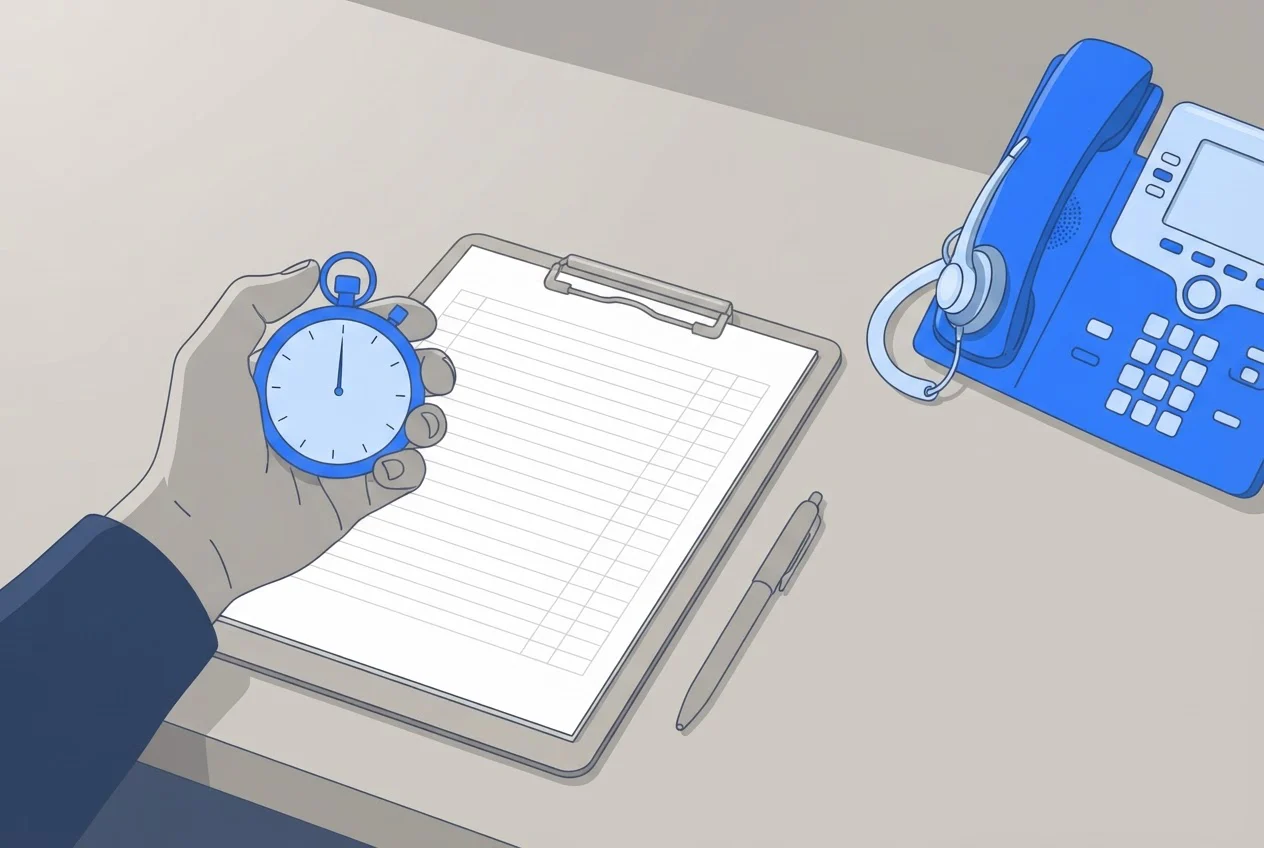
Time 20 answered calls across two working days. Write one line at the top, "AHT here = talk + hold + wrap, from answer to note saved", then fill one row per call:
| Call | Call type | Talk (min:sec, from log) | Hold (min:sec) | Wrap (min:sec) | Handle time | Repeat of an earlier issue? |
|---|---|---|---|---|---|---|
| 1 | talk + hold + wrap | yes / no | ||||
| 2 | ||||||
| … | ||||||
| 20 |
- Take the talk time from your call log.Time hold with your phone's stopwatch. Wrap runs from hang-up until your note is saved and you are ready for the next call.
- Add up the handle time column and divide by 20.That is your AHT. Also work out the talk-only average and the median (the middle call when you sort by handle time).
- Include every call type you take.Sales, support and booking calls differ, so tag them. Twenty calls is enough to see a gap, not enough for a tight benchmark. That is our recommendation.
Then run three checks. The thresholds are our rules of thumb:
- Log check. Time three calls with a stopwatch. Pass if the logged talk time is within 5 seconds of your stopwatch on all three calls; fail if any call differs by more than 5 seconds. If it fails, find out what your log counts, for example ringing.
- Median check. Pass if AHT is within 25% of the median. If AHT is more than 25% above the median, a few long calls are pulling it up. Report both and split by call type.
- Wrap-share check. Divide total wrap by total handle time. Under 25% means wrap is not your bottleneck. At 25% or more, fix wrap first, because it is time with no customer on the line. For scale, Barnsley's Corporate target works out at 127 ÷ 361 = 35%.
Where do the talk-time numbers come from?
For the talk column, we give you two sources. Our Business Dialer logs every call made through it automatically, with the contact, time, duration and outcome. After a call ends, you can add a note against it. Our Call Analytics shows average talk time and team performance. It has daily and monthly reports that you can download. The analytics dashboard is included in our Pro plan, and Enterprise has it too.
Put those talk figures into your sheet. Time hold and wrap yourself, as above. Once you have all three columns, you have an AHT whose scope you control, which is more useful than a benchmark whose scope you don't.
How many calls can one person take in an hour?
One person can take 3,600 seconds divided by AHT in seconds, if they are never idle. At the Corporate figure of 361 seconds that is about 10 calls an hour (3,600 ÷ 361 = 9.97).
Nobody is busy for the whole hour. Our model for a more realistic figure is calls per hour = 60 ÷ AHT in minutes × share of the hour spent on calls. At 6 minutes 1 second and a 60% busy share, that is about 6 calls an hour. The 60% is an illustration, not a target. To see what busy share a team of your size can sustain, use our agent occupancy calculator. It compares your measured busy share with a ceiling for your team size.
How do you shorten calls without rushing customers?
Shorten wrap first, then hold, and leave talk until last. Wrap is time with no customer waiting, so cutting it costs the caller nothing. These are our recommendations:
- Wrap: keep the same note fields for every call and type notes while you talk.
- Hold: keep prices, availability and your common answers within reach so you rarely put anyone on hold. When an answer will take time, offer a callback instead.
- Targets: set one per call type, from your own sheet's median, not one for all calls.
- Rushing check: when AHT falls, look at the repeat-call column. If AHT is down and repeat calls are not up, you shortened calls. If repeats rose, you only moved the time to another call. A rule that rewards calls under a threshold, such as the bank's 2.5 minutes, pays for short calls whether or not the problem was solved. That is our reading of how it works.

Get your call setup and reports reviewed
Frequently asked questions
Sources
- 1.Barnsley Metropolitan Borough Council, Freedom of Information reply 4737, 25 July 2025, Barnsley Metropolitan Borough Council, 25 July 2025
- 2.Bank of Maharashtra, Request for Proposal 012021 (bid schedule from 13 January 2021), section 6.2.4, Bank of Maharashtra, 13 January 2021
- 3.New York State, Call Center Standards (undated), New York State
- 4.Call Centre Helper, "What Is Average Handling Time (AHT)?", 10 June 2022, Call Centre Helper, 10 June 2022