
Trade Show Follow-Up Calls: A First-Week Plan and Log
Trade show follow up works best as a first-week calling plan. Sort contacts into three tiers on day zero, call those you made promises to first, and log every promise.

By Tej Pandya, Founder · Updated 9 Nov 2026
Key takeaways
- Sort every contact into tier A, B or C on day 0, call tier A on day 1, tier B on days 2 and 3, tier C on days 4 and 5, and use days 6 and 7 for last attempts and a review.
- A call is only as good as the written promise behind it, so every contact gets a log row with what they asked for, what you promised and by when.
- A 150-contact example needs about 8 hours of conversation across the week, which fits comfortably inside the three hours of daily talktime on TalkEasy Pro.
- Under the telecom regulator TRAI's amended 2025 rules, a follow-up call to a prospect who has not bought is promotional unless the person gave explicit consent, so ask for consent at the stand and log it. Whether a stand conversation counts as an enquiry is a question for your legal adviser.
In this article
- 1What is the best first-week plan for trade show follow up calls?
- 2Why do fast calls still fail after a trade show?
- 3How do you sort trade show contacts into tiers before calling?
- 4What should the log hold for every trade show contact and call?
- 5Can one phone line carry 150 trade show contacts in a week?
- 6Can you call people you met at a trade show?
- 7How do we run this plan in TalkEasy?
- 8Frequently asked questions
The person calling cannot say "you asked for the dealer price list" if nobody wrote down what was promised. Your team comes back from the show with a pile of cards, badge scans and half-remembered promises, and every day the pile sits, fewer contacts remember who you are.
The pile is rarely the real problem. Without the written promise, the caller falls back on "just checking in". A call that opens with the thing the contact asked for is easier to take than one that opens with a pitch.
The words to say on each call are in our follow up call script guide.
What is the best first-week plan for trade show follow up calls?
Sort every contact into tier A, B or C on day 0, then call tier A on day 1, tier B on days 2 and 3, and tier C on days 4 and 5. Use days 6 and 7 for final attempts and a review. The schedule is our recommendation for one phone line, sized for 150 contacts.
Day 0 is the first working day after the show, spent with no calls. An attempt is one dial, answered or not. A contact is reached when a conversation takes place.
| Day | What you do | Calls in the 150-contact example |
|---|---|---|
| 0 | Tier every contact and write each promise in the log. No calls. | 0 |
| 1 | Tier A, first attempt | 20 |
| 2 | Tier A second attempt for anyone not reached; tier B first half | 25 tier B |
| 3 | Tier B second half; tier A third attempt where still needed | 25 tier B |
| 4 | Tier C first half; tier B second attempt where still needed | 40 tier C |
| 5 | Tier C second half | 40 tier C |
| 6 | Last attempts on anyone still open; mark the rest dropped | Leftovers |
| 7 | Review (below) | 0 |
Call tier A up to three times, tier B up to twice and tier C once. Put the second attempt at a different time of day from the first, for example morning, then late afternoon. A missed call at 11 am is often still missed at 11:15.
For the day 7 review, count, per tier, how many contacts were reached, how many have a booked next step and how many were dropped. The plan passes when every tier A contact has either a booked next step or a written reason for being dropped. It fails if any tier A row is still blank.
Why do fast calls still fail after a trade show?
A fast trade show call fails when it does not pick up what was agreed at the stand. The contact met you once, and without a written promise a fast call is a cold call.
The speed figure most often quoted comes from web enquiries, not stands. In a Harvard Business Review study published in March 2011, covering 2,241 US companies sent web-generated leads, firms that tried to reach a lead within an hour were nearly seven times as likely to have a real conversation with a decision maker as firms that waited even an hour longer. A person who met you in a hall is a different case. Use that figure as a reason to start on day 1, not as a forecast of what your calls will achieve. Our page on lead response time covers what the idea that sales teams should respond to a lead within five minutes does and does not show.
This is US data from 2012. In a summer 2012 survey of nearly 200 exhibitors by the Center for Exhibition Industry Research (CEIR), as reported by Exhibit City News, 59% used phone follow-up tailored to the visitor's interest and 64% used customised email. More than 70% of those using either method finished within two weeks. Nancy Drapeau, research director at CEIR, said: "Findings suggest that systematic lead tracking is still in its infancy." The weak point it names is tracking, not calling, and the plan above puts its effort there.
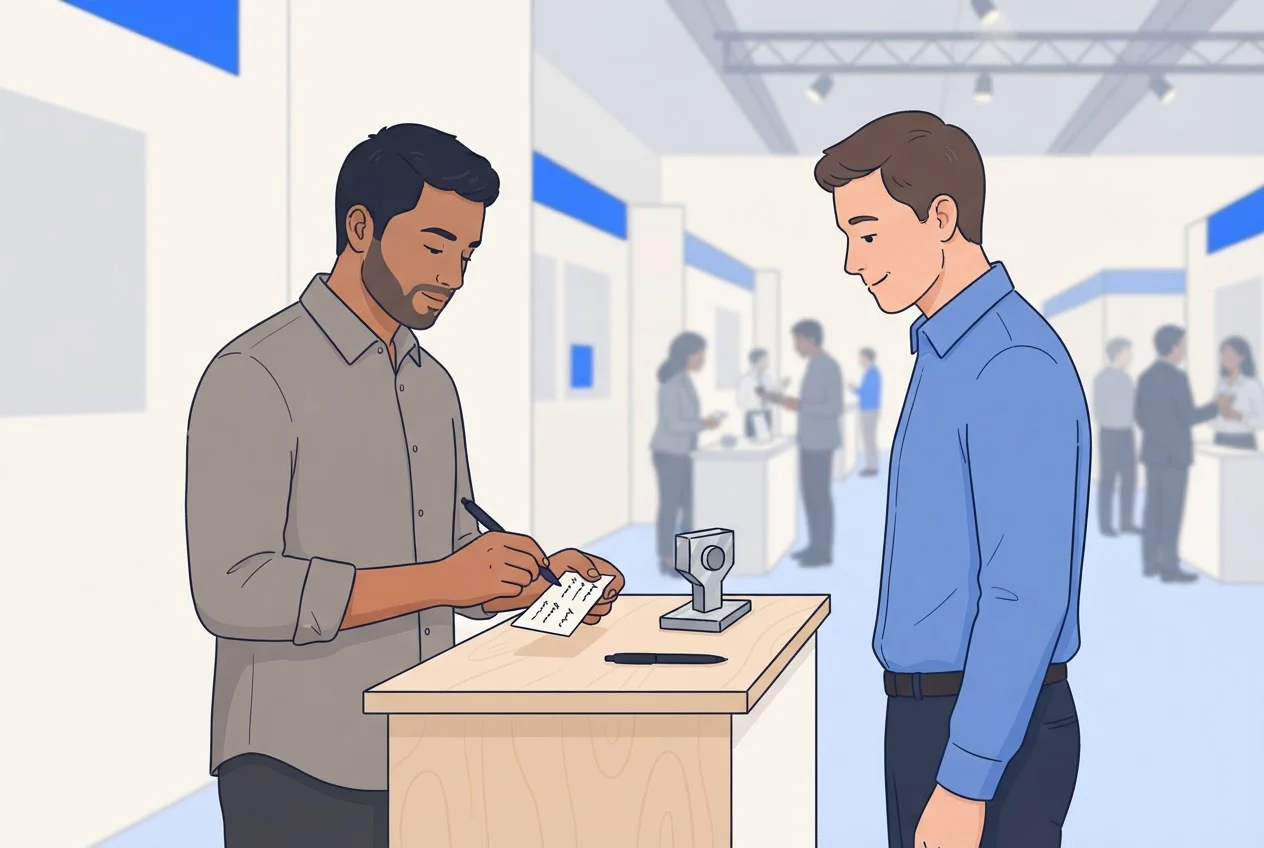
A booth conversation is worth most when it ends with an agreed next step: "The best sales execs never leave a meeting without a next step." The log below exists to carry that next step from the stand to the phone.
How do you sort trade show contacts into tiers before calling?
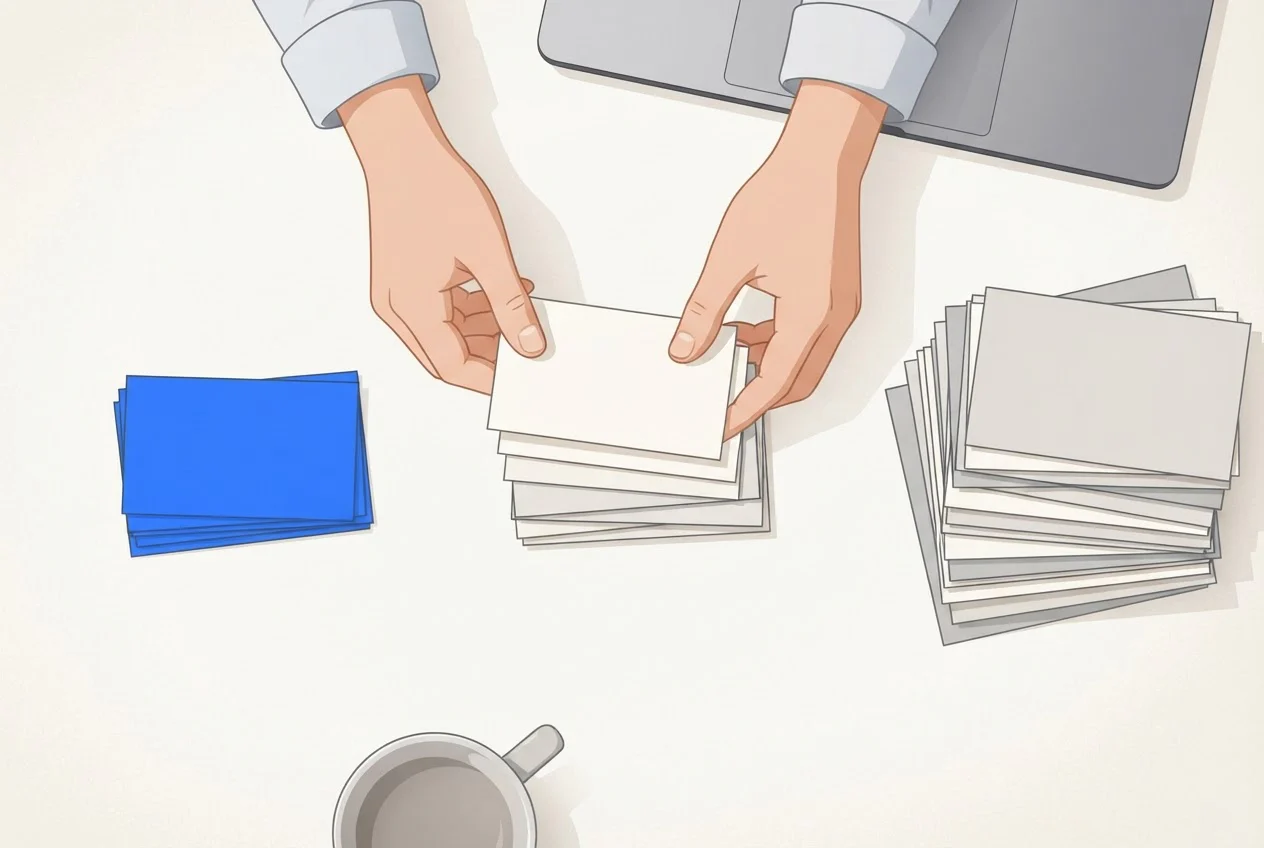
Sort by what the contact asked for, not by how friendly they seemed. A tier is a priority group that decides how soon you call and how many attempts you make. Three tiers are enough for one phone line.
- Tier A: they asked for something with a date, quantity or visit attached (a price, quotation, demo, sample or site visit), or said they would decide within three months. Test: you can write the promise in one line with a date. If you cannot, the contact is not tier A.
- Tier B: they described a real need but gave no date. Test: you can write down the need in their words, but not a deadline.
- Tier C: they swapped cards or were badge-scanned and you cannot write down what they wanted. One call, then they move to your ordinary calling list.
A contact with no written promise cannot be tier A, whoever met them. If two people on your team disagree about a tier, the one who can write the promise line wins. The four-tag test in our warm lead vs cold lead guide is a good second check on borderline B and C contacts.
What should the log hold for every trade show contact and call?
Each contact gets one log row with ten fields, and each call gets a two-line summary. The row is complete when a colleague who was not at the show could make the call from it alone.
| Field | A complete entry |
|---|---|
| Contact and company | Name, company, role, and the number exactly as handed over |
| Met at | Event, stand or session, date |
| Asked for | One line in their words, such as "price list for 200 units" |
| Promised | What you said you would do, and by when |
| Tier | A, B or C using the tests above |
| How the number reached you | Card, badge scan or said aloud; whether they agreed to be called; and whether they said WhatsApp is fine |
| Attempts | Date, time and result for each, up to three |
| Outcome | One code from a fixed list; our call disposition guide has ten ready-made codes |
| Next step | One action with a date |
| Call summary | Two lines, in the format below |
A row with nothing under "Promised" fails, and its contact cannot be tier A. A row where "Next step" has no date also fails.
The call summary has two lines. Line 1 is the need, in the contact's words, with any number such as a quantity, budget or date. Line 2 is the next step: what happens, who does it and when.
Example (made up for illustration): "Need: 200 steel racks for a Pune warehouse, wants a quote with delivery. Next: we send the quote by Friday; call back Monday 11 am to confirm."
Can one phone line carry 150 trade show contacts in a week?
Yes. Our model puts the week at about 8 hours of conversation, against the 3 hours of talktime a day that our Pro plan includes. The inputs are our assumptions, so replace them with your own average call length from past calls.
Model: 150 contacts split into 20 in tier A, 50 in tier B and 80 in tier C. Assume each reached contact takes 6 minutes in tier A, 4 in tier B and 2 in tier C.
| Tier | Contacts | Minutes each | Minutes |
|---|---|---|---|
| A | 20 | 6 | 120 |
| B | 50 | 4 | 200 |
| C | 80 | 2 | 160 |
| Total | 150 | 480 (8 hours) |
Spread across the schedule, day 1 carries 120 minutes (20 × 6), days 2 and 3 carry 100 each (25 × 4), and days 4 and 5 carry 80 each (40 × 2). The busiest day, day 1, is 120 minutes against a daily allowance of 180. It would pass the allowance only if tier A calls averaged more than 9 minutes each (180 ÷ 20).
The 480 minutes cover first conversations only. Days 1 to 5 give 900 minutes of allowance (5 days × 180 minutes); first conversations use 480, leaving 420 for retries and day 6. As of November 2026, TalkEasy Pro is ₹999 + GST a month with three talktime hours a day; extra talktime is ₹49 + GST an hour. If retries push a day 120 minutes (2 hours) past its allowance, the extra cost is 2 × ₹49 + GST = ₹98 + GST (our arithmetic from the published rate). Enterprise is quoted individually and includes unlimited talktime.
Can you call people you met at a trade show?
Yes, but a follow-up call to a prospect who has not bought is treated as promotional unless the person gave explicit consent, so ask for consent to be called at the stand and log it. This is general information, not legal advice.
The Telecom Regulatory Authority of India (TRAI) amended its commercial communications rules on 12 February 2025 (TRAI regulations page, gazette text; see also our page on the TRAI second amendment regulations 2025). The amendment's explanatory memorandum limits service communication based on inferred consent to existing customers or subscribers. It treats people who "have shown interest in a product or service but have not yet made a purchase" as prospects, whose communication falls under promotional communication only. Inferred consent is valid only for the duration or discharge of the contract. Trade show contacts who have not bought are prospects. Whether a conversation at a stand changes that is a question for your own legal adviser.
Ordinary 10-digit numbers are restricted for commercial communication, and violators face disconnection and blacklisting. Calls to numbers on the Do Not Disturb (DND) register need explicit consent (TRAI regulations page, gazette text). Check your calling setup against these rules before day 1.
Three habits cost nothing. Ask for explicit consent to be called at the stand and log it in the "How the number reached you" field. Write down what the contact asked for. And if anyone asks you to stop calling, mark the row closed and do not call again.
How do we run this plan in TalkEasy?
On the TalkEasy Business Dialer, every call you make is logged automatically with the contact, time, duration and outcome, and recorded. You add a note against the call. Paid plans (Pro and Enterprise) include call recording and history, and unlimited users and contacts. Here is how we run the week.
- Day 0Keep the tier sheet and the ten log fields in a spreadsheet. The "Promised" and "Next step" columns are the ones that matter.
- Days 1 to 5Dial each contact with one tap from the app. The call, its length and its outcome are logged for you, so your sheet only needs the tier, the promise and the next step.
- After each callAdd the two-line note against the call, so the context stays with the contact.
- Within a couple of minutes
Our AI Call Summaries show the customer's requirement, key discussion points, questions, objections, the recommended next follow-up and the call outcome. Compare them with your own two lines, and fix any promise that differs.
- Day 7Download the Sales Call Analytics report for the week, which reports call volume, answer rates, missed calls and talk time by team member. Use it with your sheet to count reached, booked and dropped per tier.
To run this plan on your own contacts, Talk to Our Expert.
Run your trade show follow-up plan in TalkEasy
Frequently asked questions
Sources
- 1.The Short Life of Online Sales Leads, Harvard Business Review, March 2011
- 2.CEIR study on exhibitor lead capture and follow-up practices, Exhibit City News
- 3.Telecom Commercial Communications Customer Preference (Second Amendment) Regulations, 2025, TRAI, 12 February 2025
- 4.Telecom Commercial Communications Customer Preference (Second Amendment) Regulations, 2025, gazette text, TRAI
- 5.Dear SaaStr: What's the best way to follow up from trade show leads?, SaaStr