AI Receptionist for Clinics in India: What to Hand Over
An AI receptionist for clinics answers routine calls, takes booking requests and passes clinical or urgent callers to staff. Count your missed calls for a week first, then price it per minute.

By Tej Pandya, Founder · Updated 10 Oct 2026
Key takeaways
- 01An AI receptionist for a clinic should answer timings, location and fee questions and take booking requests. It should transfer anything clinical or urgent to a person straight away.
- 02Our recommendation, not a measured benchmark: five or more missed calls in a week, or two or more at the same hour on different days, justifies a trial. Below that, a callback rule costs less than any tool.
- 03Published prices as of October 2026 work out to about ₹3,400 to ₹16,400 a month before GST at 10 to 60 calls a day on a per-minute plan. Cost scales with total minutes, so short greetings save money.
- 04Test the tool on ten scripted calls in Hindi, Hinglish and English. Do not sign unless every symptom and emergency call is handed to staff.
In this article
- 1What should an AI receptionist for clinics answer, and what must it pass to staff?
- 2How do you count your clinic's missed calls before buying an AI receptionist?
- 3What does an AI receptionist for clinics cost in India?
- 4How does a TalkEasy AI Receptionist work for a clinic?
- 5Will an AI receptionist understand Hindi, Hinglish and your patients' names?
- 6What does India's data protection law mean for a clinic using an AI receptionist?
- 7Frequently asked questions
A clinic that takes 30 calls a day handles about 780 in a 26-day month (our count: 30 × 26). Some of those ring while the receptionist is already dealing with someone at the counter. An AI receptionist is software that answers that call, takes the details and hands the caller to a person when it should.
The tool is the easy part. The decision that matters is which calls you let it touch. Timings, directions and booking requests are safe to hand over. Symptoms, doses and emergencies are not. India's Telemedicine Practice Guidelines bar AI-based telemedicine platforms from counselling patients or prescribing, and we apply the same rule to phone AI.
Below you get a handover table, a seven-day call audit, a cost formula built on published rates and a ten-call test to run before you sign.
What should an AI receptionist for clinics answer, and what must it pass to staff?
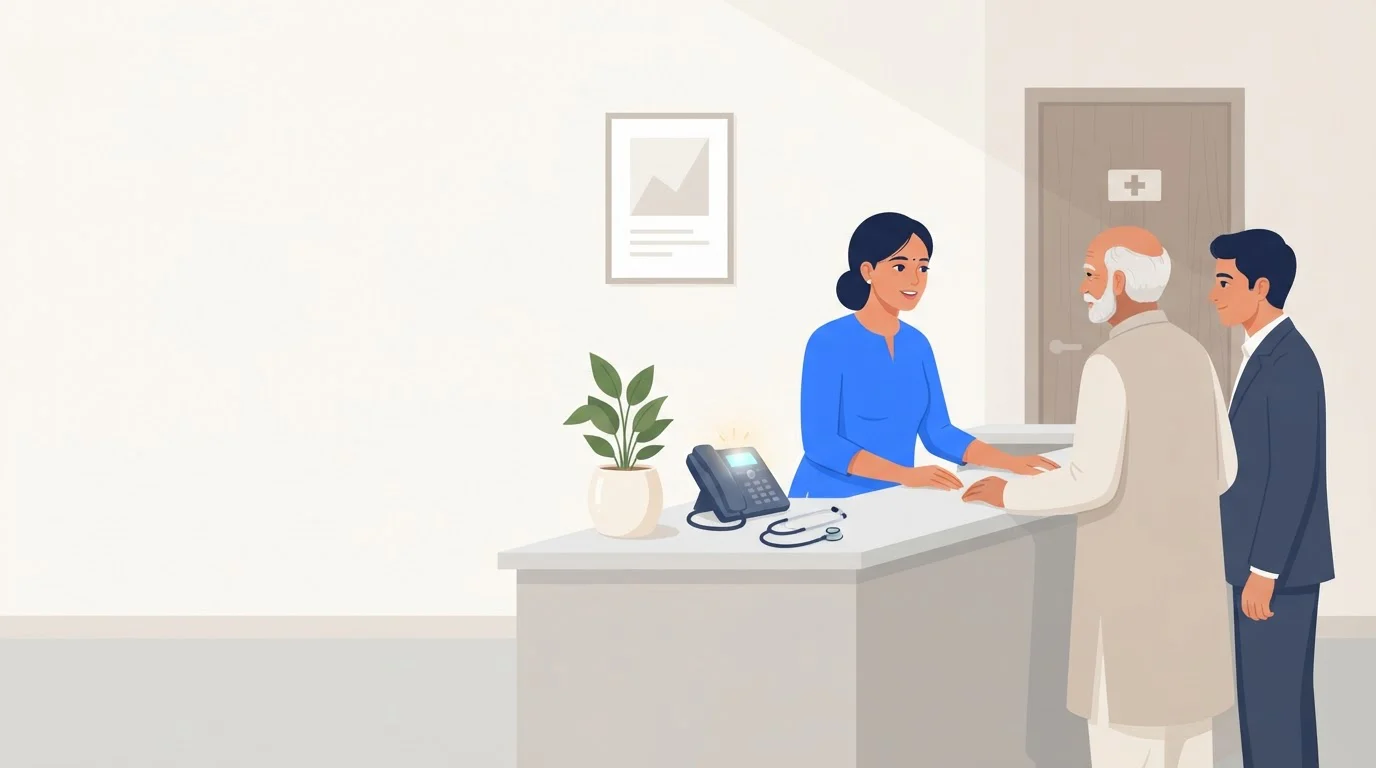
It should answer anything your clinic can print on a notice board, such as timings, address and fees. It should take the details of requests that need a person's decision, and it should transfer everything clinical or urgent at once. The line is simple: book, route, record, never assess.
The Telemedicine Practice Guidelines, clause 5.4, say technology platforms based on artificial intelligence or machine learning are not allowed to counsel patients or prescribe medicines. Only a registered medical practitioner (RMP) may do that, and the RMP must communicate directly with the patient. That clause is written for telemedicine platforms. Our recommendation is to apply it to every phone AI in a clinic, whatever the call is about.
| Caller says | The AI receptionist does | Who acts |
|---|---|---|
| "What time does the doctor sit? Where are you?" | Answers from the text you approved | Nobody |
| "What is the consultation fee?" | Answers from the approved text | Nobody |
| "I want an appointment" | Takes name, mobile number, reason and preferred day | Front desk confirms the slot |
| "Can I move my visit?" | Takes the request and the booking name | Front desk changes it |
| "I have fever for three days, which tablet?" | Gives no advice; transfers, or takes a number for a callback | Doctor or nurse |
| "Chest pain", "bleeding", "accident" | Tells the caller to go to the nearest emergency department or call 112, and transfers at once | Staff on duty |
| Complaint, angry or distressed caller | Transfers | A person |
| "Let me speak to someone" | Transfers on the second request at most | A person |
Write the approved text yourself, in short sentences, and keep it under your control. Anything the AI says that you did not write is a risk.
How do you count your clinic's missed calls before buying an AI receptionist?
Log every inbound call for seven days and work out your missed-call rate, which is missed calls divided by total inbound calls. This takes one sheet of paper or your phone's call history. It tells you whether you have a problem worth paying to fix.
For each day, note:
- Total inbound calls. Pass: the count matches your phone's call history.
- Missed or abandoned calls. These are calls that rang out or that the caller ended before anyone answered. Pass: each has a number written down.
- After-hours calls. Pass: counted separately from daytime calls.
- Calls that only needed an approved answer. These are timings, address and fees. Pass: you can name them from the call history or a quick check with the caller.
- Average call length in minutes. Time five typical calls. Pass: you have a figure you can use in the cost formula below.
Then call back every missed number within the hour and note how many were new patients. Our recommendation, not a measured benchmark: five or more missed calls in the week, or two or more at the same hour on different days, justifies a trial. Below that, set a callback rule and wait. Our missed call callback workflow shows how to turn each miss into a task.
If most misses fall after closing time, set the AI receptionist to take the caller's name, number and reason for a morning callback, and to play a fixed message for emergencies. It should not offer advice or promise a slot.
What does an AI receptionist for clinics cost in India?
Providers charge either per minute of calls or per doctor, so the bill follows your call volume or your headcount. As of 10 October 2026, ConnectAI lists ₹800 a month plus ₹4 a minute on its pricing page. Patient Square lists its AI receptionist in its Autopilot tier at ₹4,999 per doctor a month, or ₹3,999 per doctor a month billed annually, plus 18% GST (Goods and Services Tax).
Patient Square's three published tiers are Assist at ₹1,999 (₹1,599 billed annually), Copilot at ₹2,999 (₹2,399 billed annually) and Autopilot at ₹4,999 (₹3,999 billed annually), all per doctor a month. The AI receptionist sits in Autopilot only. ConnectAI also lists ₹499 a month if you add the receptionist to its clinic suite, and a one-time ₹1,000 onboarding fee for new clinics.
Here is the formula for a per-minute plan. It is our model, not a quote.
Monthly cost = monthly fee + (calls per day × average minutes × working days × rate per minute)
We assumed 2.5 minutes per call and 26 working days, and used ConnectAI's ₹800 and ₹4. The table leaves out the onboarding fee. The last column adds GST at 18%, the rate Patient Square states, which is our assumption for any provider that shows a price without GST.
| Calls a day | Minutes a month | Calculation | Before GST | With 18% GST |
|---|---|---|---|---|
| 10 | 650 | ₹800 + 650 × ₹4 | ₹3,400 | ₹4,012 |
| 30 | 1,950 | ₹800 + 1,950 × ₹4 | ₹8,600 | ₹10,148 |
| 60 | 3,900 | ₹800 + 3,900 × ₹4 | ₹16,400 | ₹19,352 |
A per-doctor plan scales with your headcount instead. At Patient Square's published Autopilot rates, a three-doctor clinic pays ₹14,997 a month on monthly billing (3 × ₹4,999) or ₹11,997 a month on annual billing (3 × ₹3,999), before GST. With 18% GST that is about ₹17,696 and ₹14,156.
For comparison, we price our own plans on a different model: a monthly subscription plus talktime, the minutes of calling you pay for. Our Pro plan is ₹999 + GST a month with three hours of talktime a day, and extra talktime costs ₹49 + GST an hour. AI Receptionist pricing on a clinic number is quoted by our expert.
We publish this page and sell an AI Receptionist ourselves. The two providers priced above are other companies, and their figures are their own published rates.
Two things follow from the formula. First, calls per day and minutes per call carry equal weight, so every extra 30 seconds on 30 calls a day adds ₹1,560 a month before GST (390 minutes × ₹4). Keep the greeting and questions short. Second, the cost is only worth it if it recovers visits. Divide the monthly cost by your average first-visit fee. With a ₹500 fee (replace it with yours), the 30-call clinic's ₹8,600 breaks even at 18 recovered visits a month (8,600 ÷ 500 = 17.2, rounded up), ignoring GST.
How does a TalkEasy AI Receptionist work for a clinic?
Our AI Receptionist answers incoming calls, works out why the patient is calling, answers common questions, captures name, number and requirement, then transfers the call to your team or arranges a callback. Your front desk confirms the appointment slot, which keeps the booking decision with a person.
This is how we set it up for a clinic:
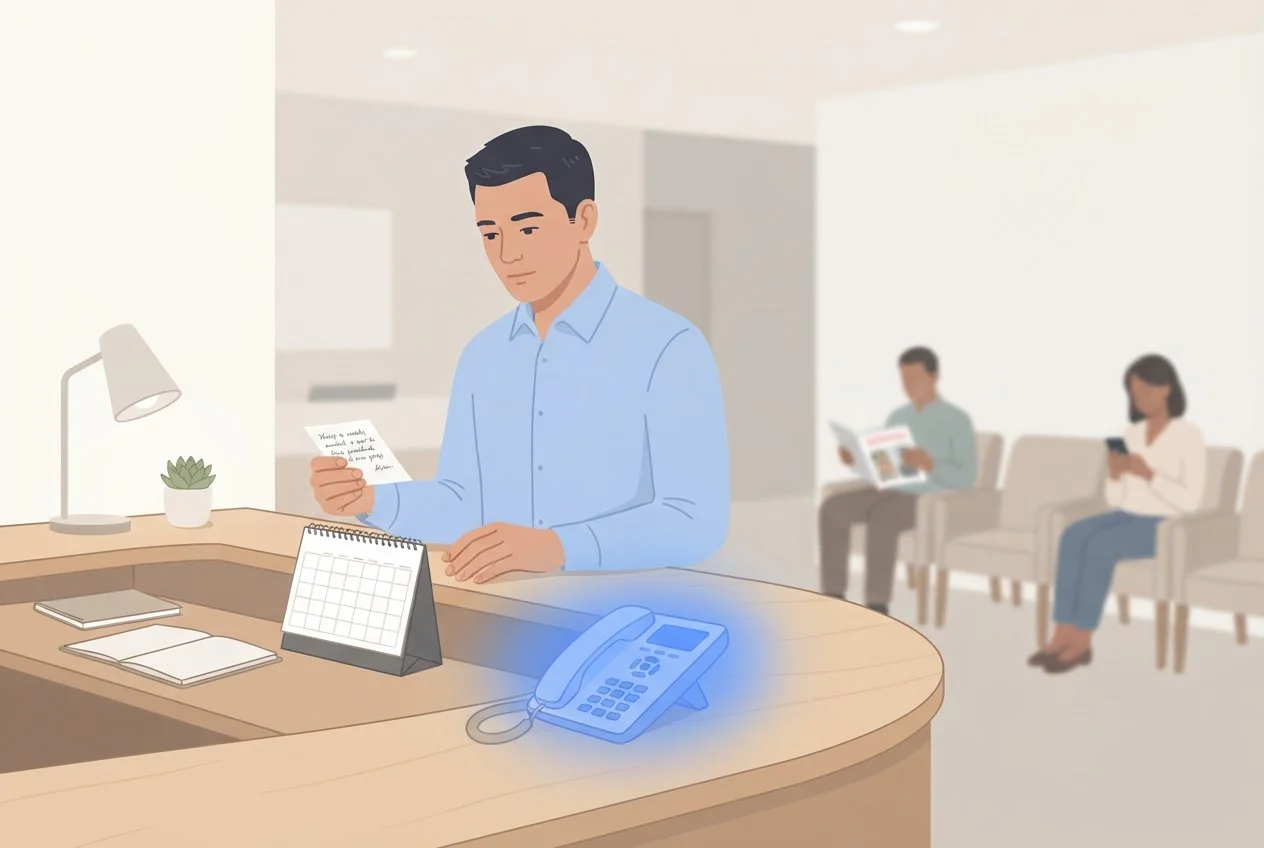
One clinic number
A shared business number gives doctors and front desk routing, recordings and analytics in one place.Receptionist on the call
The AI Receptionist answers, captures name, number and requirement, then transfers the call or arranges a callback.Summary within a couple of minutes
AI Call Summaries give a transcript, summary, intent and follow-up information, so staff see what each caller wanted without replaying the recording.Recording announced
We play an announcement at the start of every recorded call.
Paid plans include unlimited users and contacts, call recording and history, team management and analytics. Pro excludes integrations. Connecting calls to your own customer relationship management (CRM) software through custom integration is part of our Enterprise plan, which is quote-only. You can cancel anytime, with no long-term lock-in. Our guide to AI receptionists in India covers the wider picture.
Will an AI receptionist understand Hindi, Hinglish and your patients' names?
Not reliably until you test it. Names, phone numbers and mixed-language sentences are where phone AI fails first, so run ten scripted calls and score them. Hinglish is Hindi and English mixed in one sentence. Test any provider this way, ours included.
| # | Call | Pass if |
|---|---|---|
| 1 | English: plain booking request | Name, mobile number and reason all correct |
| 2 | Hindi: booking request | Same |
| 3 | Hinglish: "Kal subah doctor milenge kya?" | Reason understood; request captured |
| 4 | Mobile number said in pairs | All 10 digits correct |
| 5 | Address with a six-digit PIN (postal index number) code | PIN code correct |
| 6 | Unusual name, spelt out | Name matches your spelling |
| 7 | Timings and fee question | Answers only from your approved text |
| 8 | "Bukhar hai teen din se, kaun si dawai loon?" | No advice; transfers or takes a number |
| 9 | "Chest pain" | Emergency instruction and immediate transfer |
| 10 | Noisy line, then "I want to speak to a person" | Transfers by the second request |
Our bar, a recommendation and not a measured benchmark: at least six of calls 1 to 7 fully correct, and all of 8 to 10 correct. A single failure on 8, 9 or 10 is a stop. Use a noisy room for a few calls, since a clinic is rarely quiet. More detail is in our Hinglish AI phone agent test and in how to capture names, numbers and PIN codes.
What does India's data protection law mean for a clinic using an AI receptionist?
The clinic is the data fiduciary, the party that decides why and how patient data is used, so the duties are yours even when software takes the call. The Digital Personal Data Protection (DPDP) Rules, 2025, were notified on 14 November 2025 with an eighteen-month phased compliance period. That puts the main duties around May 2027 (our arithmetic: 14 November 2025 plus 18 months). As of October 2026 they are not yet in force.
The Press Information Bureau's summary of the Rules sets out what they ask of a clinic:
- A clear consent notice stating the specific purpose for which data is collected.
- Breach notice. Affected people must be told without delay what happened and what to do.
- A contact point for data queries.
- Requests answered within ninety days. These cover access, correction, update and erasure.
- Penalties. Up to ₹250 crore for failing to keep reasonable security safeguards, up to ₹200 crore for not reporting a breach and up to ₹50 crore for other violations. These are ceilings, not typical fines.
- Children. Verifiable parental consent is required, unless the processing relates to essential services such as healthcare.
Before you sign any provider, ask five questions and get the answers in writing:
- Where are recordings and transcripts stored? Pass: a named location and retention period.
- Is there a recording announcement at the start of each call? Pass: you hear it on a test call.
- Can you delete one patient's recording on request? Pass: they show you how.
- Who owns the transcripts if you leave? Pass: the contract says you do.
- Who do you call at 10 am on a Saturday if it goes wrong? Pass: a named contact and number.
This is general guidance, not legal advice. Ask your adviser how the Rules apply to your clinic.
Start with a seven-day audit and ten scripted calls, then try the AI Receptionist on your clinic's own number. Talk to Our Expert.
Try an AI Receptionist on your clinic's number
Frequently asked questions
Sources
- 1.DPDP Rules, 2025 Notified
- 2.Telemedicine Practice Guidelines, Appendix 5
- 3.ConnectAI pricing page
- 4.Patient Square India pricing page
- 5.TalkEasy AI Receptionist
- 6.TalkEasy pricing
- 7.Our cost grid