Cold Call Opening Lines for India: 6 to Use and a Test
The best cold call opening lines state your name, one specific reason for calling and an honest ask for 30 seconds. Skip the bad-time question and test your lines on real calls.

By Tej Pandya, Founder · Updated 10 Oct 2026
Key takeaways
- 01The best cold call opening line gives your name and company, one reason specific to this person, and a single ask. The reason comes before any question about their time.
- 02
In Gong's analysis of more than 300 million calls, the "bad time" opener ranked lowest of the openers tested, and a permission opener that owns the cold call ranked among the highest.
- 03
- 04Twenty calls per opener only reveals large differences. Alternate the two lines, log one outcome per call, and extend to 50 each if the result is close.
In this article
- 1What are the best cold call opening lines for Indian callers?
- 2Why does "Did I catch you at a bad time?" rank last?
- 3Can you trust the success rates published for cold call openers?
- 4Is "How are you?" a safe way to begin a sales call?
- 5What must you check before making a sales call to a stranger in India?
- 6How do you test two cold call openers on your own calls?
- 7Frequently asked questions
Gong's analysis of more than 300 million cold calls found that "Did I catch you at a bad time?" succeeded 2.15% of the time, the lowest of the openers it tested (Gong, published July 2024). Gong is a US sales-software company and the lines it tested are in English, so this is not Indian data. The line is also the one that sounds most polite, which is why it survives.
Politeness is not the problem. The line hands a stranger an exit before they know why you called. In our experience, Indian buyers take that exit quickly, because an unknown number is often a loan, card or insurance pitch, and the first few seconds decide which one you are.
This page gives you openers in English and Hinglish (Hindi written in English letters) that put the reason first. It then shows how far published success rates can be trusted, what to check under TRAI's September 2026 rules, and how to test which line works for your buyers.
What are the best cold call opening lines for Indian callers?
Use one shape: your name and company, one specific reason you are calling this person, then a single question or an honest ask for 30 seconds. A cold call here means a sales call to someone who has not asked to hear from you.
| Situation | Say | Avoid |
|---|---|---|
| Owner, and you have checked something about their business | "Hello Mr Gupta, this is Aditi from [Company]. I saw your shop is listed on one delivery app but not another, and that is what I help with. Do you have 30 seconds?" | "Did I catch you at a bad time?" |
| Owner, no real signal (honest cold call) | "Mr Gupta, this is a cold call, so I will be quick. I am Aditi from [Company], calling about [one problem businesses like yours have]. Give me 30 seconds, and tell me if it is not relevant." | "How are you today, sir?" followed straight by the pitch |
| Hinglish, with a signal | "Namaste Gupta ji, main Aditi bol rahi hoon, [Company] se. Maine aapki dukaan ki Google listing dekhi, usi baare mein call kiya hai. 30 second mil sakte hain?" | "Kya yeh baat karne ka sahi samay hai?" |
| Hinglish, honest cold call | "Gupta ji, seedha bata deti hoon, yeh cold call hai. [Company] se Aditi bol rahi hoon. 30 second dijiye, kaam ka na lage to bol dijiye, main call rakh dungi." | A long company introduction before the reason |
| Receptionist or assistant | "Namaste, Aditi bol rahi hoon [Company] se. Gupta ji se baat ho sakti hai? Unke [online orders] ke baare mein baat karni thi." | "Connect me to the decision maker" |
| Referral | "Gupta ji, Rahul ji ne aapka naam diya tha. Unke saath maine [specific work] kiya hai. 30 second mil sakte hain?" | Naming a referrer who did not suggest the call |
If the caller is a man, say "bol raha hoon", "bata deta hoon" and "rakh dunga". Fill each bracket with something you checked about the person before dialling. If you have nothing, use an honest cold call line, because an invented detail is exposed by the first question.
Use the surname with "ji" (Gupta ji) until the person invites a first name. In our view, a first-name-only opener tends to sound either like a bank call or too familiar, especially to an older owner.
Why does "Did I catch you at a bad time?" rank last?
The "bad time" opener asks permission to hang up before giving any reason to stay. In Gong's analysis of more than 300 million cold calls, it succeeded 2.15% of the time, against 11.18% for a permission-based opener that owns the cold call and then asks to pitch (Gong, 2024).
A separate Gong dataset of 90,380 first cold calls shows the same bottom position. There, success means a booked meeting: the "bad time" line succeeded 0.9% of the time, which is 40% less likely than the 1.5% baseline, while beginning with "The reason for my call is…" raised the success rate 2.1 times (Gong Labs, updated March 2026).
The openers that work say why before they ask anything. Our recommendation follows: no question about the person's time until they know your reason.
Can you trust the success rates published for cold call openers?
Trust the order, not the percentages. The same line moved from 2.15% to 0.9% between Gong's two analyses, and we infer the datasets and measures differ (our inference). Both put the "bad time" question at or near the bottom, and the 90,380-call analysis also found a warm greeting did well.
| Opener | 300 million-call analysis (Gong, 2024) | 90,380-call analysis (Gong Labs, 2026; success = booked meeting) |
|---|---|---|
| "Did I catch you at a bad time?" | 2.15% | 0.9% |
| "How's your day going?" | 7.6% | – |
| "How are you?" | – | 5.2% |
| "How have you been?" | – | 10.01% |
| Permission-based opener | 11.18% | – |
| "Have you heard our name tossed around?" | 11.24% | – |
A dash means that opener appears in the other analysis only. The 90,380-call baseline for first cold calls is 1.5%.
A percentage from any single study cannot be carried onto your calls. Your buyers, your language and your offer set the real numbers, so the Hinglish versions above are ours to test, not proven. For India, the nearest evidence we can cite is TRAI's complaint record on unsolicited calls, in the checks section below.
Is "How are you?" a safe way to begin a sales call?
It is safe to greet, but not to build the opening on small talk. In Gong's 90,380-call analysis, "How have you been?" succeeded 10.01% of the time and "How are you?" 5.2%, both above the 1.5% baseline for booking a meeting (Gong Labs). Those are US sales calls in English, so a warm greeting does no harm in that data, but the Hinglish equivalents are untested.
Our recommendation for first calls to someone who does not know you: a short "Namaste Gupta ji", your name and company, and the reason within the first five seconds. Line A: "Namaste Gupta ji, Aditi bol rahi hoon, [Company] se. Aap kaise hain?" followed by your reason. Line B: a reason-first opener from the table. The test below tells you which your buyers prefer.
What must you check before making a sales call to a stranger in India?
Check who or what dials the call, whether each number is clear to call, and whether you hold a record that allows it. As of 10 October 2026, the rule that governs your calls is the Telecom Regulatory Authority of India (TRAI) Third Amendment Regulations, notified on 18 September 2026 (regulations; press release). It replaces regulation 4, under which the Second Amendment of 12 February 2025 had required senders to tell their operator about auto dialler and robo-call use (Second Amendment), with the A2P declaration below.
Dates. Most provisions start 30 days after publication in the Gazette of India, and regulations 4, 6, 8(a) and 18 after 60 days (regulation 1(3)). The text is marked "to be published in the Gazette", so we count from 18 September 2026: 30 days ends on 18 October 2026 and 60 days on 17 November 2026. A later Gazette date moves both.
What counts as A2P. An A2P (application-to-person) call is a voice call started by an application, software system or automated platform without direct human dialling, including auto dialling, robo-calls and pre-recorded or artificial voice (regulation 2(ea)). In our reading, a call a person dials is human-dialled.
Only A2P calls carry these duties:
- Declare A2P use in advance to your originating operator with the CLI (calling line identification) ranges you will use. The operator records it on the DLT (distributed ledger technology) platform, and an undeclared A2P call is treated as unsolicited commercial communication (UCC). This is new regulation 4, due on 17 November 2026 on our count.
- A terminating operator may charge the originating operator up to ₹0.05 (5 paise) a minute on A2P calls, from the same date (regulation 35A). Calls from the 140xx, 1600xx and 1601xx series carry no charge and cannot be flagged as suspected spam for recipients.
Every sales call carries these duties, human-dialled or not:
- UCC is any commercial communication that is neither as per the recipient's consent nor as per their registered preference (TCCCPR 2018, regulation 2(bw)), and a subscriber not registered for commercial communication shall not make it (regulation 3). A promotional call to a number on the preference register, without consent, is UCC whoever dials it.
- Action against a sender starts at 3 or more unique complaints within ten days where the sender's CLI is also flagged by AI/ML detection (press release).
- An enquiry counts as a relationship for seven days only, and it must be made in writing or digitally and kept in verifiable form (regulation 2(bb)).
From January to April 2026, 10,26,187 of 11,49,186 UCC complaints, 89.3%, were against unregistered telemarketers (TRAI explanatory memorandum).
Run four checks before a calling session:
Is every call dialled by a person, or declared as A2P?
Pass: a person starts every call, or you have declared your A2P use and CLI ranges before 17 November 2026. Fail: an auto dialler, robo-call or pre-recorded voice on undeclared numbers.Have you scrubbed the list against the preference register?
Scrubbing means comparing your target list with the National Customer Preference Register (the Do Not Disturb register) and consent records (regulation 2(be)). Pass: every list is scrubbed before dialling and anyone who said no is removed. Fail: a bought or old list dialled as it is.
Do you hold a record that allows each call?
Pass: recorded consent, or a written or digital enquiry from the last seven days that you can retrieve. Fail: a lead you cannot trace to either.Does the opener carry your name, company and reason in the first two sentences?
Pass: all three, before any question. Fail: a question comes first.
How do you test two cold call openers on your own calls?
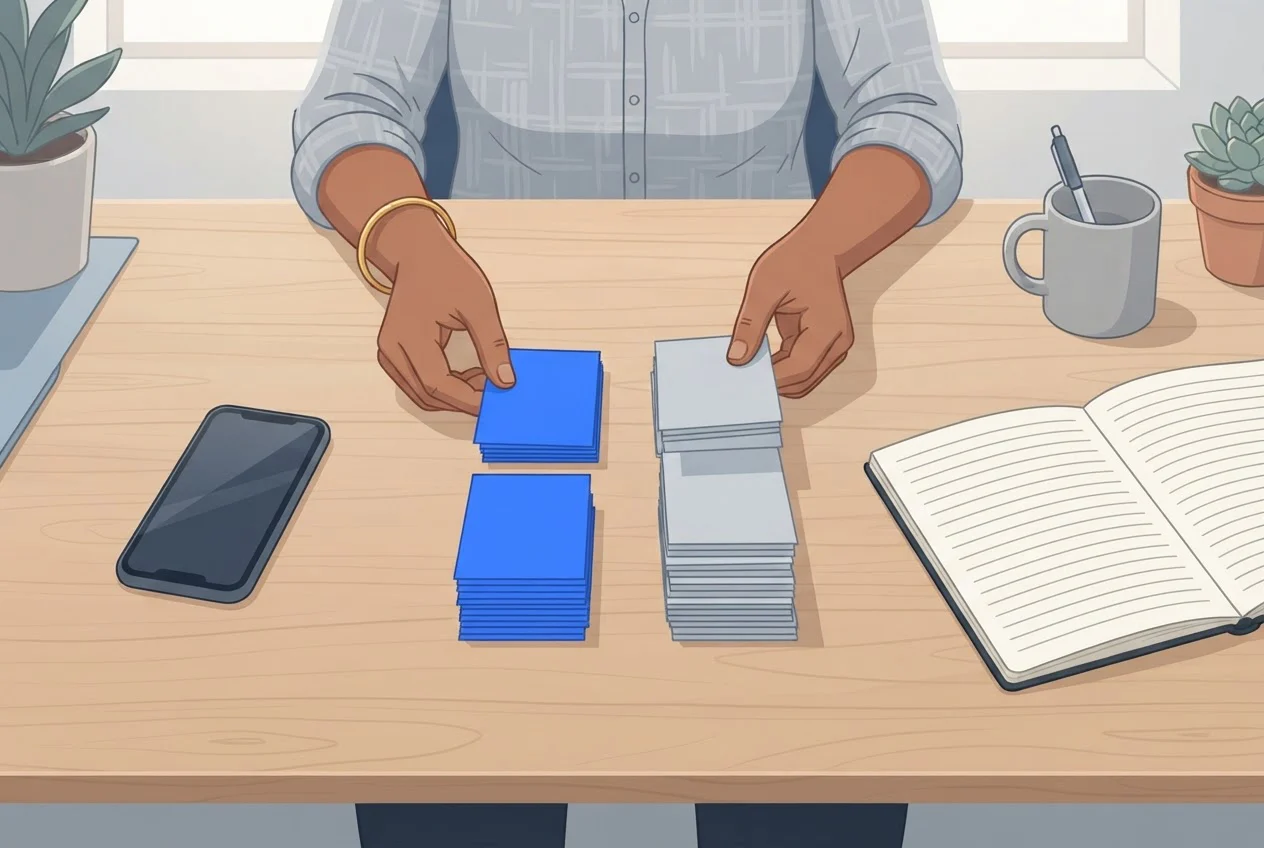
Alternate two lines call by call, log one outcome per call, and compare after 20 calls each:
Pick two lines.
Your current opener, and one from the table above.Alternate them.
Use line A, then line B, with the same kind of prospect in the same time window, not one line in the morning and the other in the afternoon.Log one outcome per call.
Hung up within 15 seconds; stayed past 30 seconds; asked a question; agreed to a next step. Our guide to call disposition codes for Indian telecallers gives you ready labels.
Compare
the share of calls that stayed past 30 seconds, or better, agreed a next step.Read the gap honestly.
Our calculation uses a two-sided Fisher exact test (a standard check of whether two small counts differ by more than chance) at the 5% level with 20 calls per line. If one line keeps 4 callers past 30 seconds, the other needs 11 before the gap is clearly more than chance. If one keeps 6, the other needs 14. A smaller gap is noise. At 50 calls per line, 10 against 20 clears the same bar.
In our Business Dialer, calls are logged and can be recorded, and you can add a note against the call when it ends. Click-to-call means a person dials every call. AI Call Insights can flag objections in recordings. As of October 2026, our Pro plan is ₹999 + GST a month with three hours of talktime (paid calling time) a day, and extra talktime is ₹49 + GST an hour.
Once an opener earns its 30 seconds, the next job is the script itself: see our telecalling script for India. When a call ends without a yes, the follow up call script by last outcome covers what to say next.
Run your 20-call test with our team
Frequently asked questions
Open with your reason, then offer two specific slots. For example: "Gupta ji, [Company] se Aditi. Aapke [online orders] ke baare mein call kiya hai. Kya Thursday 11 baje ya Friday 4 baje 15 minute mil sakte hain?" (Gupta ji, Aditi from [Company]. I called about your online orders. Could you do 15 minutes on Thursday at 11 or Friday at 4?) In our view, two options make "yes" easier than "when are you free?"
Start with "Namaste", the person's surname and "ji", then your name, company and one reason, and end with a request for 30 seconds. Use "aap" throughout. For example: "Namaste Gupta ji, main Aditi bol rahi hoon, [Company] se. Maine aapki dukaan ki Google listing dekhi, usi baare mein call kiya hai. 30 second mil sakte hain?" (Hello Mr Gupta, I am Aditi from [Company]. I saw your shop's Google listing and that is what I am calling about. May I have 30 seconds?)
Sources
- 1.Gong: The best and worst cold call openers, backed by data from 300M calls, Gong, July 2024
- 2.Gong Labs: Cold call opening lines, analysis of 90,380 cold calls, Gong Labs, March 2026
- 3.TRAI: Telecom Commercial Communications Customer Preference (Third Amendment) Regulations, 2026, full text (PDF), TRAI, 18 September 2026
- 4.TRAI: Press Release No. 119 of 2026 on the Third Amendment (PDF), TRAI, 18 September 2026
- 5.TRAI: Telecom Commercial Communications Customer Preference (Second Amendment) Regulations, 2025, full text (PDF), TRAI, 12 February 2025
- 6.TRAI: Telecom Commercial Communications Customer Preference Regulations, 2018 (PDF), TRAI