Call Disposition: Meaning and 10 Codes for Indian Telecallers
A call disposition is the label a rep picks when a call ends to record what happened. Ten exclusive codes, kept separate from lead stage, are enough for outbound telecalling.

By Tej Pandya, Founder · Updated 3 Oct 2026

Key takeaways
- 01
A call disposition is one label per call, chosen from a short fixed list. Ten codes cover outbound telecalling: No answer, Not reachable, Wrong or invalid number, Spoke to someone else, Callback requested, Interested with a booked step, Interested needing information, Not interested, Do not call, and Call dropped.
- 02
Keep the disposition separate from lead stage. The code records what happened on this call. A person updates the stage after judging the whole conversation.
- 03
Give "Do not call" its own code and act on it the same day, with the date stored. As of October 2026, TRAI's consent and complaint rules make that record your evidence.
- 04
Test consistency before you trust any report. Have two people code the same ten recordings independently, and aim for agreement on at least nine.
In this article
- 1What is a call disposition, and how does it differ from lead stage and call notes?
- 2Which 10 disposition codes should every telecaller use after a call?
- 3How many dispositions does a telecalling team need?
- 4Which call disposition code fits a messy call?
- 5Why does "Do not call" need its own code instead of "Not interested"?
- 6What do 100 coded calls show about your lead list?
- 7How do you check that every telecaller uses the codes the same way?
- 8How do TalkEasy call summaries help you keep dispositions honest?
- 9Frequently asked questions
Give three telecallers the same call, a lead who says "I'm in a meeting, try later", and you can get "Call back later", "Not interested" and "No answer". Each rep can defend the choice. The weekly report then counts the same situation three ways.
A longer list of labels does not fix that. A short list does, if each code has a definition, one test for when to pick it, and one automatic next step.
In India one code also carries regulatory weight. The Telecom Regulatory Authority of India (TRAI) announced on 18 September 2026 that action against a sender can start after three unique complaints in ten days when an AI system has also flagged its number, down from five. A stop request filed as "Not interested" is the call most likely to be repeated.
Below are ten codes for outbound telecalling, the rules for choosing between them on messy calls, and checks that show whether your team codes calls the same way.
What is a call disposition, and how does it differ from lead stage and call notes?
A call disposition is the single label a rep picks from a fixed list when a call ends, recording what happened on that call, such as No answer or Callback requested. Dialers also call it a wrap-up code or call outcome. This page uses "disposition" throughout.
Three fields get confused, and they answer different questions:
| Field | Question it answers | Who sets it | Example |
|---|---|---|---|
| Disposition | What happened on this call? | The rep, once, when the call ends | Callback requested |
| Lead stage | Where is this lead in our sales process? | A person, after judging the whole conversation | Demo given |
| Call notes | What detail must we remember? | The rep, in free text | "Wants the 2BHK, asked for a WhatsApp brochure" |
A disposition changes with every call, while a lead holds one stage at a time. A lead can sit in "Demo given" while today's call is "No answer". If you merge the two fields, a missed call can look like a lost lead.
Which 10 disposition codes should every telecaller use after a call?
Use these ten codes after every outbound call. Each is exclusive, so any call fits exactly one. Retry counts and timings are our recommendations, so adjust them to your lead quality.
| # | Code | Pick it when | Next step |
|---|---|---|---|
| 1 | No answer | The phone rang out or was busy | Retry at a different time of day, up to three attempts over a week |
| 2 | Not reachable | Switched off, out of coverage, or a network message played | Retry next day. After three tries on different days, check the number |
| 3 | Wrong or invalid number | The number is not in service, or the person says it is not the lead's | Remove the number and look for another contact on the lead |
| 4 | Spoke to someone else | A relative, colleague or gatekeeper answered and the lead was unavailable | Ask for a time and create a callback task for it |
| 5 | Callback requested | The lead asked to be called later, or answered without a yes or a no ("I'll think about it"). Date and time required | Task at the stated time. If the lead gave no date, default callback in 3 days |
| 6 | Interested, next step booked | A visit, demo, meeting or payment has a date. Date required | Reminder, plus a WhatsApp confirmation to the lead |
| 7 | Interested, needs information | The lead wants price, a brochure or details before deciding | Send on WhatsApp within the hour, task for the next day |
| 8 | Not interested | The lead said no, in words | Close for now. Review in a quarter if you have a new offer |
| 9 | Do not call | The lead asked you to stop calling | Stop all calls at once and store the date |
| 10 | Call dropped | The line cut before any conversation | Retry the same day |
Write notes only on codes 5, 6 and 7, where the detail changes what happens next. Every other call needs one tap. There is no "Other" code, because a catch-all bin is where unclassified calls pile up.
How many dispositions does a telecalling team need?
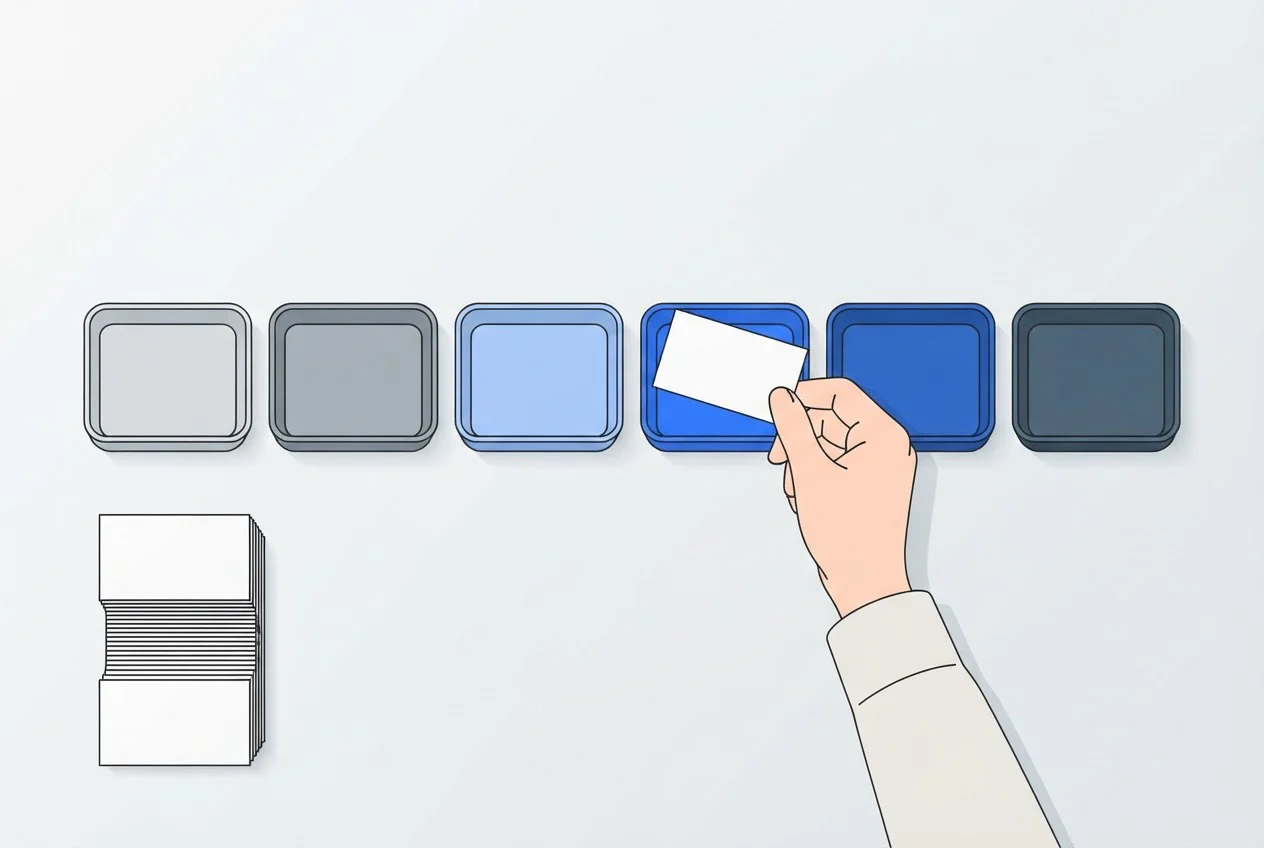
Ten is enough because the ten codes lead to six different actions: retry, remove the number, callback task, follow-up task, close the lead for now, and stop all calls. Fewer codes would hide differences that change what a rep does next. More would split calls that reps cannot reliably tell apart.
We keep codes 1, 2 and 10 apart even though all three lead to a retry. Their timing differs, and so does what they tell you. A high share of code 2 points to bad numbers, code 1 to bad calling times, and code 10 to line quality. Codes 3, 8 and 9 also stay apart: the first removes a number, the second closes a lead, and the third stops every call. This is our recommendation, not a standard.
To test your own list, take any two codes and ask whether they lead to the same action and the same line in a report. If both answers are yes, merge them. Past about ten codes, reps start choosing by habit or by whatever sits at the top of the screen, and the same call gets different codes from different people.
Which call disposition code fits a messy call?
The lead's words decide the code, not the rep's guess about what the lead meant. If the words contain a time or a maybe, the code is 4 or 5. If they contain a no, it is 8. If they contain a request to stop, it is 9, and that overrides everything else.
| What happened | Code | Why |
|---|---|---|
| "I'm busy, not now." | 5 | A busy lead has not refused. Ask "Shall I call at 6?" before you end the call |
| "Hello? Hello?" and the line cuts | 10 | No conversation happened, so the lead has not declined |
| His wife answers: "He's out, call tonight." | 4 | The callback depends on someone else's message, so it is not code 5 |
| A recorded voice says the number is switched off | 2 | The lead could not be reached, which is not a refusal |
| "Send me the details on WhatsApp." | 7 | The lead has asked for something, which makes them more than a "maybe" |
| "Stop calling me." | 9 | A stop request is never "Not interested" |
| "I don't know any such person." | 3 | Remove the number from this lead |
| "I'll think about it." | 5 | Ask "Shall I call on Thursday?" If the lead gives no date and no refusal, use code 5 with a default callback in 3 days. Use 8 only if the lead says no |
Most miscoding comes from the first row. A hurried "not now" is filed as "Not interested", and a live lead leaves your list because a rep did not ask for a time.
Why does "Do not call" need its own code instead of "Not interested"?
"Do not call" needs its own code because a stop request is a consent event, and "Not interested" is not. Under TRAI's February 2025 amendment, a sender may re-acquire consent from a customer who revoked it only after ninety days from the date of revoking. A customer also has seven days from receiving an unsolicited communication to complain about it. A date-stamped code 9 is how you show when a request came in.
As of 3 October 2026, TRAI has finalised the Third Amendment Regulations, 2026, announced in its press release of 18 September 2026. It revises certain complaint timelines, so confirm the current complaint window in the gazette text. It also gives customers a 15-day appeal against how a complaint was resolved. The press release announces no change to the ninety-day rule, so we keep ninety days as the minimum. Its provisions start on the dates in the gazette notification, so ask your telecom provider which apply to your numbers.
If your team uses an auto-dialler, robo-calls or pre-recorded voice, the Third Amendment treats them as application-to-person (A2P) calls: voice calls started by software without direct human dialling. You must declare A2P use to your telecom provider beforehand, with the numbers involved. Undeclared A2P calls are treated as unsolicited commercial communication.
Which rules apply depends on the call. Cold calls that advertise a product or service are promotional voice calls, and they may reach only subscribers who have not blocked promotions in the Preference Register (the Do Not Disturb register) or who have given consent. Calls to an existing customer about something they bought, such as warranty, delivery or a balance, are service calls. Mixing promotion into a service call makes it promotional. These definitions are in clauses (av) and (bh) of the 2025 amendment.
Our recommendation for code 9:
- Stop calling the same day, so a repeat call cannot become a complaint.
- Store the date of the request. Without it you cannot show when the ninety days began.
- Do not argue or try to win the lead back. A rep who says "Are you sure?" after a stop request creates the problem the code exists to prevent.
The Digital Personal Data Protection (DPDP) Act, 2023, section 6, lets a person withdraw consent as easily as they gave it. Under the DPDP Rules 2025, the consent and notice duties apply from 13 May 2027. Our recommendation: a one-tap code 9 makes withdrawal easy to record, where a free-text note someone must later notice does not.
For the wider rules on numbers and recording, see our guide to outbound calling in India.
What do 100 coded calls show about your lead list?
100 coded calls show how many leads need another attempt and how many have really left the list. The figures below are our model, not a benchmark. We invented the split to show the arithmetic, so replace it with your own week's counts.
Suppose a rep makes 100 dials in a day:
| Code | Calls |
|---|---|
| 1 No answer | 38 |
| 2 Not reachable | 9 |
| 10 Call dropped | 3 |
| 3 Wrong or invalid number | 5 |
| 4 Spoke to someone else | 7 |
| 5 Callback requested | 10 |
| 6 Interested, next step booked | 5 |
| 7 Interested, needs information | 8 |
| 8 Not interested | 13 |
| 9 Do not call | 2 |
| Total | 100 |
From these counts:
- Contact rate = connected calls ÷ attempts. In our model, connected means a person answered and the call reached a real outcome (codes 4 to 9). That gives 45 ÷ 100 = 45%.
- Interest rate = (code 6 + code 7) ÷ connected calls = (5 + 8) ÷ 45 = 28.9%, about 29%.
- Retry load = codes 1, 2 and 10 = 38 + 9 + 3 = 50 calls.
- Leads leaving the list = codes 3, 8 and 9 = 5 + 13 + 2 = 20. The other 80 stay open and create tasks: 50 retries plus 7 + 10 + 5 + 8 = 30 callbacks and follow-ups.
The lesson is that 50 of those 100 calls are not rejections. A team that files "No answer" as "Not interested" would discard half its list. For the weekly report built on these numbers, see how to track your sales team's calls.
How do you check that every telecaller uses the codes the same way?
Run five tests, each with a pass mark and a fail mark. The thresholds are our recommendations.

Double-coding test
Pick ten recorded calls. Two people code them independently. Pass if they agree on at least 9 of 10. Fail if they agree on 8 or fewer, and fix the definitions before you fix the people.Refusal test
Take ten calls coded 8. Pass if the lead's no is audible or written down in every one. Fail if any is a hang-up or a "not now".Date test
Check every call coded 5 or 6. Pass if each has a date and time, or the default callback date for code 5. Fail if any code 5 or 6 call has no date and time. Make the field mandatory so a blank cannot be saved.Stop test
Check every call coded 9. Pass if the lead was removed from calling lists the same day. Fail if any number was dialled again.Count test
Compare total dials with total coded calls. Pass if they match. Fail if coded calls are fewer than dials, because those calls are going unrecorded.
How do TalkEasy call summaries help you keep dispositions honest?
A call summary gives you a second view of each call to check against the code. TalkEasy AI Call Summaries record the customer's requirement, objections, recommended next follow-up and overall call outcome. Managers and admins can review them on the team dashboard, so a manager can compare the summary with the code.
That makes the double-coding test cheap. If a rep chose "Not interested" and the summary shows the customer asked for a callback, you have found a miscoded lead without playing the recording. Our Call Analytics shows total calls and connected calls, and the performance of each team member, which give you the figures for the contact rate above. Our call summary guide has an example summary you can compare with your own.
As of October 2026, TalkEasy Pro costs ₹999 + GST per month, with 3 hours a day of talktime, unlimited users and contacts, AI Call Assist, call recording and history, and an analytics dashboard.
Check every call code against an AI call summary
TalkEasy AI Call Summaries record the outcome of each call, so managers can compare the summary with the code the rep chose.
Try TalkEasyFrequently asked questions
Yes. An uncoded call cannot be counted or followed up. Keep the ten-code list on one screen so choosing takes a single tap, and require notes only on codes 5, 6 and 7. Then the rule costs seconds, not minutes.
AI can propose the outcome, but a rep should confirm it, because codes 8 and 9 change what happens to the lead. Our AI Call Summaries record the overall call outcome, which works well as a check against the code the rep picked.
Yes. On an inbound call the customer has chosen to call you, so No answer and Wrong number rarely apply. Record the result, such as resolved, escalated or callback needed, and add a reason-for-call field. Missed inbound calls are tracked separately as missed calls.
Usually not. Labels such as "Quote sent" or "Site visit done" are lead stages, not call results, so they belong in the stage field. Add a code only when a repeated call situation needs a next step none of the ten covers.
Sources
- 1.Telecom Commercial Communications Customer Preference (Second Amendment) Regulations, 2025 (gazette text, February 2025), Telecom Regulatory Authority of India
- 2.Press release of 18 September 2026 on the Telecom Commercial Communications Customer Preference (Third Amendment) Regulations, 2026, Telecom Regulatory Authority of India, 18 September 2026
- 3.Digital Personal Data Protection Act, 2023 (official text), Ministry of Electronics and Information Technology
- 4.Digital Personal Data Protection Rules, 2025, rule 1, 13 November 2025
- 5.AI Call Summaries and Call Analytics, TalkEasy