
Sales Team Call Tracking: How to Track Calls Across a Sales Team


TL;DR
We recommend sales team call tracking that joins a managed phone layer to CRM records, clear ownership rules, controlled outcomes and follow-up tasks. This guide shows our full operating model, from tool selection and call-record fields to routing, manager dashboards, recording governance and a safe six-step rollout.
Sales Team Call Tracking: How to Track Calls Across a Sales Team
India had 1,354.28 million telephone subscriptions at the end of July 2026, according to TRAI. For growing sales teams, that mobile-first environment makes shared ownership, consistent records, and reliable follow-up increasingly important.
Sales team call tracking works when every customer call creates a structured record, assigns ownership to the right representative, connects the activity to the correct CRM contact, captures the outcome, and creates the next action. Recordings, AI summaries, and analytics can add context, but they cannot compensate for unreliable routing or incomplete CRM data.
This guide explains how to build a call-tracking system across a sales team, choose the right technology layer, define call records, automate follow-ups, build manager dashboards, and roll out the system without disrupting customer conversations.
What Does the Sales Team Call Tracking Need To Work?
A reliable system has six connected components: business numbers or a dialer, routing and ownership rules, call event records, CRM associations, recordings or summaries, and reporting. When one component operates separately, managers get an incomplete view and representatives often have to enter information manually.
The operating flow should be straightforward: phone system, routing, call event, CRM association, recording or summary, follow-up, and reporting. Starting with a Virtual Business Number also ensures that customer relationships remain connected to the business rather than an employee’s personal number.
Every call should receive a durable call ID. That identifier connects the phone number, representative, timestamps, outcome, recording status, and CRM activity while giving operations teams a reliable way to reconcile failed or missing events.
A useful system should answer five questions for every call:
-
Who handled the call?
-
Which customer or prospect was involved?
-
What happened during the interaction?
-
What happens next?
-
Did the system record and route everything correctly?
That foundation makes sales team call tracking useful for both representatives and managers. Without it, additional analytics usually create more reports without creating better visibility.
Choose The Right Call-Tracking Layer
There is no single tool category that solves every sales team’s needs. The right approach depends on whether the primary problem is shared calling, outbound volume, CRM activity, attribution, or conversation analysis.
Tool Type | Primary Job | Must Connect To | Test Before Choosing |
CRM Calling | Logs calls inside customer records | Contacts, accounts, deals, tasks | Required outcomes and routing |
Business Phone System | Manages shared numbers, queues, and transfers | CRM and analytics | Ownership and call ID retention |
Dialer | Speeds structured outbound calling | Lead lists, CRM, ownership rules | Duplicate prevention and callbacks |
Call-Tracking Platform | Attributes inbound calls to sources | Website, campaigns, CRM | Team-management capabilities |
Conversation Intelligence | Supports summaries, search, and coaching | Recording source and CRM | Record completeness and accuracy |
For high-volume outbound teams, a Business Dialer should create the call event automatically and connect it to the assigned lead. For inbound teams, the phone system should determine who receives the call, what happens after a transfer, and when an unanswered call requires follow-up.
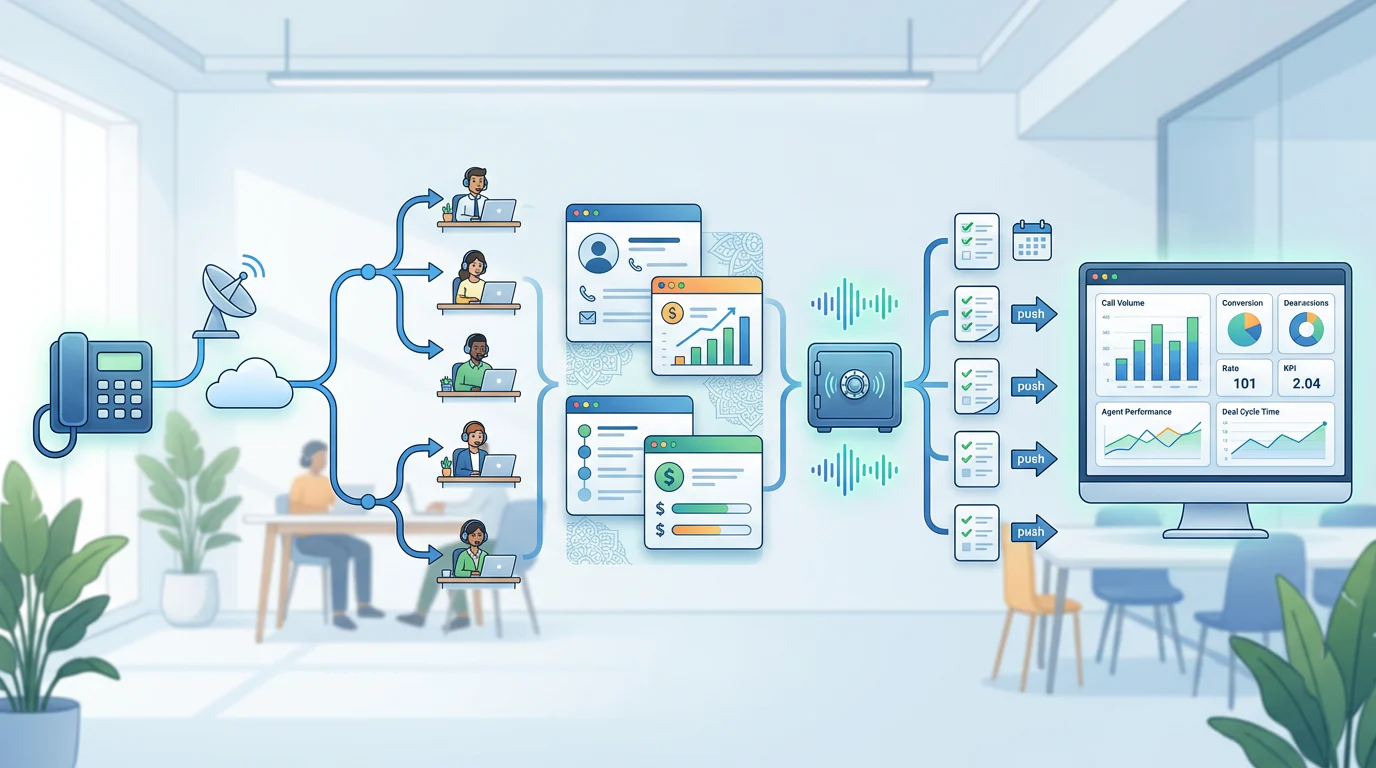
Do not introduce a conversation-intelligence tool to solve a routing problem. Similarly, a basic activity log cannot explain changes in conversion without reliable customer and pipeline associations.
The goal of sales team call tracking is to connect these layers rather than force one tool to perform every function. A clean architecture makes it easier to identify whether a problem originates in calling, CRM data, automation, or coaching.
Define What Every Sales Call Record Should Contain
A useful call record is a structured business event rather than a free-form note. It should tell the organization who handled the call, which customer it involved, what happened, what was promised, and what action needs to happen next.
Capture Identity And CRM Relationships
Store the call ID, representative ID, team, contact ID, account ID, deal ID when relevant, and source number. Normalize phone numbers before attempting to match them against CRM records.
If a number matches multiple contacts or accounts, send the event to an exception queue instead of allowing automation to guess. Incorrect ownership can create duplicate outreach and distort performance reporting.
Capture Event And Outcome Fields
Store call direction, originating and receiving numbers, start time, answer time, end time, duration, status, and controlled disposition. A practical outcome list might include connected, no answer, busy, voicemail, wrong number, qualified, follow-up booked, not a fit, and escalation.
Keep the list short enough for representatives to use consistently. Too many dispositions create inconsistent reporting and encourage users to select whichever option is easiest.
Add Recording And Consent Information
Recording fields should include recording status or secure location, consent or notice status, transcript status, retention class, access classification, and deletion date where applicable.
Record The Next Action
The final part of the record should capture the next action, due date, task owner, follow-up result, synchronization status, retry count, and failure reason. AI Call Summaries can speed up documentation, but summaries should support structured outcomes rather than replace them.
Field Group | Required Fields | Validation Rule |
Ownership | Call ID, representative, team, contact, account, deal | Ownership must resolve before reporting |
Event | Direction, numbers, timestamps, duration, status | Use one timezone and immutable call ID |
Outcome | Disposition, notes, next action, due date | Only approved outcomes close a call |
Evidence | Recording status, consent, retention class | Access follows recording policy |
Reliability | Sync status, retry count, error reason | Failed events enter a recovery queue |
Build Routing And CRM Automation Around Ownership
Routing should establish accountability before the customer has to repeat their information. A useful precedence order is named account owner, territory owner, available representative through round robin, and then a shared queue.
That approach prevents existing customers from being treated like anonymous inbound leads. It also makes transfers and callbacks easier to audit because responsibility is established at every stage.
A transferred call should retain its original call ID, source, first-response timestamp, and recording status. Callback ownership should remain with the original representative for a defined period before returning to a shared queue.
Match Existing Customers First
Normalize incoming phone numbers before searching the CRM. If a confident match exists, attach the call to that contact, account, and relevant opportunity.
If multiple records match, create an exception rather than a duplicate. A designated data owner can resolve the ambiguity without creating conflicting ownership between representatives.
Create Follow-Up Tasks Automatically
After a completed call, the system should update the call record, associate the correct CRM objects, save the outcome, and create the next task. For missed inbound calls, create a callback task and start the response-time clock.
This automation is one of the most practical benefits of sales team call tracking because representatives should not have to remember every administrative step after a customer conversation.
Recover Failed Synchronizations
A failed CRM sync should remain visible instead of disappearing into an integration log. Store the source event ID, error reason, retry status, and recovery owner.
The system should retry safe failures automatically and alert the appropriate administrator when manual intervention is required. Team Collaboration can help teams keep these exceptions visible to the people responsible for resolving them.
Prevent Duplicate Leads
Before creating a new lead, check whether an open contact, account, or opportunity already exists. If it does, preserve the current owner and add the new activity to that record.
This prevents multiple representatives from contacting the same customer with different information. It also keeps sales team call tracking tied to one customer history instead of fragmented records.
Build Manager Dashboards Around Outcomes
Managers need more than call volume. The dashboard should separate activity, service levels, selling outcomes, conversation quality, and pipeline impact.
Useful metrics include inbound answer rate, outbound connection rate, median first-response time, overdue callbacks, outcome mix, meeting conversion, reviewed-call quality, coaching completion, and pipeline linked to verified call records.
Call Analytics should allow managers to segment these metrics by team, queue, representative, source, and period without requiring manual spreadsheet exports.
Dashboard Panel | What It Measures | Manager Action |
Coverage | Calls, attempts, inbound answer rate | Adjust staffing or queues |
Speed | First-response time and overdue callbacks | Rebalance ownership |
Outcomes | Connections, qualification, meetings | Improve lists or qualification |
Quality | Reviewed calls and coaching actions | Assign specific coaching |
Pipeline | Deals linked to calls | Audit CRM associations |
Data Health | Missing outcomes, duplicates, failed syncs | Run data-quality reviews |
Pipeline attribution should remain conservative. A call should only be treated as creating or influencing the pipeline when the activity is linked to the relevant deal and source.
If that association is missing, classify the call as unlinked rather than assigning revenue based on assumption. This keeps sales team call tracking useful for decision-making instead of turning incomplete CRM data into misleading performance numbers.
Deploy Call Tracking Without Disrupting Sales
A safe rollout should begin with a controlled group rather than the entire sales organization. Test routing, CRM associations, recording behavior, callbacks, duplicate prevention, and failure recovery before expanding access.
Recording governance should also cover notice, purpose, retention, access controls, redaction, export rules, and deletion. If payment information can appear during calls, recording controls should prevent sensitive card-verification data from being retained after authorization.
1. Assign Owners And Success Metrics
Give sales operations responsibility for the data model and dashboards. Managers should own coaching and outcome quality, while administrators should own integrations, permissions, and recovery processes.
2. Map Numbers And Routes
Document every business number, queue, territory rule, shared line, transfer path, CRM object, and escalation owner. This creates a reference point before automation is configured.
3. Configure Records And Automation
Set controlled dispositions, matching rules, follow-up triggers, retry behavior, and exception queues. Avoid allowing representatives to create their own outcome categories.
4. Run Realistic Test Calls
Test inbound calls, outbound calls, transfers, voicemail, callbacks, duplicate leads, missed calls, unavailable recordings, and failed CRM synchronization. Confirm that every scenario produces the expected record.
5. Validate Reports And Train Representatives
Reconcile sample calls against CRM records before relying on the dashboard. Train representatives on ownership, dispositions, follow-up expectations, and what to do when automation fails.
6. Review Data Quality Monthly
Audit missing fields, duplicate records, failed synchronization, recording access, retention jobs, and unresolved exceptions. Use Reliable CRM Call Logging as a benchmark for complete and recoverable records.
Build A Better Calling System With TalkEasy
TalkEasy gives Indian sales teams a mobile-first way to manage shared business calling without relying on scattered personal numbers and disconnected call histories. Its business calling, team management, call history, recordings, AI assistance, and analytics provide the foundation needed to create more consistent customer communication.
Start by defining which number customers should call, who owns incoming conversations, which outcomes representatives must record, and how quickly callbacks should happen. Then connect those rules to your CRM so customer activity, follow-up, and pipeline records remain synchronized.
TalkEasy can support teams that need shared inbound numbers, structured outbound calling, faster follow-up, or better visibility into sales conversations. Connect with our team to explore all about your sales calling workflow.
FAQs On Sales Team Call Tracking
What Are The Best Tools For Tracking Sales Team Calls?
The right setup depends on the workflow. Most teams need a business phone layer for shared calling, CRM logging for customer context, and analytics for reporting.
How Can I Manage Calls For My Entire Sales Team?
Assign ownership through routing rules, maintain a shared exception queue, connect calls to CRM records, and automatically create follow-up tasks after defined outcomes.
What Should A CRM Sales Call Record Include?
A CRM call record should include the representative, customer, direction, timestamps, duration, outcome, recording status, consent information, next action, and relevant deal associations.
Which Sales Call Metrics Should Managers Review?
Review call activity, answer and connection rates, response time, outcomes, callback completion, quality reviews, coaching actions, and verified pipeline associations each week.