
Glossary
AI call summary
Also called: AI call summarisation · automated call summary

By Tej Pandya, Founder · Reviewed 20 Sept 2026
Definition
An AI call summary is a concise, structured account of the important information in a recorded call, created from the conversation or its transcript. A transcript records what was said; a summary highlights meaning and outcomes. A follow-up is a proposed or confirmed action that happens after the call.
In practice
- Keep the transcript or recording available when a short summary leaves uncertainty about a detail.
- Treat a suggested follow-up as a draft until a person confirms the owner, timing and customer-facing wording.
- Review names, dates, quantities and commitments before using a summary to make a promise or update a record.
- Use a structured summary for fast hand-offs, then return to the source record when the decision is high impact.
The three records answer different questions
| Record | Question it answers | What it contains |
|---|---|---|
| Transcript | What was said? | The written conversation, usually in speaking order. |
| AI call summary | What mattered? | A concise account of requirements, discussion points, questions, objections, outcome and suggested next step. |
| Follow-up | What happens next? | A proposed or confirmed action, such as a callback, estimate, appointment or escalation. |
A transcript is evidence. A summary is an interpretation of the useful parts of that evidence. A follow-up is work after the call, so it needs a clear status rather than being assumed from a summary.
Why the source record still matters
A summary can be clear and still carry forward an error from the transcript. Sharma and colleagues’ 2024 speech-summarisation study found that automatic-speech-recognition errors can reduce the informativeness, coherence and factual consistency of transcript-based summaries.
For higher-impact use, check the summary against the transcript or recording before acting. NIST’s 2024 report on machine-generated reports says generated reports should be evaluated for completeness, accuracy and verifiability.
Turn a suggestion into accountable work
A useful review asks five questions: Is the customer detail right? Is the commitment real? Is the date right? Who owns the action? Has anyone actually completed it?
The ICO’s guidance on human review recommends meaningful human checks and logging overrides where AI output informs decisions. For everyday call handling, the practical version is simple: correct the record first, then send or assign the follow-up.
What an integrated call tool can provide
TalkEasy turns recorded calls into transcripts and short summaries that include key points, customer intent and a suggested follow-up. A manager can use that record to scan the conversation before opening the full recording, while the team still keeps the source material available for important checks.
For a sales workflow that separates transcription from the action record, see Better Sales Call Transcription Than Generic Call Summaries. For the broader coaching workflow, see Turn Sales Calls Into AI Summaries for Coaching and Follow-Up.
Treat each hand-off as a separate object. The review stage is where a suggested follow-up becomes approved work rather than a guess copied from a summary.
The Five Stages Before Action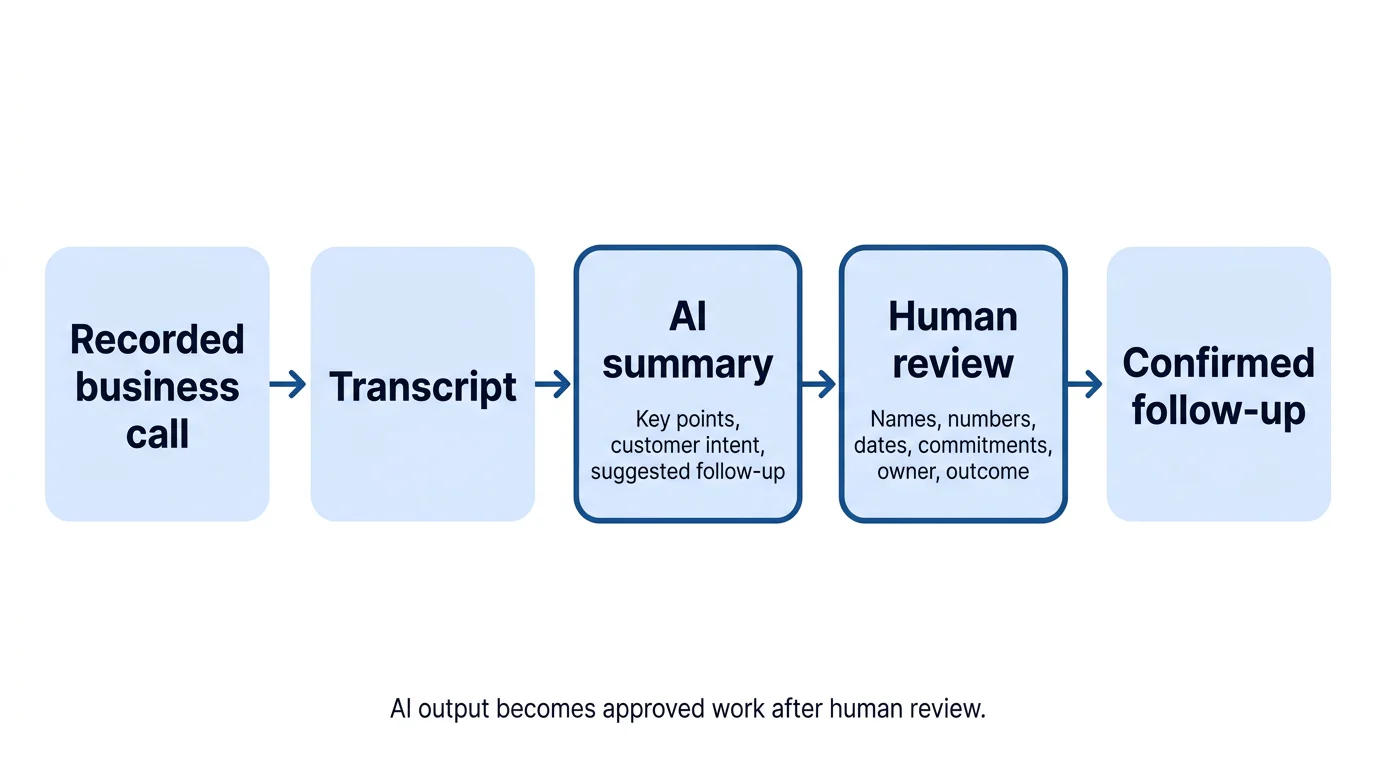
Related terms
Keep reading


Frequently asked
No. A transcript is the written record of what people said during a call, often in speaking order. An AI call summary condenses that record into the decisions, needs, questions, outcomes and possible next steps that a reader needs quickly.
Not by definition. An AI call summary may suggest a next step, but a follow-up is only completed when someone confirms the details, chooses an owner and channel, and carries out the call, message, task or other action.
Check names, phone numbers, dates, quantities, commitments, the call outcome and the proposed owner against the transcript or recording. Review matters most when an error could change a customer promise, appointment, payment, escalation or compliance record.
A short summary is useful for scanning and hand-offs, but it is not the best source for resolving a disputed detail. Sharma and colleagues’ 2024 speech-summarisation research found that transcription errors can reduce the quality of transcript-based summaries.
Turn call context into a reviewable next step
See how a shared business-calling workflow can keep recordings, summaries and follow-up context together.
Talk to Our Expert