


TL;DR
We recommend choosing Hindi code-switching voice AI by completed-call evidence, not by a language-count claim. This guide shows Indian teams how to test Hinglish, accents, critical details, Tier-1 workflows, confidence recovery, and human handoffs, then use the results to select a safe rollout path.
Which Voice AI Handles Hindi Code-Switching?
India had 1,330.58 million telecom subscriptions in March 2026, according to the TRAI dashboard. For a 15-agent call centre, that makes real phone-call performance more important than a polished language demo.
Voice AI for Indian callers should be chosen by completed-call evidence, not a language count. The strongest Hindi code-switching voice AI keeps the conversation intact when a caller changes languages, confirms names and numbers, handles corrections, and hands the transcript and task state to a person when it cannot safely complete the request.
We cover the language tests, scoring rules, transfer checks, and deployment questions an Indian team should use before automating routine calls.
What Must Hindi Code-Switching Voice AI Handle?
Hindi support is a starting point, not a decision. A caller may use Hindi for the request, English for a product name, Romanised Hindi in a reference message, and an English number format when confirming an account. An AI voice agent needs to preserve intent through those changes rather than asking the caller to restart.
The important distinction is between recognition, transliteration, translation, and automatic language detection. Recognition turns spoken words into text. Transliteration changes script. Translation changes language. Detection identifies the likely language. None alone proves the agent can finish a customer task.
| Test Area | A Basic Claim Proves | A Completed-Call Pass Requires | Common Failure |
|---|---|---|---|
| Hindi ASR | Spoken Hindi can be transcribed | Intent and critical details are captured correctly | Misheard names or amounts |
| Hinglish Switching | Two languages are available | The agent retains context after an in-sentence switch | A language reset or irrelevant reply |
| Transliteration | Output can use Roman or Indic script | The correct entity reaches the workflow | Hindi wording becomes an incorrect ID |
| Translation | Speech can be converted to another language | The business meaning survives the conversion | A payment or status term changes meaning |
| Auto-Detection | The system identifies a language | It responds and continues accurately | Detection works, but the next turn fails |
| Regional Speech | A regional language is listed | The specific caller cohort completes the task | Accent, dialect, or borrowed terms fail |
A practical test should include Hindi, Hinglish, and the regions your callers actually use. It should also include addresses, dates, amounts, names, account references, and borrowed English terms, because these are the details that make an automated call useful or risky.
A virtual business number can give a team one shared call path for this work, while making it easier to observe routing, recordings, and transfers before changing how every customer call is handled.
How Do We Test a Hindi Code-Switching Voice AI?
A useful benchmark is a call simulation, not a language checklist. We would test every option with consented call recordings, identical workflow prompts, the same escalation rules, and a scorecard that makes failures visible.
Build Phone-Grade Audio
Use both clear and difficult recordings: normal mobile calls, low-bandwidth audio, background noise, interrupted turns, and callers who correct themselves. The public MUCS paper covered about 600 hours across seven Indian languages, including Hindi-English and Bengali-English code-switching tracks. It is a useful reminder that multilingual speech evaluation needs more than one clean audio sample.
Test Tier-1 Outcomes
Give each call a bounded job: account lookup, delivery or service status, FAQ answer, payment guidance, or ticket creation. Each task should have one known correct outcome and clear limits on what automation may do.
Use a documented data-capture policy to decide which fields need explicit confirmation. Account identifiers, dates, amounts, addresses, and corrections should never be guessed from partial recognition.
Score Completed Calls
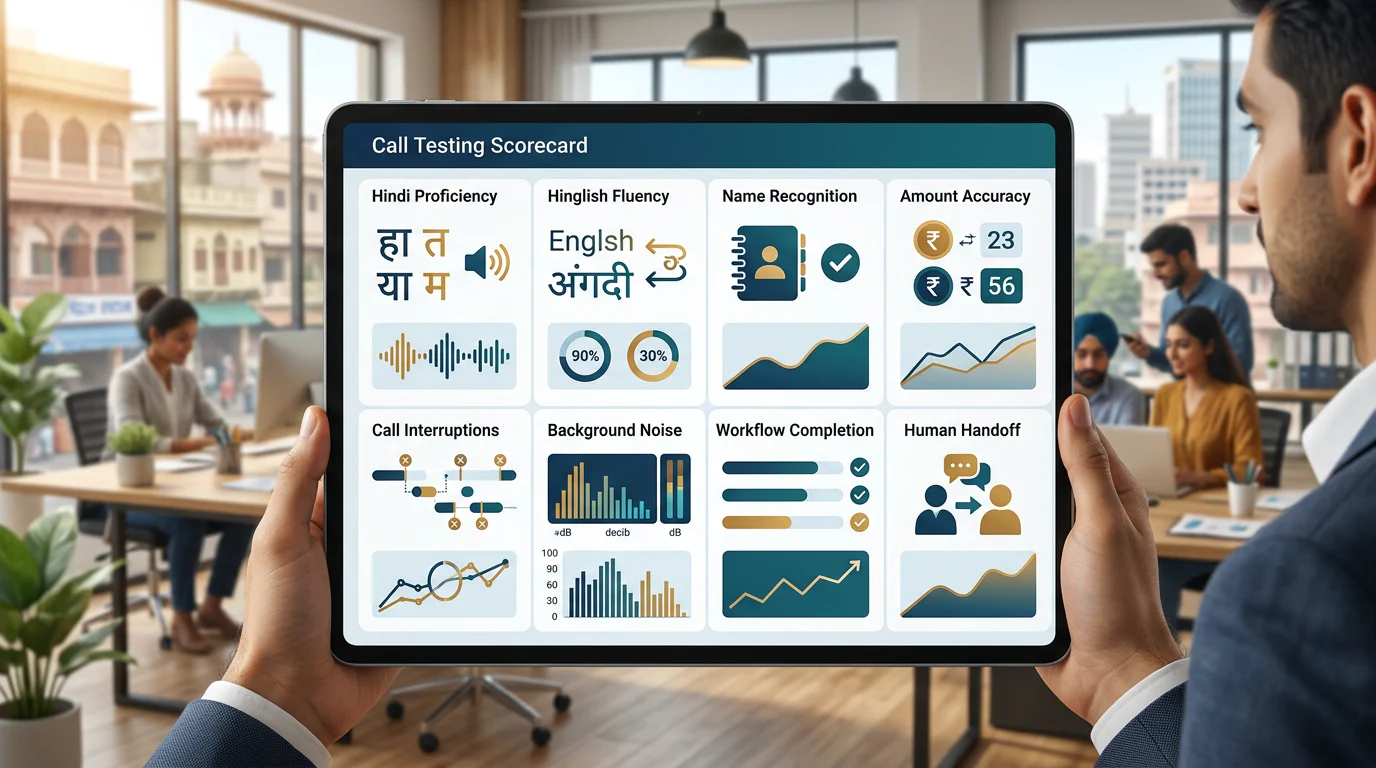
Score intent selection, critical-field accuracy, code-switch continuity, recovery after interruption, final outcome, and safe escalation. Report completion rate separately from critical-field accuracy. A system that answers quickly but creates the wrong ticket is not completing the call.
Record whether a critical field was confirmed, corrected, or inferred. A data capture guide helps turn the score into a reviewable operational record instead of a broad demonstration claim.
Publish Transcript Examples
Show short, anonymised examples alongside the expected result:
- “Mera refund status check karna hai for order AB-2917.”
- “Address Sector 62 hai, sorry, Sector 63, Noida.”
- “Kal ₹2,500 pay kiye the, but receipt nahi aayi.”
These examples reveal whether the system handles a switch, a correction, and a number in the same conversational turn. They also give reviewers a useful AI call insight into why one workflow succeeds while another needs escalation.
Which Capabilities Decide a Completed Call?
The best option is not necessarily the one that advertises the longest language list. It is the option that can show a repeatable pass on your callers, your workflow, and your critical details. Keep claimed support and tested outcomes in separate columns.
| Selection Factor | What To Ask | Evidence That Matters | Decision Signal |
|---|---|---|---|
| Language Coverage | Which exact languages and scripts are supported? | Dated documentation plus call tests | Test every intended region |
| Hinglish Handling | Can callers switch mid-sentence? | Transcript continuity and correct response | No forced language restart |
| Indian Accents | How does it handle local pronunciation? | Samples from your caller regions | Names and locations remain correct |
| Interruptions | Can callers barge in or correct the agent? | Successful repair in recordings | Agent resumes the right task |
| Critical Details | Does it confirm numbers and dates? | Field-level scoring | No guessed account or payment data |
| Human Transfer | Does context move with the caller? | Receiving-agent context check | Caller does not repeat the issue |
| Pricing | What is billed and what is included? | Current public terms or a written quote | Compare total workflow cost |
For an operations team, transcripts and AI call summaries should make the result reviewable. Review a sample of successful calls, transferred calls, and failures by language. That gives managers evidence for whether one cohort is ready to expand.
A decision should also account for the quality of the agent’s voice and its ability to ask a focused clarification. A natural answer that silently misstates an amount or account code is worse than a short pause followed by an accurate confirmation. Record the reason for every failed call, then improve the script, the knowledge source, or the escalation rule before introducing another language cohort.
When Should an Agent Confirm or Transfer?
A phone agent should confirm rather than guess whenever it hears a critical detail with low confidence, receives a caller correction, or reaches an action outside its authority. This is especially important for account lookups, payment guidance, address changes, and tickets that trigger a follow-up.
A safe recovery sequence is simple: explain that the detail needs checking, ask one focused clarification, repeat the confirmed value, then proceed or transfer. If a person is needed, the transfer should carry the caller’s detected language, transcript, verified fields, workflow state, and unresolved question.
| Transfer Stage | Required Action | What The Receiving Person Needs |
|---|---|---|
| Trigger | Caller asks for a person or confidence stays low | Reason for transfer |
| Caller Notice | Explain the handoff in the caller’s current language | Clear expectation of what happens next |
| Context Handoff | Send transcript and confirmed details | Account or ticket context |
| Live Connection | Route to the right queue or team member | Language and workflow priority |
| No-Agent Fallback | Create a callback or ticket after confirmation | Preferred callback language and number |
A reliable CRM phone integration prevents the handoff from becoming a blank screen for the next person. It also makes it possible to audit whether a field was confirmed, corrected, or inferred.
Call recordings and transcripts can contain personal data. The DPDP Act requires organisations to stop processing consent-based personal data when consent is withdrawn, unless another legal basis applies. Define recording notice, retention, access, deletion, and escalation responsibilities before rollout.
Managers should review completion, repeat contact, transfer reason, and failed entity capture by language and workflow. Call analysis turns those reviews into a regular operating process, showing whether automation is improving a real call outcome or only moving work to another queue.
TalkEasy Can Help You Test Before You Scale
At TalkEasy, we give Indian SMBs a practical place to run this test before they expand automation. We combine a virtual business number, AI Call Assist, call recording and history, team management, and an analytics dashboard so your team can review what actually happened on each call. Start with one repetitive Tier-1 workflow, keep people available for exceptions, and review calls by language, entity type, and transfer reason. Our Pro plan includes unlimited users and contacts plus three hours a day of talktime, while enterprise deployments cover customisation and integrations. We will help you map the workflow, define confirmations for critical details, and set a human handoff that preserves the caller’s context. Bring several real calls, including Hinglish, regional speech, corrections, and noisy audio. Then choose the rollout pace using completed-call evidence, not a demo, for your exact callers. TalkEasy AI Biz Number
FAQs on Hindi Code-switching Voice AI
Can a Hindi Voice Agent Handle Hinglish in One Sentence?
Yes. A capable system should preserve the caller’s intent when Hindi and English appear in one utterance, then confirm critical details instead of guessing after the switch.
Is Automatic Language Detection Enough for Indian Business Calls?
Not by itself. Detection can identify a language, but testing must show that the agent retains context, responds naturally, and completes the requested business workflow.
Which Details Should a Voice Agent Always Confirm?
Confirm account identifiers, amounts, dates, addresses, and corrected information. When confidence stays low or a request needs human judgment, route the caller with the context.
What Makes a Human Handoff Seamless?
Pass the transcript, detected language, verified details, workflow state, and unresolved question to the receiving person, who should continue without asking the caller to restart.