
Automotive Call Tracking in India: Count Missed Calls First
Automotive call tracking starts with counting what happens to every call a showroom or workshop receives: picked up, sent to voicemail, dropped on hold, or never called back, over seven days.

By Tej Pandya, Founder · Updated 24 Oct 2026
Key takeaways
- Automotive call tracking in India starts with a seven-day log of every call to one line, scored three ways: not picked up, not reached a person, and not called back.
- The same 100 calls can read as 4%, 36% or 18% missed, depending on the definition. Choose yours before comparing with any benchmark.
- Answering a call is not booking an appointment. In a 2014 US sample, staff made no appointment attempt on 63% of answered calls.
- Knowing which advert made a call needs a separate tool. Our reports count calls and recover missed ones.
In this article
- 1What is automotive call tracking, and which half should a dealership do first?
- 2Why does the same phone line show 4%, 18% or 36% missed calls?
- 3Does an answered call still lose the booking?
- 4How do you run a seven-day call audit on one phone line?
- 5What goes in the call log?
- 6How do you work out the three rates?
- 7How do you check the calls that were answered?
- 8Which fix does each result point to?
- 9How do we run this audit in TalkEasy?
- 10What does call tracking cost in India as of October 2026?
- 11Frequently asked questions
A dealer who asks how many calls the service desk misses gets a different answer depending on who counts. A phone report that treats voicemail as answered shows a small leak. A report that counts only calls a person picked up shows a large one. Both are right for their own definition.
The gap is not small. A Car Wars white paper, reported in July 2026 by the US trade outlet CBT News, puts the average dealership connection rate, meaning calls that reach an employee, at 63% to 65%. That leaves 35% to 37% of callers unconnected. The data is American, but the counting problem is the same in an Indian showroom, a multi-brand workshop or a used-car lot, and your own seven-day log is the benchmark that matters for an Indian line.
This page gives you a seven-day call log, three rates to work out from it, and a table that tells you which fix to make. Tracing a call back to an advert is a separate job, covered near the end.
What is automotive call tracking, and which half should a dealership do first?
Do call handling first. Automotive call tracking means recording what happens to each call a dealership or workshop receives, and it has two halves: call handling and source attribution. Call handling asks whether the call was answered, by whom, how fast, and whether it ended in a booking or a callback. Source attribution asks which advert or listing made the phone ring.
Our recommendation is to do call handling first. It needs no new phone numbers, and it shows whether attribution is your real problem. Money spent on adverts that bring calls nobody picks up is wasted whichever advert it was.
Attribution works by putting a different phone number on each advert or listing. We come back to it after the audit.
Why does the same phone line show 4%, 18% or 36% missed calls?
The same line shows different rates because "missed" has three working definitions: the call rang out, the caller never reached a person, or the caller was never helped. Published studies use different ones, so their numbers cannot be compared with each other or with your line.
Two published examples show the spread:
| Study | Sample | Figure |
|---|---|---|
| 1,000 sampled mobile calls to US dealerships | 16% unanswered | |
| A US dealer network, about 900 million call minutes a year | 63% to 65% connected, so 35% to 37% not (our subtraction from 100%) |
Our worked example shows how one line can produce several numbers. These are invented figures, chosen to show the arithmetic: 100 calls, of which 4 rang out, 12 went to voicemail, 20 hung up on hold and 64 reached a person.
| Definition | Calls counted | Rate |
|---|---|---|
| Not picked up (rang out) | 4 | 4% |
| Not reached a person (rang out, voicemail, hung up on hold) | 4 + 12 + 20 = 36 | 36% |
| Lost and not recovered (not reached, and nobody called back) | 18 of the 36, if half got a callback | 18% |
A phone system that counts voicemail and dropped calls as "answered" would report this line as 96% answered. The caller who waited on hold and gave up would not agree.
We use "not reached a person" as the headline rate. It is the caller's view, and it is the one that moves when you change staffing or routing.
Does an answered call still lose the booking?
Yes. An answered call can still end with no appointment, because answering and booking are different skills. In the Marchex sample above, staff made no appointment attempt on 63% of answered calls and did not ask for contact details on 66%. Of all callers, 74% asked about parts and service and 14% about vehicles. That study is from 2014 and from the US, so read it as a pattern to test, not a benchmark to match.
The Indian evidence is older but points the same way on follow-up. A 2020 Ipsos digital audit of seven mass-market carmakers in India found that 48% of enquirers were contacted, 30% within two hours, and 48% received a follow-up call. Those were online enquiries, so they show follow-up habits, not phone answering.
This is why the audit has a third rate, lost and not recovered. A missed call costs you the sale only if nobody calls back. Our recommendation is one callback attempt within 15 minutes of every missed call, with the outcome written down. How to turn a missed call into a task is in our missed call callback workflow, and the speed question is in lead response time.

How do you run a seven-day call audit on one phone line?
Pick one line, such as the service desk number, and log every call for seven days. Seven days puts each weekday and the weekend in the sample once. If the line gets fewer than about 50 calls in the week (our rule of thumb), run two weeks so the percentages rest on enough calls.
What goes in the call log?
Use one row per call and these columns:
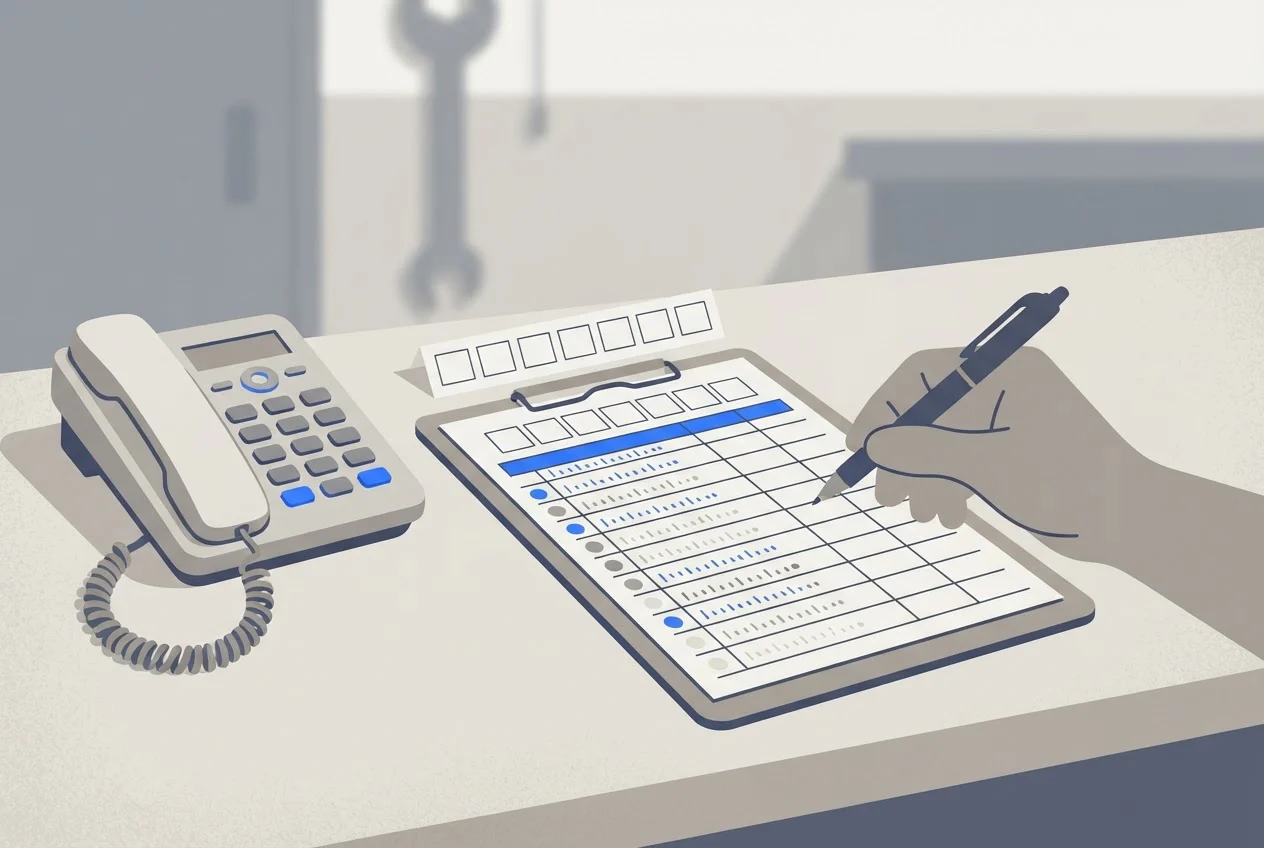
| Column | What to enter |
|---|---|
| Date and time | From the call log |
| Department | Sales, service, parts, or wrong number |
| Outcome | Reached a person, rang out, voicemail, or hung up on hold |
| Seconds to answer | Ring time until a person picked up |
| Callback | Within 15 minutes, later, or never |
| Result | Booked, quote given, status check, or nothing |
A plain phone call history does not show who hung up on hold, so that outcome needs a tracking tool or a staff tally.
For the Result column, use a short list of outcome codes. Our guide to call disposition codes has ten you can copy.
How do you work out the three rates?
At the end of the week, count the rows and use these formulas:
- Not-picked-up rate = calls that rang out ÷ all calls.
- Not-reached-a-person rate = (rang out + voicemail + hung up on hold) ÷ all calls.
- Lost-and-not-recovered rate = not-reached calls with no callback ÷ all calls.
Group the not-reached calls by hour and by weekday. If more than half fall inside two hours of the day, you have a staffing gap at those hours. That threshold is our rule of thumb, not a published standard.
How do you check the calls that were answered?
Listen to 10 answered calls from across the week. A call passes if at least 4 of these 5 are true:
- A person picked up within 20 seconds (about five rings).
- The caller's name and number were taken.
- The vehicle and the problem or model were noted.
- If the caller wanted an appointment, at least two appointment slots were offered. Count this test as passed on calls that did not seek an appointment, such as parts or status checks.
- If nothing was booked, a callback time was promised.
The line passes if 8 of the 10 calls pass. This is our own standard. Adjust the bar once you know your starting point.
Which fix does each result point to?
| What the week shows | Likely fix |
|---|---|
| Not-reached calls cluster in one or two hours | Change the duty roster (rota) or add a person at those hours |
| Most not-reached calls are voicemail | Share the number across more people, and call back automatically |
| Many callers hang up on hold | Add people to answer, or shorten the transfer |
| Answered calls but few bookings | Coach from the recordings, and use the five tests above |
| High lost-and-not-recovered rate | Make one callback attempt a rule, and log it |
Callbacks need a limit as well as a deadline. Repeated chasing annoys customers, so one attempt per missed call, logged, is a sensible default.
How do we run this audit in TalkEasy?
On TalkEasy, your sales desk, service desk and parts counter share one business number, and every call is logged whoever picks up. The Pro plan includes unlimited users, so nobody is left off the number to save cost. You can cancel anytime with no long-term lock-in.
Here is how each step of the audit maps to what we offer:
- Our Sales Call Analytics report shows total calls, answer rate, missed calls, average talk time, peak hours and team performance. It gives daily and monthly views, and you can download it. Use it for the first rate and the hour clusters, then add the department and result columns yourself.
- Call recording and call history are included in Pro. Use them for the 10-call listening check. Tell callers a call is being recorded; our guide to the call recording announcement has wording and a test.
- Missed Call Automation is designed to call the customer back automatically after a missed call. Use it for the callback attempt, and note the outcome yourself.
- AI Call Summaries give a transcript, summary, intent and follow-up information within a couple of minutes, so you can review more than 10 calls.
- If you want your own CRM (customer relationship management) software linked, that is part of the Enterprise plan, which is priced by quote.
We built our reports for counting calls and recovering missed ones. They do not trace a call back to a particular advert. If most of your marketing money goes to two or three sources and you want to know which one earns the calls, add a separate attribution tool after you fix the answering. That is our recommendation, not a rule.
What does call tracking cost in India as of October 2026?
On TalkEasy, the Pro plan costs ₹999 + GST (goods and services tax) a month for unlimited users, and it includes 3 hours a day of talktime, the calling minutes included in the plan. Extra talktime is ₹49 + GST an hour. These are the prices as of 24 October 2026.
Because Pro is not priced per user, a ten-person team pays the same ₹999 + GST a month as a two-person one, before any extra talktime. Enterprise is priced by quote, so ask us if you need unlimited talktime or custom CRM integration.
Run the seven-day call audit on your own line
If you want help running the seven-day audit on your own line, talk to our expert or write to support@groweasy.ai.
Frequently asked questions
Sources
- 1.CBT News: Why dealers are missing 30% of phone opportunities, 21 July 2026
- 2.Automotive Remarketing: Study, dealerships only answering 16 percent of incoming phone calls, 23 September 2014
- 3.Ipsos India: Automakers not 100% digitally ready, 10 August 2020
- 4.TalkEasy pricing, 24 October 2026