
Best Voice AI Alternatives for Conversational SaaS Support
Compare conversational voice AI alternatives for SaaS support by call flow, Intercom context, safe escalation, testing and after-hours telephony.

Best Voice AI Alternatives for Conversational SaaS Support
In India, the total telephone subscriber base reached 1,330.58 million at the end of March 2026, according to TRAI subscriber data. At that scale, an awkward after-hours call experience becomes a support problem quickly, not a minor automation defect.
Choose conversational voice AI alternatives for SaaS support only after they prove they can understand multi-turn requests, stop when callers interrupt, retain corrections, use approved knowledge, and transfer the reason and context to a human. We compare conversation control, Intercom exchange, after-hours escalation, telephony, security and a 12-call test.
How Do You Compare Conversational Voice AI Alternatives for SaaS Support?
A replacement should be judged by the work it completes when a caller changes direction, not by how natural its first greeting sounds. We look for a clear owner for after-hours calls, a usable phone-number setup, reliable escalation, and records that let the daytime team see exactly what happened.
The matrix below separates common platform approaches. Treat every capability as a question for a live test, especially where a provider describes an API connection as an integration.
| Platform Approach | Best Fit | Conversation Proof To Demand | Intercom Approach | Telephony And Handoff | Commercial Pattern |
|---|---|---|---|---|---|
| API-led voice platform | Engineering-led SaaS teams | Interruptions, tool failures, multi-intent calls | API or middleware | Imported number or SIP, custom transfer | Usage-based |
| Managed enterprise voice agent | Large support operations | Security review and measured containment | Scoped integration | Enterprise routing design | Quote-led |
| Visual workflow builder | Operations teams with defined workflows | Corrections across branches | API or middleware | Purchased number, carrier connection or SIP | Subscription or usage-based |
| Speech-first multilingual platform | Indian-language or noisy-audio workflows | Accent, barge-in and noisy-call tests | Custom integration | Enterprise telephony scope | Quote-led |
| Helpdesk-native voice layer | Intercom-centred teams | Knowledge, ticket and handoff continuity | Native workspace context | Phone, forwarding or SIP | Plan eligibility and usage-based |
| Our business-number workflow | Indian SMB support teams | Callback, routing and call-history review | Enterprise-tier customisation | Virtual business number and team routing | Plan-based |
| Custom stack | Teams with specialist requirements | End-to-end observability and failure recovery | Direct object mapping | Buyer-selected carrier or SIP | Component and engineering cost |
We use the phrase AI Voice Agent for the conversational layer, but the full service includes routing, a knowledge source, action permissions, call records and people who own unresolved work. If any one of those layers is vague, the replacement is not ready for an after-hours support line.
What Does Better Conversation Handling Sound Like?
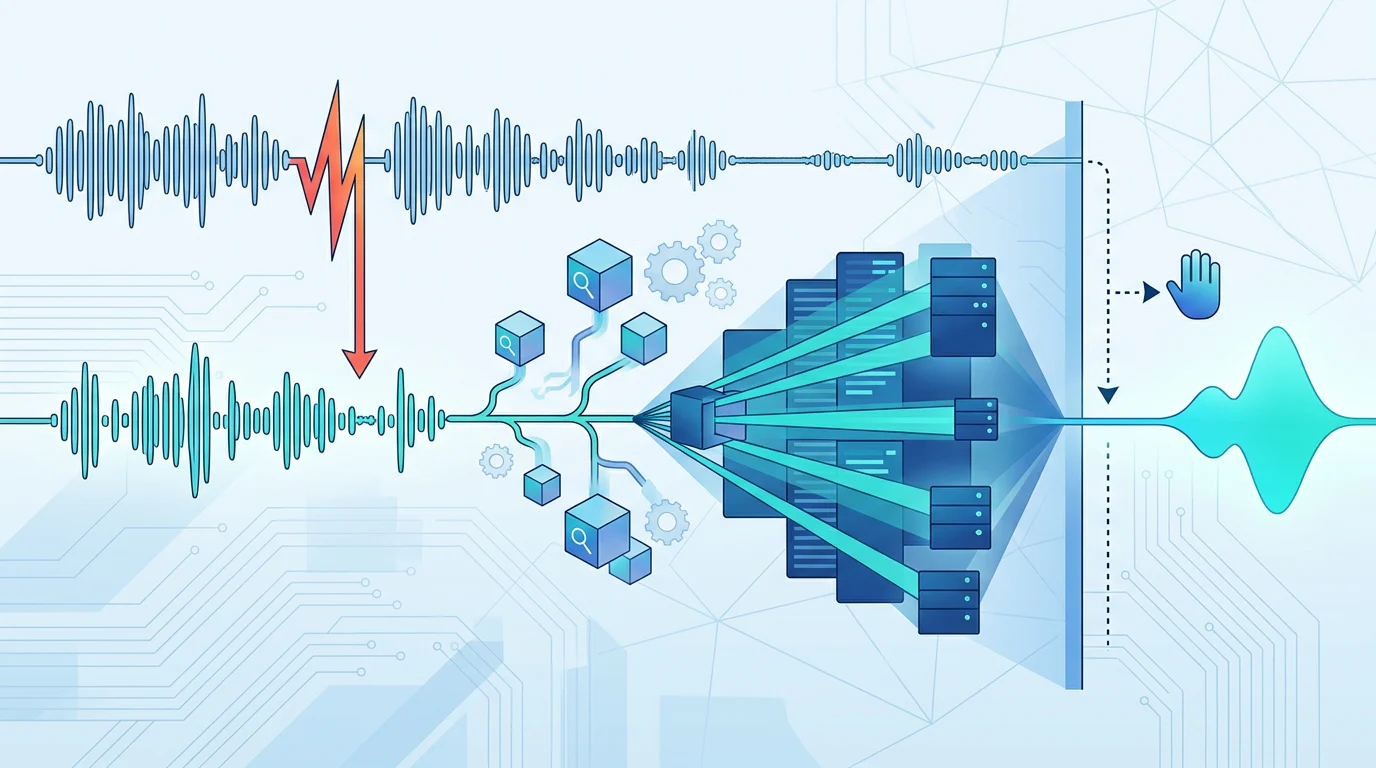
A natural voice is useful, but the real test is whether the system listens at the right moments. A caller may interrupt an answer, correct a plan name, ask a billing question and then mention an outage. A capable agent should acknowledge the change, keep the first issue available, and ask which task matters most now.
Test Turn-Taking and Silence
Measure the delay after the caller finishes speaking, then measure whether the agent stops promptly when the caller speaks over it. Test five, ten and twenty seconds of silence. The right behaviour is not always another question: it may be a brief check-in, a recap, or a graceful offer to call back.
Run the same script with ordinary office noise and with speakers who use Indian English, Hinglish, regional pronunciation, pauses and self-corrections. We recommend recording the audio conditions with every result, so a strong demo on clean audio cannot hide a weak production experience.
Keep Knowledge Answers Grounded
An agent should answer from an approved knowledge base, identify the source version in its internal trace, and say it cannot confirm an answer when the relevant content is absent. It should not improvise account policy, pricing, security advice, or product behaviour.
Intercom explains that correcting a knowledge source can update the answer immediately, which makes source ownership a practical operating task, not a one-time implementation step. See its knowledge source guidance. We pair that approach with AI Call Insights, so recurring wrong answers become visible to the people who maintain support content.
Check Corrections and Multiple Intents
Use a test call where the caller says, “Actually, I meant the annual plan,” after the agent has begun answering about a monthly plan. Then add a second request such as an outage update. The agent should preserve both threads, confirm priority, and avoid forcing the caller to repeat information.
This is where rigid conversational IVR flows often feel clunky. The better replacement handles the correction as context, not as a failed menu selection.
How Should Intercom Context Move During a Call?
Intercom integration should mean more than placing a transcript somewhere after the call ends. Before launch, map exactly what the voice system reads, what it writes, when it writes it, and which action is blocked until the caller is authenticated.
Intercom Data Connectors can map API response fields into contact or company attributes, but a safe voice workflow still needs deliberate identity and authorisation rules. Its data connector guide is useful for planning those fields and the API response shape.
| Object | Voice System To Intercom | Intercom To Voice System | Required Control |
|---|---|---|---|
| Contact | Phone number, verification state, language | Approved contact and company fields | Stable match key and minimum data use |
| Conversation | Transcript, summary, disposition | Relevant prior context | Timestamp and idempotency key |
| Ticket | Escalation reason, severity, callback time | Open-ticket status | Duplicate prevention |
| Knowledge Context | Retrieved source and version reference | Approved answer or live-data result | Traceability and access policy |
| Action Log | API outcome, error and recovery path | Workflow status | Auditable event history |
A native helpdesk voice layer may simplify this map, while other platforms need API or middleware work. Neither route removes the need to decide sync direction. Contact information may be read before a call, while a callback request may be written during it and a summary may be written after it ends.
Use Reliable CRM Call Logging to keep the post-call handoff dependable. A delayed summary is less useful when an on-call teammate needs to understand an unresolved incident immediately.
When Should a Voice Agent Escalate or Create a Callback?
The safest after-hours agent knows when not to act. Public FAQs can be answered from approved content, but account-specific requests need identity checks and limited data access. Sensitive changes, payments, security incidents and unclear entitlement requests should be constrained by a policy that routes to a person or a controlled callback.
An effective escalation carries the caller’s stated problem, completed checks, relevant account identifier, failed actions and requested next step. It should not make the customer repeat the story after waiting through an automated conversation.
-
Authentication: Verify the caller before revealing account-specific information or taking a sensitive action.
-
Restricted Actions: Require a human, an approved workflow, or a second verification step for high-impact changes.
-
Warm Handoff: Send the reason, summary and relevant context before connecting a teammate.
-
No-Agent Recovery: Capture the callback number, promised time window and clear ownership when nobody is available.
-
Failure Recovery: When an API, knowledge lookup or transfer fails, explain the limitation plainly, preserve the request and trigger the fallback path.
Intercom’s phone deployment guidance includes outside-office-hours routing, callbacks, workflow handoffs and call forwarding, which are useful patterns to evaluate in any stack. Review its phone deployment guidance alongside your own escalation policy.
We also use AI Missed Call Agent workflows for situations where a response cannot happen live. The callback should capture enough context for the next person to act, rather than becoming another vague item in a shared queue.
How Do You Test and Buy with Confidence?
We recommend treating every provider demonstration as a starting point. A procurement decision should use recorded calls, a fixed scoring sheet, known failure conditions and the same number path for each option. That approach separates a polished claim from an observed result.
Use a Twelve-Scenario Test Script
Run these twelve scenarios before launch, then repeat them after meaningful changes to prompts, knowledge, telephony or integrations:
- A straightforward password-reset question.
- A caller correction midway through an answer.
- Two separate intents in one call.
- A caller interruption during a longer response.
- Five, ten and twenty seconds of silence.
- Background noise and poor call quality.
- Indian English or Hinglish where relevant.
- An unsupported request that requires a safe refusal.
- An outdated knowledge article.
- An account-specific request before verification.
- An unavailable teammate and callback creation.
- An API timeout, invalid response or failed transfer.
Use AI Call Summaries to preserve the caller’s request, the attempted resolution, the source used and the exact reason for escalation. A useful summary makes the overnight handoff actionable without asking the customer to begin again.
Score the Results, Not the Demo
Record p50 and p95 response delay after the caller finishes speaking, interruption stop-time, intent completion, knowledge accuracy, transfer success, callback creation, and recovery success. Add a transcript, audio file, API trace, source version and final support outcome to every test.
A strong initial result matters, but support teams also need a way to identify regressions after a knowledge-base update or routing change. Compare scores by workflow version and call condition, not just by a single overall percentage.
Ask for Operational Evidence
Ask who owns the phone number, the concurrency limit, uptime reporting, transcript retention, data residency, security review, support response and incident process. Ask whether recordings can be redacted, how data is used, and how a caller’s request is deleted when policy requires it.
We recommend framing those questions through the AI Risk Framework: identify the risk, measure the behaviour, manage the control and document who is accountable. A robust launch plan also records who investigates low completion, failed transfers, abandoned callbacks and inaccurate answers.
Use Call Analytics to review those signals over time. The goal is not to prove that automation can answer every call, but to know exactly when it should answer, escalate, recover or stop.
TalkEasy for After-Hours Call Management
At TalkEasy, we help Indian teams make after-hours customer calls easier to own. We bring a virtual business number, shared call history, AI Call Assist, recordings, team management and analytics into one mobile-first workflow, so the next person can see what happened before returning a call. We do not ask a support team to trust a polished demo. We ask it to define approved answers, escalation rules, callback ownership and the call tests that prove its workflow under pressure. That is especially useful when callers switch language, correct themselves, or reach you outside office hours. Start by mapping your current number, team availability and support handoffs. Then we can help you decide whether a voice agent, a callback flow, or both, fit the job with a clear owner and a record everyone can review the next morning. TalkEasy AI Biz Number
FAQs on Conversational Voice AI Alternatives for SaaS Support
What Makes a Voice AI Alternative Feel Conversational?
A conversational agent remembers caller corrections, handles interruptions without talking over people, asks useful clarifying questions, and preserves task context through resolution, callback creation, or transfer.
Can a Voice Agent Use Intercom Context Safely?
Yes, when identity, permitted fields, sync direction, and action limits are explicitly designed. The agent should retrieve only necessary data and leave an auditable, useful handoff.
How Many Test Calls Should We Run Before Launch?
Use twelve scripted calls covering interruption, correction, noisy audio, account safety, knowledge accuracy, escalation, callbacks, and failed integration recovery. Repeat them after meaningful workflow changes.