AI Receptionist for Hotels in India: Which Calls to Hand Over
An AI receptionist for hotels suits fixed-answer calls such as timings and directions, and should capture details for availability, group and event enquiries while complaints, money disputes and emergencies stay with staff.

By Tej Pandya, Founder · Updated 1 Nov 2026

Key takeaways
- Hand over fixed-fact calls (timings, parking, amenities, directions). Take a callback for availability, group and event calls, and for rate calls unless you approved the wording. Keep complaints, money disputes, emergencies, accessibility needs and anything outside your policy with staff.
- Without a live room and rate lookup, the AI should never promise availability. It should quote a rate only in words you have approved, and otherwise capture the enquiry for a callback.
- Log seven days of real calls before you switch anything on. Your own log, not a general list, tells you which calls to route.
- Judge a pilot on five numbers: answer rate, missed calls, leads captured, transfers and callbacks completed, each compared with your baseline week.
In this article
- 1What should an AI receptionist for hotels take, and what should staff keep?
- 2How do you sort your own enquiry calls in seven days?
- 3Why do rate and availability questions go to a callback?
- 4What should staff receive when a call is handed over?
- 5What does our AI Receptionist cover for a hotel?
- 6How do you run a seven-day pilot with five numbers?
- 7What do you owe guests on call recording and personal data?
- 8Frequently asked questions
A hotel phone rings for six or seven different reasons, and only some of them need a person. The checkout time, the parking question and the road from the station get the same answer every time. A complaint about last night's room does not.
Most advice on AI receptionists assumes a property management system (PMS), the software that holds live rooms and rates. A six-room hotel or a homestay usually has a register, a spreadsheet or an online travel agency (OTA) dashboard instead. Without a live lookup, an AI asked "is Saturday free, and what's the rate?" can only guess, so that call needs different handling.
This page gives you a seven-day log to sort your own enquiry calls, six call types sorted into three groups: hand over, hand over with a callback, and keep. It then covers the handover rules, a pilot with five numbers to check, and the privacy points for guest data.
What should an AI receptionist for hotels take, and what should staff keep?
Give the AI the calls that have one correct answer you can write down today. Keep with staff every call where the answer depends on a decision, a payment or a person's state of mind. Calls in between are captured by the AI and finished by a human.
In the table, "hand over" means the AI handles the call. "Keep" means staff handle it, and the AI only transfers.
| # | Call type | Example | Tag | Rule |
|---|---|---|---|---|
| 1 | Fixed facts | Check-in and check-out times, parking, breakfast hours, directions, house rules | Hand over | The AI answers only from text you have written and approved |
| 2 | Room, tour or package enquiry, including rate and availability | "Is Saturday free? What is a double?" | Availability: capture and call back, the AI never answers. Rate: hand over only in wording you approved in writing, otherwise capture and call back | Capture the enquiry, do not promise a room or a price |
| 3 | Group, wedding, event or corporate-rate enquiry | 12 rooms for a wedding weekend | Hand over with callback | The AI captures the details, staff negotiate |
| 4 | Booking change, cancellation or refund exception | "Can I get my advance back?" | Keep | A policy and money decision belongs to a person |
| 5 | Complaint, billing dispute, emergency, accessibility need, medical issue | "The AC failed and I was charged twice" | Keep, transfer at once | These need judgement and speed |
| 6 | Anything outside policy, or unclear | A request you have never set a rule for | Keep | Default rule: if the call fits no row, a person takes it |
This split is our recommendation, not an official standard. It is deliberately cautious, because a wrong answer to a type 4 or 5 call costs more than a slow answer to a type 1 call.
How do you sort your own enquiry calls in seven days?
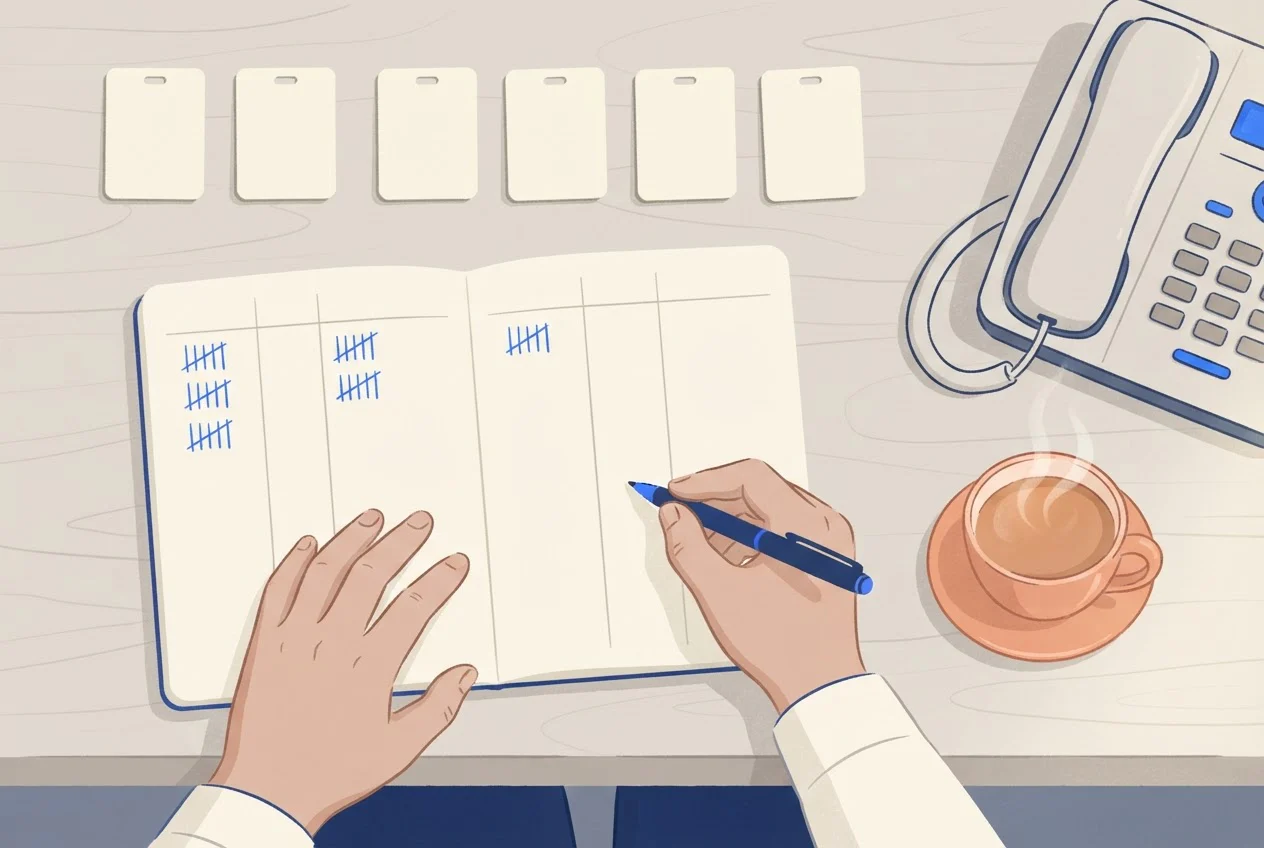
Write down every enquiry call for seven days, tag each with one of the six types above, and mark whether it was answered or missed. After a week you will see which types dominate and where you lose calls. Do this before changing any setting.
Use one line per call with these columns:
| Date and time | What the caller asked (one line) | Type (1 to 6) | Who answered (you, desk, nobody) | Outcome |
|---|
Three habits make the log useful:
- Log missed calls too. A missed call has no type, so write what you think it was from the number and any message. Missed calls are the ones that cost you a guest.
- Note the hour. Check-in rush, late evening and early morning are when a small desk cannot pick up. Mark OTA and travel-agent calls in the outcome column, because they may cluster in your busy hours.
- Tag honestly. If a caller asks about rooms and then asks for a discount, tag the call by the harder part (type 3 or 4), not the easier one.
At the end of the week, count calls per type. A property where type 1 dominates gains most from handing over. Where types 2 and 3 dominate, the gain is in capturing the enquiry reliably and calling back fast. Where types 4 and 5 dominate, the phone problem is service, and an AI will not fix it. For night calls in particular, see our after-hours call answering page.
Why do rate and availability questions go to a callback?
Rate and availability calls go to a callback because an AI receptionist that cannot see your live rooms and rates cannot know either answer. A quoted price is a promise to a guest. A rate that was right last month, or a room that was sold on an OTA an hour ago, becomes a dispute at check-in.
Our AI Receptionist does not check live room availability or rates. That is a limit of what we offer, and it shapes the rule:
- Availability: never answered by the AI. It captures the dates and party size, and a person confirms.
- Rate: answered only in a sentence you have approved in writing, such as "Rates depend on the dates, our team will confirm the exact price today". Do not give it a number unless the number will be true on any date the caller might ask about.
- Everything else on the call: still captured. Name, dates, number of guests and phone number reach you even when the answer waits.
The AI is still useful for these enquiries: the caller is greeted straight away, gets the fixed facts, and leaves with a clear next step. The alternative is a ring that nobody picks up.
What should staff receive when a call is handed over?
Staff should receive the caller's name, dates, party size, phone number, the exact question and what the AI told the caller. With those six items, the person calling back never has to ask the guest to repeat themselves.
Two handover routes cover everything:
- Transfer: the AI connects the call to a person while the caller is still on the line. Use it for types 4 to 6, and whenever the caller asks for a person. Our guide to warm transfer versus cold transfer explains how to pass the details across.
- Callback: the AI captures the enquiry and a person rings back. Use it for types 2 and 3, and when nobody is free to take a transfer. Our missed call callback workflow covers the follow-up step.
Decide in advance who takes each route and by when. A callback with no owner is a missed call with extra steps. We suggest a deadline you can keep on a bad day, such as "before the end of the same day for every captured enquiry".
What does our AI Receptionist cover for a hotel?
Our AI Receptionist answers calls, works out why the caller is ringing, answers the frequently asked questions (FAQs) you give it, captures names, numbers and requirements, and either connects the caller to the right team member or schedules a callback.
For a hotel, that maps to the table like this:
- Type 1: answered from the FAQs you set.
- Types 2 and 3: the enquiry is captured, and the callback is booked.
- Types 4 to 6: the call is transferred to staff.
After each call, our AI Call Summaries produce a transcript and a short summary within a couple of minutes, covering the customer requirement, the questions asked, the next follow-up and the call outcome. Our call analytics report total calls, answer rate, missed calls, talk time and peak hours, and the reports can be downloaded. If your team misses a call, our missed call automation can call the customer back automatically once you switch it on in settings.
As of November 2026, our Pro plan costs ₹999 + GST a month with three hours of talktime a day, and extra talktime is ₹49 + GST an hour. Customers can cancel anytime. Customer relationship management (CRM) integration is Enterprise-only and quote-only. This page is about phone calls only.
How do you run a seven-day pilot with five numbers?
Run the AI on the call types you tagged as hand over for seven days, keep the same log, and compare five numbers with your baseline week. Review every call in the pilot, because a small property has few enough calls to read them all.
| Number | How to count it | Pass | Fail |
|---|---|---|---|
| Answer rate | Calls answered divided by calls received. Baseline: from your log; pilot: from our call analytics | Answer rate at least 10 percentage points above baseline in your three busiest hours (our suggested threshold) | Less than 10 points above baseline in those hours |
| Missed calls | Calls nobody or nothing answered | Fewer than baseline in the same hours | No change |
| Leads captured | Type 2 and 3 calls where name, dates, party size and number were all recorded | Every such call has all four | Any lead missing one of the four |
| Transfers | Calls passed to a person | Every transfer is a type 4 to 6 call or a caller who asked for a person | A type 1 call was transferred, which means an approved answer is missing |
| Callbacks completed | Callbacks promised against callbacks done and logged | Every promised callback has a logged outcome by the deadline you set | Any callback left open past the deadline |
Then apply two rules, which are our recommendation:
- If a type 4, 5 or 6 call was dealt with by the AI beyond a short acknowledgement and transfer, narrow what you hand over.
- If many type 1 calls were transferred, write the missing answers and run the week again.
Use the summaries to read each call quickly, and listen to the recording whenever a summary and your tag disagree.
What do you owe guests on call recording and personal data?
We recommend telling callers at the start of the call that it may be recorded, and handling the name, number and travel dates you capture as personal data under India's Digital Personal Data Protection Act, 2023 (DPDP Act). Our recording setup plays an announcement at the start of the call.
As of 1 November 2026, the notice, safeguards and erasure duties below are not yet in force.
The Act's text sets these duties, which apply to a business that decides why and how guest data is used:
- Notice: a request for consent must come with, or after, a notice stating the data being collected, the purpose, how the person can exercise their rights and how to complain to the Data Protection Board (section 5(1) of the DPDP Act). Under section 7(a), personal data a caller volunteers for a stated purpose, such as an enquiry, is a legitimate use, so a notice may not be required for those details. Notice is needed when you ask for consent or use the data for other purposes.
- Safeguards: you must take reasonable security safeguards against a personal data breach, including for processing done for you by another party (section 8(5)).
- Erasure: erase the data once the person withdraws consent or the purpose is served, unless a law requires you to keep it (section 8(7)).
- Penalty: the Act's Schedule says a breach of the safeguards duty may be penalised by up to ₹250 crore. That is a ceiling, not a typical outcome.
In practice, we recommend three habits: keep enquiry records only as long as you need them, limit who can open recordings, and never let a phone call collect card numbers or ID numbers.
Talk to Our Expert
Frequently asked questions
We have not published a list of languages for the AI Receptionist, so do not assume Hindi or Hinglish (mixed Hindi and English) support. Ask us for a test call in the languages your guests use and judge it in your seven-day pilot. Our guide to AI receptionists in India covers the basics.
Sources
- 1.Digital Personal Data Protection Act, 2023, Ministry of Electronics and Information Technology (MeitY), Government of India
- 2.DPDP Rules, 2025 Notified, Press Information Bureau, Government of India, 17 November 2025
- 3.TalkEasy AI Receptionist