


TL;DR
We help remote sales teams choose a business phone dialer by matching the dialling mode to the sales motion, then enforcing local-time rules, CRM write-backs and consent controls. This guide compares click-to-call, power, parallel and predictive approaches, maps a three-time-zone workflow, and gives a practical path for growing from five to 20 reps without disrupting active campaigns.
Business Phone Dialer for Remote Sales Teams: Which Fits Best?
Distributed outbound calling needs discipline as much as speed. In 2025, telecom enforcement activity in India included over 7 lakh notices and 5.6 lakh restrictions related to spam telemarketing, according to TRAI’s 2025 update. That makes local calling windows, consent records and suppression rules part of the sales workflow, not a late compliance task.
A business phone dialer for remote sales teams should combine local-time calling rules, CRM synchronisation, voicemail and dead-number handling, regional number controls, and centralised reporting. Use click-to-call for research-led follow-up, power dialling for paced list work, parallel dialling for live-conversation volume, and predictive dialling only with mature compliance governance.
We will compare the modes, show how a three-time-zone workflow works, identify what causes spreadsheet dialling waste, and map a safe rollout from five to 20 reps.
Which Business Phone Dialer for Remote Sales Teams Fits the Work?
The right choice starts with the sales motion, not headcount. A five-person team making researched callbacks may need more context per call than a larger team working a clean, time-sensitive prospect list. The dialler should remove mechanical work while preserving ownership, history and a clear next action.
Use this mode table as the first filter. A feature only matters when it supports the way the team actually sells.
| Dialling Mode | How It Works | Best Sales Motion | Primary Control |
|---|---|---|---|
| Click-to-Call | A rep starts one call from the contact record | Research-led follow-up, accounts and callbacks | Required outcome and next task |
| Power Dialling | The next call starts sequentially after the previous attempt | Structured SDR lists and paced outreach | Attempt cap and local calling window |
| Parallel Dialling | Several prospects are called at once, then a live answer connects | Clean, high-volume prospect lists | Human-answer detection and cancelled-call workflow |
| Predictive Dialling | The system changes pace based on expected availability | Mature, high-volume operations | Consent, abandonment and jurisdiction controls |
We built our business dialer around click-to-call because some teams need to retain the conversation context after every outreach attempt. It suits follow-up-heavy sales motions where notes, recordings and ownership matter more than automatic list progression.
Which Dialling Setup Matches Your Team’s Constraints?
A comparison should reveal trade-offs, not pretend every team needs the same stack. Start by deciding whether the work requires one deliberate call at a time, rapid live-answer volume, or a controlled mix of both.
The matrix below is designed to be sortable on a published page. It compares the practical controls a remote team should verify during a trial, including those that are often hidden behind a sales demo.
| Setup Type | Dialling Modes | Time-Zone Logic | CRM Workflow | Compliance And Reputation Controls | International Reach | Verified India Pricing | Best Fit |
|---|---|---|---|---|---|---|---|
| Our Click-to-Call Workspace | Click-to-call, one contact at a time | Team-owned queue and working-hour rules | Call history, recordings, notes and summaries | Recording announcement, role-based access and internal workflow controls | India-first workflow | ₹999 + GST/month for Pro | Indian follow-up teams needing shared calling context |
| Structured Power Platform | Click-to-call and sequential power dialling | Business-hour and local-time controls to test | Contact, call outcome and task write-back | Consent fields, retry caps and suppression checks to test | Confirm country routes before launch | India rate not publicly quoted | Teams moving from manual lists to paced automation |
| High-Volume Parallel Platform | Power and parallel dialling | Queue-level window controls to test | Bi-directional activity sync to test | Voicemail detection, number rotation and reputation monitoring to test | Confirm local-number availability | Quote required | SDR teams with clean lists and trained managers |
| Predictive Enterprise Platform | Power, parallel and predictive dialling | Campaign-level schedule controls to test | CRM and sequence synchronisation to test | Consent evidence, pace monitoring and exception reporting | Confirm supported regions | Quote required | Mature operations with formal governance |
A shared virtual business number can give remote reps one professional calling identity, but it does not replace a dialling strategy. Before selecting a platform, test whether its number type, recording process, calling permissions and reporting all match the markets the team serves.
How Should a Remote Team Automate Calling Across Three Time Zones?
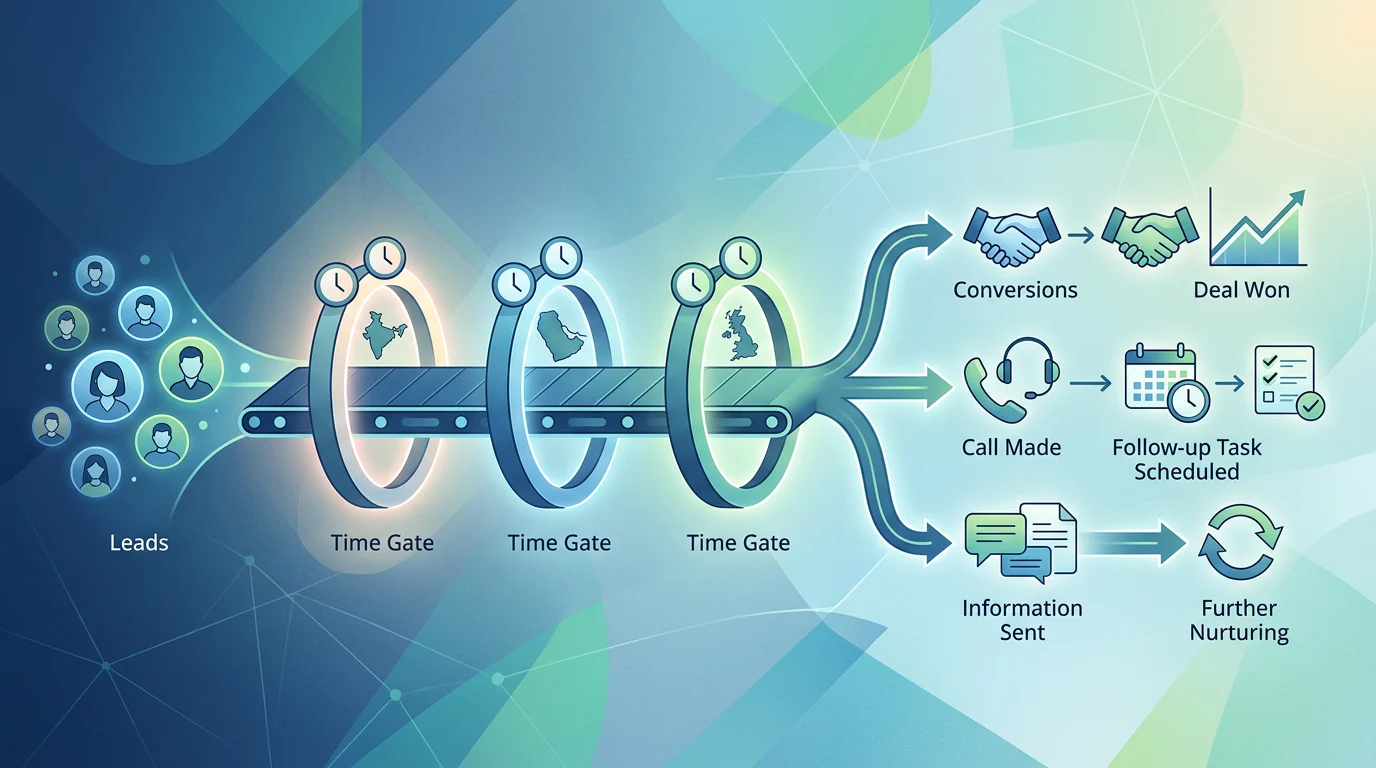
Timezone automation is a queue design problem. Each record needs a contact timezone, owner, consent status, last outcome, next eligible attempt and sequence status before a rep sees it. The TCCCPR framework centres commercial communication on recipient preferences, so a remote team should treat local timing and suppression as mandatory data fields.
Assign the Queue Before the Rep
Assign each lead to one owner and one operating region. Avoid shared spreadsheets where two reps can call the same record because neither can see the other’s activity in real time.
The queue should also define what happens after a missed call, a voicemail, a rejected call and a no-answer attempt. A dialler that only increases call volume without controlling ownership creates duplicate outreach.
Gate Every Call by the Contact’s Local Time
The rule should use the prospect’s local time, not the rep’s clock. Store local calling windows in the queue and pause records that are outside the permitted period.
| Lead Timezone | Permitted Local Calling Window | Primary Coverage | Outside-Window Action |
|---|---|---|---|
| IST | 09:30 to 18:30 | India team | Queue the next eligible slot |
| GST | 09:30 to 18:30 | Gulf coverage | Hold until the local window opens |
| BST | 09:30 to 18:30 | UK coverage | Reserve for the later rep block |
Write Outcomes Back Without Rework
Every call should return the same minimum record: contact, owner, outcome, recording reference, disposition, next task, opt-out status and sequence state. A reliable CRM call integration prevents a rep from making the call and then rebuilding the same context manually.
A sync failure needs its own exception queue. Do not allow a campaign to keep moving when the contact history, call outcome or follow-up task has failed to reach the team’s system of record.
Control Voicemail, Dead Numbers, and Reputation
Voicemail detection should send a record into an approved voicemail or follow-up path. Dead numbers should be tagged and removed from the active queue, not repeatedly retried. No-answer records need a next eligible time, while opt-outs and internal do-not-call records must be suppressed immediately.
Number reputation deserves the same operational attention. Repeated calls from one number, poor list quality and weak suppression logic can create avoidable risk, so teams should monitor how number use, activity spikes and complaint patterns affect deliverability.
Why Does Spreadsheet Dialling Drain Sales Productivity?
Manual dialling loses time in small fragments: copying numbers, listening for voicemail, finding the right record, writing notes, setting reminders and checking whether someone else already called. Those fragments become a major drag when the whole team works from disconnected data.
Measure the problem for five working days before changing tools. Track attempts, live answers, voicemail, dead numbers, manual admin time, duplicate records, CRM sync failures and completed follow-ups. That baseline will show whether the team needs faster calling, cleaner data, stronger ownership or all three.
The Telecommunications Act provides for user-protection measures, including consent and Do Not Disturb provisions. That is why list hygiene must connect to a real suppression process, rather than relying on a rep to remember which contacts should not be called.
Keep the post-call record usable with AI call summaries, especially when a remote manager needs to understand a conversation without asking the rep to recreate it. The outcome, next step and customer context should stay together for the next call.
How Can a Team Scale from Five to 20 Reps Without Downtime?
A safe migration keeps active campaigns stable while the new workflow proves itself. Do not switch every rep at once, especially when the current queue contains live callbacks or qualified leads.

Prepare the Data and Rules
Export the active list and deduplicate it before import. Preserve owner, timezone, consent state, last disposition, next task and sequence stage. Define the required outcome list before anyone starts calling.
Number hygiene must also have a clear owner. Review every active number, define an escalation path for complaint patterns, and ensure the team knows when a calling pattern needs to be paused instead of repeated.
Build internal do-not-call rules into the import process. Managers should also review the conditions that contribute to business number spam labels, including uncontrolled retries and inconsistent calling patterns.
Pilot a Non-Critical Campaign
Start with two reps and a small, non-critical segment. Test answered calls, voicemail, dead numbers, callbacks, opt-outs, call recordings and failed CRM write-backs. The aim is not volume, it is proof that every outcome lands where it should.
Add Reps in Controlled Cohorts
Move from two reps to five, then 10, then the remaining users only after each cohort can complete the workflow cleanly. Keep the old workflow available until the new queue has stable ownership and reporting.
Review attempts, conversations, follow-up completion and disposition quality together in call analytics. If a manager cannot find the call, outcome, owner and next task quickly, the migration is not ready for the next cohort.
Run a Final Go or No-Go Check
Before moving active campaigns, confirm that local-time windows work in every region, internal do-not-call records suppress correctly, recordings follow the team’s access rules, number reputation is monitored and a rollback owner has the prior export.
TalkEasy for Remote Sales Follow-Up Teams
Choose TalkEasy when your team needs a shared business calling workspace without turning every follow-up into a separate spreadsheet task. We bring one-tap calling, recordings, call history, team visibility and AI-assisted summaries into the daily motion, so managers can see the outcome and reps can act on the next step.
For a five-to-20-rep rollout, start with one active workflow, a clear contact owner and a disciplined disposition set. Our Team Centre keeps the calling context available to the people responsible for follow-up, while our call history helps managers review execution without asking reps to reconstruct the day. We can help you map your business number, team roles, recordings, routing and reporting around the sales motion you actually run. Start small, confirm each handoff, then add teammates with the same rules. Talk to our expert and begin with TalkEasy AI Biz Number
FAQs on Business Phone Dialer for Remote Sales Teams
Which Dialling Mode Works Best for Remote Prospecting?
Use power dialling when reps need controlled, one-at-a-time list progression. Use parallel dialling for clean, high-volume lists, and click-to-call when research and context matter most.
How Do We Stop Calls Outside Local Hours?
Store the contact’s timezone, consent state and next eligible time in a shared queue. Configure the dialler to block out-of-window calls and schedule the permitted attempt.
What Must Sync to the CRM After Each Call?
Synchronise contact, owner, call outcome, recording reference, disposition, next task, opt-out status and sequence state. Route failed write-backs to a manager-owned exception queue for resolution.