
Glossary
First Call Resolution (FCR)
First call resolution (FCR) is the share of issues solved on the first call, with no repeat call about the same issue. The count depends on the repeat window you choose.

By Tej Pandya, Founder · Updated 4 Nov 2026
Also called FCR
On this page
- 01Definition
- 02Quick facts
- 03What does first call resolution mean, and how do you calculate it?
- 04Why does the repeat window change your FCR so much?
- 05How do you count first call resolution from a week of calls?
- 06What is a good first call resolution rate?
- 07How can first call resolution look better than it is?
- 08What is first call resolution confused with?
- 09How TalkEasy handles it
- 10Example
- 11Related terms
- 12Frequently asked
What is first call resolution?
First call resolution (FCR) is the percentage of customer issues fully solved on the first call, with no repeat call or callback needed. Divide issues solved on the first call by all issues, then multiply by 100.
Key takeaways
- FCR is the percentage of issues with no repeat call in your chosen window, out of all issues: (issues with no repeat call ÷ all issues) × 100.
- The repeat window matters more than the formula. In a ten-caller example the same calls score 90%, 80% or 60% at 2, 7 or 30 days.
- Published averages of 71% to 75% are for reference only; set your own baseline from four weeks of calls.
- A high FCR can hide early call endings and promised callbacks, so spot-check the calls you counted as resolved.
Quick facts
- Formula
- (issues with no repeat call ÷ all issues) × 100
- Channel covered
- Voice calls only; counting every channel gives first contact resolution
- Recommended window
- 7 days for ordinary price, booking and delivery enquiries; 30 days where an issue takes weeks to settle, such as a refund
- Published averages
- 71% (SQM Group) and 75% (TechTarget)
- Minimum sample
- At least 50 issues in total
Two teams can take the same week of calls and report an FCR of 90% and 60%. Neither has miscounted. One waits two days for a customer to ring back about the same problem. The other waits thirty.
The repeat window, the number of days you watch for the same caller to ring back, can move the number by 30 points on the same calls, as the example below shows. What counts as "first" and what counts as "resolved" need deciding too.
A small team on one business number usually has no survey tool or ticketing system. It has a call history, and the steps below need only that and a spreadsheet. You finish with a pass or fail for every issue, one FCR figure for the week and a baseline to beat the next. This page shows how to count FCR from that history, with a worked example, a sheet you can copy and a check that stops the number flattering you.
What does first call resolution mean, and how do you calculate it?
First call resolution (FCR) is the percentage of customer issues fully solved on the first call, with no repeat call or callback needed. Divide issues solved on the first call by all issues, then multiply by 100. If 40 of 50 issues in a week are solved first time, FCR is 80%.
Three words in that definition hide choices:
- "First" means the first call about that issue, not the customer's first call ever.
- "Call" means voice only. Counting chat, email and every other channel gives first contact resolution, a wider measure (Wikipedia).
- "Resolved" means the caller did not need to come back or wait for a callback.
Why does the repeat window change your FCR so much?
The repeat window is the number of days you watch for the same caller to ring back about the same issue. Windows differ by call type: one example treats status enquiries as settled after 5 days, while claims can take up to 30 (TechTarget, 24 July 2024).
Same ten calls, three repeat windows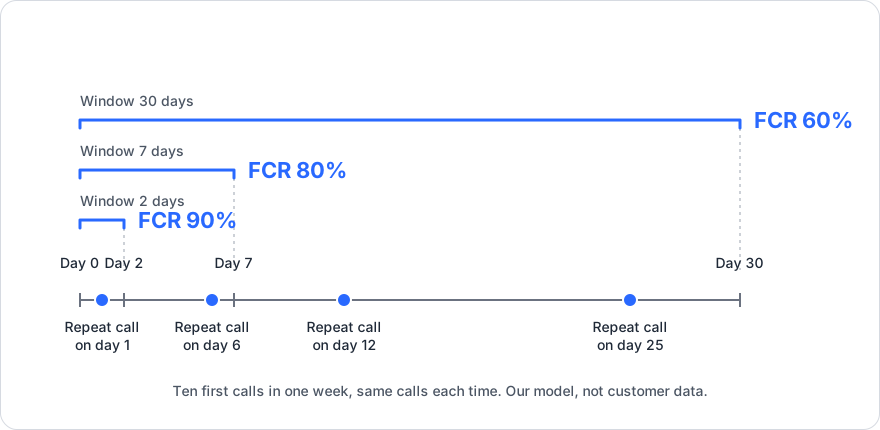
Here is how much that matters. The table is a model with ten invented first calls in one week, not customer data. Four callers ring back about the same issue, after 1, 6, 12 and 25 days.
Use 7 days for ordinary price, booking and delivery enquiries. Use 30 days only where an issue takes weeks to settle, such as a refund. Pick one window and never change it when you compare weeks.
- Window
- 2 days
- Callers who rang back inside it
- 1
- FCR
- (10 − 1) ÷ 10 = 90%
- Window
- 7 days
- Callers who rang back inside it
- 2
- FCR
- (10 − 2) ÷ 10 = 80%
- Window
- 30 days
- Callers who rang back inside it
- 4
- FCR
- (10 − 4) ÷ 10 = 60%
How do you count first call resolution from a week of calls?
Score every issue in one week as pass or fail against one repeat window, then spot-check the passes. You need a week that ended at least 7 days ago, so every call has had the full window.
- List the issues. One row per issue, with caller number, date, topic in a few words and outcome. Merge repeat calls into the first call's row and mark it fail. Count a caller who rings from a second number only if you can match them by name or topic.
- Look forward 7 days. Search the call history for the same number. Pass: no later call on that topic. Fail: any later call on that topic, or a first call that ended with the caller told another team or a callback would follow. A transfer passes only if the caller's question was answered before they hung up.
- Calculate. FCR = passes ÷ rows × 100. Repeat call rate is 100 minus FCR.
- Spot-check five passes. Read the summary or play the recording. Pass: the caller's question was answered before they hung up. Fail: any call where it was not. Review those calls before you trust the number.
- Keep going for four weeks. Your own average becomes your baseline. Use at least 50 issues in total: one repeat then moves FCR by 2 points (1 ÷ 50), not the 10 points it moves with ten issues.
Copy this layout into a spreadsheet, one row per issue. A "Y" in the repeat column is a fail.
caller number,date,topic,outcome,repeat call within 7 days (Y/N),pass/fail,spot-checked
FCR cell, with pass/fail in column F: =COUNTIF(F2:F200,"Pass")/COUNTA(F2:F200)*100
What is a good first call resolution rate?
SQM's 71% average comes from post-call surveys and AI quality scoring across 500+ contact centres worldwide, not repeat-call counts, and is not specific to India. SQM treats 80% or more as the level reached by only about 5% of those centres (SQM Group, updated August 2026). TechTarget gives 75% as a typical average for companies (TechTarget).
Do not set those figures directly against your sheet. Beat your own four-week baseline first.
How can first call resolution look better than it is?
FCR counts the absence of a repeat call, so anything that stops a repeat call being logged raises it, whether or not the problem is solved. Three causes are common:
- Calls ended early to protect the number.
- Late returns. A caller who rings back on day 8 of a 7-day window, or never returns, is invisible.
- Merged repeat calls. Folding a repeat caller into the original row without marking it a fail means a second call about the same problem is never counted against you.
Step 4 above is the guard. Read FCR next to average call duration and call abandonment rate: a team that ends calls fast and drops callers will not show it in FCR alone.
What is first call resolution confused with?
FCR is confused with four neighbouring measures:
- First contact resolution counts every channel, not only calls.
- Repeat call rate is the flip side of FCR in the method above.
- Call disposition is the outcome label on each call, and consistent labels make step 1 faster. See call disposition codes.
- Call centre KPIs (key performance indicators) put FCR beside the rest; see call centre KPIs for a small Indian team.
How TalkEasy handles it
On TalkEasy, the shared call history shows every teammate the same calls and recordings on one business number. Each call gets an AI Call Summary within a couple of minutes, with customer intent, suggested follow-up and call outcome, which fills the topic and outcome columns without replaying the recording. The downloadable call analytics reports (daily and monthly) show total calls, answer rate and missed calls; filter the dates to the week being scored. Missed Call Automation is designed to call customers back after a missed call. Count a callback you triggered as a failed first call, never as a pass. Our missed call callback workflow page covers when to create a task. As of November 2026, Pro costs ₹999 + GST a month, with three talktime hours a day.
Example
Take ten first calls in one week, where four callers ring back about the same issue after 1, 6, 12 and 25 days. Scored with a 7-day window, only two of those repeats count, so FCR is (10 − 2) ÷ 10 = 80%.
Frequently asked
Sources
- 1.SQM Group: First Call Resolution benchmark, SQM Group, August 2026
- 2.TechTarget: What is first call resolution (FCR)?, TechTarget, 24 July 2024
- 3.Wikipedia: First call resolution, Wikipedia
Questions about first call resolution?
Ready to see your own repeat callers? Talk to our team or write to support@groweasy.ai.