


TL;DR
HVAC missed-call text-back can work without number porting when the carrier can surface the required call event and a compliant sender handles two-way replies. We show how to choose forwarding, porting, or a new number, define safe triggers, assign ownership, meet Indian messaging obligations, and pass five live acceptance tests before launch.
Can HVAC Missed-Call Text-Back Work Without Number Porting?
A Government of India update reported that India’s DLT system blocked more than 7.5 crore communications per day on average in December. For a small HVAC crew, that makes a recognised sender, a clear purpose, and a reliable handoff more important than simply sending another automated message.
Yes. HVAC missed-call text-back without number porting can work when your carrier can forward the relevant call condition or expose it to your phone platform, and a compliant SMS sender can accept replies. The result depends on who owns SMS, what counts as missed, and who takes over. Test every fallback before going live.
This guide compares the workable routes, explains the ownership questions that decide them, and gives a no-code build plus acceptance test. An AI Missed Call Agent belongs only after the original number and reply ownership are clear.
Which Route Keeps Your Existing Number?
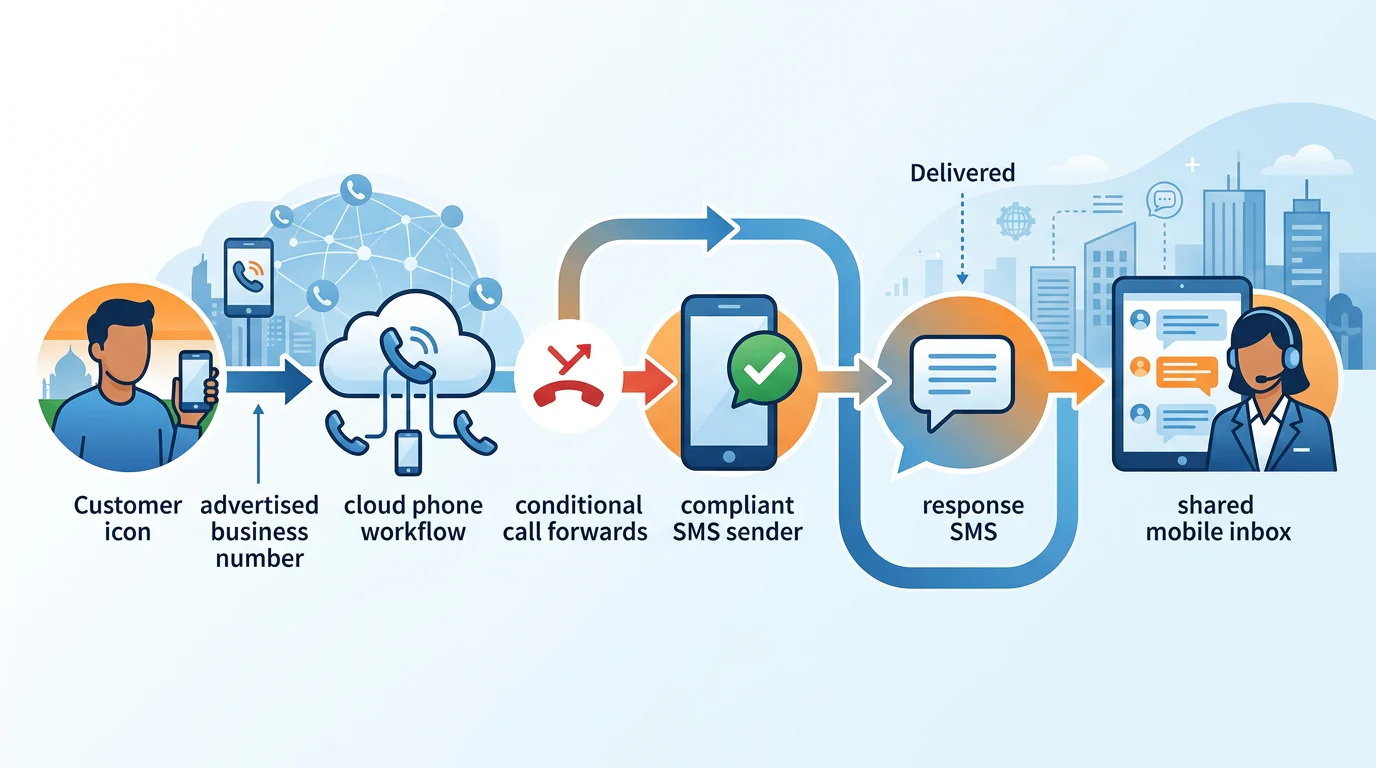
Keeping the number on your van, website, and Google Business Profile is not the same as keeping every part of its phone setup unchanged. A no-port setup works only when the original call can reach an observable destination and the customer’s reply lands with a real person.
Compare the Three Routes
The Indian mobile licence framework lists call forwarding for busy, no reply, and not reachable conditions, but that does not mean every carrier, plan, or number type exposes the same event data. Treat licence framework support as a reason to test forwarding, not as a promise that a text-back rule can see every missed call.
| Route | What Stays The Same | Best Fit | Main Limitation |
|---|---|---|---|
| Conditional forwarding | The advertised voice number remains with its carrier | You can forward no-answer or busy calls to a workflow that identifies the caller and sends replies | A forwarded leg may not preserve the event, caller identity, or reply path you need |
| Number porting | Customers can keep dialling the same number after cutover | You need one phone platform to control voice events and same-number SMS | Porting adds coordination, timing, and post-cutover testing |
| New messaging number | The advertised voice number stays unchanged | You can clearly introduce a separate SMS conversation number | The customer may not recognise the sender as the number they dialled |
For a three-person team that wants the least disruption, start with conditional forwarding. If it cannot show the original caller, suppress duplicates, and receive replies in a shared inbox, move to porting or disclose a separate messaging number instead of hiding the gap.
Check the No-Code Capability Matrix
| Option Type | Existing-Number Forwarding | SMS And Reply Ownership | Mobile Access | No-Code Decision |
|---|---|---|---|---|
| TalkEasy | Confirm for the carrier and number type before launch | Confirm the sender identity and shared reply path | Android app available | Use after the full acceptance test passes |
| Carrier-Forwarded Workflow | Carrier-dependent | May be separate from voice ownership | Depends on the inbox provided | Best low-disruption route when all five tests pass |
| Ported Virtual Number | Available after cutover | One provider can own voice and messaging | Depends on the chosen app | Use when same-number control matters most |
| Separate Messaging Number | Voice number remains unchanged | Replies use the separate messaging identity | Depends on the inbox provided | Use only with clear customer-facing disclosure |
A Virtual Business Number can simplify long-term routing, but it should follow the operational decision, not replace it.
Who Owns Voice, SMS, and Replies?
Call forwarding moves a voice call. It does not automatically transfer the right to send messages from that same number, receive customer replies, or give every technician access to the conversation. Those are separate decisions, and each one needs an owner.
In India, the sender side matters. TRAI’s sender guidance describes registered headers, content templates, principal entities, and consent records as parts of the commercial messaging framework. The exact classification of a missed-call response depends on its purpose and provider setup, so do not turn one customer interaction into an unapproved promotional sequence.
Map the Five Owners
- Voice Number Owner: The person or account that can change carrier settings, voicemail, and forwarding rules.
- Call Event Owner: The system that can prove whether a call rang out, was busy, reached voicemail, or failed to forward.
- SMS Sender Owner: The approved sending identity, template configuration, and delivery records.
- Reply Inbox Owner: The shared place where a customer response appears, with mobile access for the right people.
- Callback Owner: The named person responsible for the next human call, not an unnamed “office” queue.
A shared inbox is useful only if the people on duty can see context, assign work, and act quickly. Build that responsibility into Team Collaboration, including weekday, after-hours, and weekend ownership.
Keep the Customer’s View Coherent
Customers care less about telecom architecture than about whether the message identifies the business and whether somebody replies. If the text comes from a different sender than the number they dialled, say who you are immediately and make the next action obvious.
Before enabling automation, answer four questions: Which account changes forwarding? Which account sends the first text? Where does a reply appear? Who calls back if the SMS cannot solve the request? If any answer is unclear, the system is not ready for live leads.
HVAC Missed-Call Text-Back Without Number Porting: Which Events Trigger It?
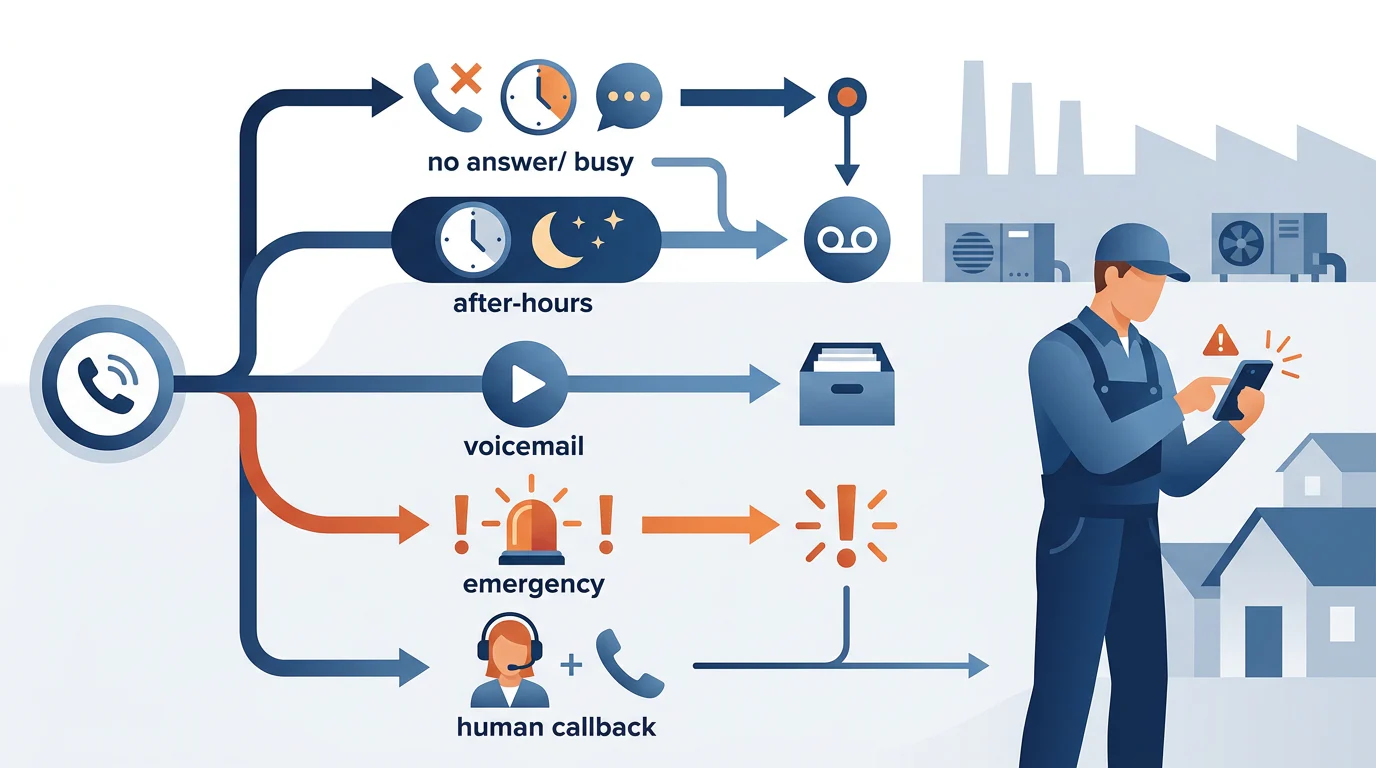
A missed call is a business rule, not one universal network status. Platforms and carriers can label busy, rejected, unreachable, voicemail, and no answer differently, which is why the SIP standard distinguishes busy and decline conditions instead of treating them as the same event.
Set the trigger around what the team can actually handle. For example, a customer who reaches a technician’s voicemail may technically have connected to something, while a caller whose forward destination fails has received no useful help at all. Keep those outcomes visible in AI Call Insights rather than treating every unanswered call as identical.
Define Each Terminal Event
- No Answer: Send one response after the agreed ring window and create a callback task.
- Busy: Send only when every intended answer point was unavailable and the call did not connect elsewhere.
- Rejected Call: Keep this separate from no answer. A caller may have hung up or declined a connection for reasons that do not require an automated follow-up.
- After-Hours Call: Use availability-aware wording only when an on-call owner can fulfil the promise.
- Voicemail: Test it separately. Do not assume a voicemail connection should receive the same treatment as a true no-answer event.
- Forwarding Failure: Create an internal alert and fallback callback task. Do not send a routine confirmation when the system cannot prove what the customer experienced.
Route Emergencies, Routine Work, and Human Takeover
For immediate danger such as smoke, sparking, or a suspected gas issue, the response should prioritise safety, alert the on-call human, and direct the customer to appropriate emergency help. India’s 112 service is the national emergency response number for police, fire, medical, and other emergencies.
Routine requests need a simpler route: identify the issue, locality, and callback preference, then assign one person to book or return the call. An AI Voice Agent can help cover straightforward intake, but it should not remove the named owner for an urgent or unresolved request.
Suppress Duplicates and False Positives
Use one text per caller and event window. A second forwarding leg, a voicemail event, or a repeat call should not create a pile of identical messages. Connected calls should always suppress the missed-call text.
How Can a Three-Person Team Set This up Without Code?
No-code does not mean no design. It means the carrier settings, message logic, inbox, and responsibility can be configured without a developer after the team has defined what should happen.
-
Inventory The Existing Number: Record the carrier, account holder, voicemail route, business hours, and current forwarding rules. Use our guide to set up your number to document the route before changing it.
-
Choose The Least Disruptive Route: Test conditional forwarding first. Port only when same-number voice and messaging control are essential and forwarding cannot provide it.
-
Set Exact Triggers: Define no answer, busy, after-hours, voicemail, rejection, and forwarding failure separately. Explicitly exclude connected calls.
-
Configure The Reply Path: Make the message identify the business, send replies to one shared inbox, and assign daytime and after-hours owners.
-
Write Two Response Paths: Use one safety-first message for emergencies and one concise booking or callback message for routine service requests. Do not enrol the caller in a marketing campaign from this event.
-
Apply Messaging And Data Controls: Follow the applicable local sender, template, consent, opt-out, and recipient-preference requirements. Set quiet hours that match both recipient expectations and the team’s ability to respond.
-
Document Retention And Run Live Tests: Keep only the call and SMS data needed for the stated operational purpose or lawful requirement. India’s data deletion rule requires erasure when consent is withdrawn or the specified purpose is no longer served, subject to legal retention needs.
The message itself should be brief, specific, and truthful about availability. A good first response opens a conversation. It does not pretend that an unstaffed inbox has booked a technician.
How Do You Test This Setup Before Launch?
A single successful text proves only that one branch fired once. Acceptance testing proves that the customer sees the right identity, the team receives the reply, and the system does not send an awkward duplicate when conditions change.
| Test Call | What To Do | Pass Criteria | If It Fails |
|---|---|---|---|
| No Answer From A New Caller | Let the call ring through the defined threshold | Correct caller identity is logged and exactly one text arrives | Check forwarding, event visibility, and sender setup |
| Busy Or Overflow | Occupy intended answer points | Only the intended overflow rule fires, with no text after a connected call | Refine busy and connected-call suppression |
| After-Hours Call | Call during the configured closed period | Correct availability wording, quiet-hour behaviour, and assigned owner | Update hours, ownership, or message copy |
| Reply And Human Takeover | Reply with a routine HVAC request | Reply appears in the shared inbox and the owner sees enough context to respond | Repair permissions, notifications, or callback assignment |
| Voicemail, Failure, And Repeat Call | Leave voicemail, test an unreachable forward, then call again | No duplicate text, a failure alert appears, and each outcome follows its own rule | Correct terminal-event logic and deduplication |
Record what happened, including sender identity, elapsed trigger time, reply destination, and callback completion. The Missed Call Revenue Loss Calculator can help the team frame the operational value without guessing at recovery.
Repeat the five calls whenever someone changes a carrier setting, voicemail, business hours, team role, sender registration, or routing destination. The safest automation is the one that keeps proving its behaviour after change.
TalkEasy for a Tested HVAC Call Path
At TalkEasy, we build for Indian teams that need shared call handling without making every technician an administrator. For an HVAC business, our useful starting point is not a generic automation switch. It is a short routing review: which number customers dial, where unanswered calls go, which inbox receives replies, and who owns the next callback. We can help your team map that path, organise Team Centre access, and test it from a real mobile before you rely on it. If the existing number cannot support the required event or messaging path, we will make that limitation clear before a wider rollout. Our Pro plan includes unlimited users and contacts, AI Call Assist, call recording and history, team management, and an analytics dashboard. Start with the workflow your three people can actually run, then add customisation or integrations only when the operating need is real. TalkEasy AI Biz Number
FAQs on HVAC Missed-call Text-back Without Number Porting
Can We Keep Our Existing Number?
Yes. Keep the advertised voice number if conditional forwarding preserves the caller event and the text workflow is compliant, reply-capable, and validated by your team before launch.
Does Forwarding Make Texts Come from Our Existing Number?
Not necessarily. Forwarding can retain the voice number while a separate authorised sender handles text, so confirm displayed sender, shared reply inbox, and callback identity.
Which Calls Should Trigger an Automated Text?
Use separate rules for no answer, busy, after-hours, rejection, voicemail, and forwarding failure. Connected calls should never trigger a missed-call text, and duplicate events need suppression.
How Should We Handle an HVAC Emergency?
Send a safety-first message, alert the on-call person, and direct immediate danger to emergency help. Then record the event, owner, callback outcome, and any booking.
What Must We Test Before Launch?
Use a new caller number to test no answer, busy, after-hours, reply ownership, voicemail, forwarding failure, duplicate suppression, sender identity, and final callback responsibility before launch.