Sales Call Tips for India: A 7-Check Scorecard for Your Calls
The best sales call tips are the ones you can count on your own recordings. Check India's calling rules first, then score ten calls on seven checks and fix the weakest.

By Tej Pandya, Founder · Updated 25 Oct 2026
Key takeaways
- Seven yes-or-no checks, scored on ten recorded calls, show which habit to fix first.
- Under the Telecom Regulatory Authority of India (TRAI) regulations, a call whose main purpose is to solicit business is commercial communication, and the sender must be registered with a telecom operator to make it.
- TRAI switches off midnight to 10 am and 9 pm to midnight by default for unsolicited commercial calls, so 10 am to 9 pm is the safe window for people who have not asked to hear from you.
- Score ten calls, find the check with the lowest total, fix that one for a week, then score ten more.
In this article
- 1What are the sales call tips that hold up for Indian teams?
- 2Which Indian rules decide whether you can make a sales call?
- 3Check 1: Are you allowed to make this call?
- 4Why do most sales call tips fall short for Indian teams?
- 5How should you open a sales call in India?
- 6Check 2: Did you give your reason in the first sentence?
- 7How much should you talk on a sales call, and what should you ask first?
- 8Check 3: Did you talk for half the call or less?
- 9Check 4: Did you ask before you priced?
- 10How do you handle an objection and end a sales call with a next step?
- 11Check 5: Did you answer the objection with a question?
- 12Check 6: Did you fix the next step aloud?
- 13Check 7: Did you follow up the same day?
- 14How do you score ten calls with TalkEasy?
- 15Frequently asked questions
Most lists of sales call tips tell you what a good call sounds like and leave you to guess whether yours did. They also skip the question that comes first in India: were you allowed to make that call, at that hour, from that number?
This page answers both: the Indian calling rules, read from the regulator's own text, and a scorecard of seven yes-or-no checks, each settled with a recording and, for talk share, a stopwatch.
Seven checks is a deliberate limit. You score ten recent calls, add up each check across the ten, and the lowest total tells you where to start. We recommend fixing one habit a week: changing one thing is easier to check than changing several.
It is written for small Indian teams that call enquiries, existing customers and cold prospects, whether that is one founder or a team of ten.
What are the sales call tips that hold up for Indian teams?
Seven hold up, because each is a yes-or-no test on a recording. Here is the scorecard, with the pass mark for each check. The checks cover permission to call, the opening, talk share, questions before price, objections, the next step and the follow-up.
| # | Check | Pass (1 point) | Fail (0) |
|---|---|---|---|
| 1 | Allowed to call | Placed between 10 am and 9 pm Indian Standard Time (IST), and the person asked for the call (form, missed call, WhatsApp enquiry) or is an existing customer | Outside those hours, or a cold call to someone who never asked |
| 2 | Reason in the first sentence | Your name, company and reason came before your first question | You opened with "how are you?" or a pitch |
| 3 | Talk share | In a 2-minute stretch from the middle of the call, you spoke for 60 seconds or less | More than 60 seconds |
| 4 | Ask before you price | You asked at least two questions about their situation before price came up, one at a time | Price came first, or you asked nothing |
| 5 | Objection | You answered the first objection with a question | You argued, or gave in at once |
| 6 | Next step | A day and a time were said aloud, or a clear no was recorded | "I'll call you sometime" |
| 7 | Same-day follow-up | A WhatsApp message or SMS with the next step went out the same day | Nothing sent |
How to score. Pick ten recent recorded calls, a mix of enquiries and cold calls. Score each call out of 7. Then add up each check across the ten calls, so every check has a total out of 10. Fix the lowest total this week, and score ten new calls next week. A check totalling 8 or more is holding.
Check 1 rests on TRAI's regulations, explained next. Checks 2 to 7 are our recommendations; no regulation sets them. Treat the 60-second line as a target, not a law.
Which Indian rules decide whether you can make a sales call?
TRAI treats any voice call whose primary purpose is to advertise or solicit business as commercial communication. Its regulations bar a sender who is not registered with a telecom operator from making one, and the operator may suspend or disconnect that sender's numbers. This is in the consolidated text of the Telecom Commercial Communications Customer Preference Regulations (TCCCPR), regulation 3(2), as of the 21 May 2026 version.
Check 1: Are you allowed to make this call?
You are, if the call falls in the right hours, the person has a reason to expect it, and your number is set up for it. Take each in turn.
Hours. The regulations list nine time bands in Schedule II, from midnight to 6 am up to 9 pm to midnight. They state that the first three and the last are off by default for every customer, whether or not the customer has registered any preference. In plain terms, midnight to 10 am and 9 pm to midnight are closed to unsolicited commercial calls unless the customer opts in. We read that as a default window of 10 am to 9 pm for people who have not asked to hear from you. Customers can block more bands, days or categories through TRAI's 1909 service, which many people know as Do Not Disturb (DND).
Reason to expect the call. Unsolicited commercial communication means communication that is neither covered by the recipient's consent nor within their registered preferences. The regulations define inferred consent as permission that can reasonably be inferred from the customer's conduct or relationship with you, and it does not extend beyond the duration or discharge of the contract. So an enquiry or a live customer relationship is your best footing. Keep a record of when and how each lead asked to be called.
Your number. As of July 2026, TRAI requires promotional voice calls from any business to use a 140-series number. The 1600-series is for service and transactional calls by banks, insurers and other regulated entities. Ask your operator in writing for a 140-series number before you start outbound sales calling. If you use an auto dialer (software that places calls automatically), regulation 4 requires you to notify your operator in advance, in writing, of the dialer and what the calls are for.
Why do most sales call tips fall short for Indian teams?
In our view, most English-language sales call advice is written for other markets and does not cover TRAI hours, the 140 series, WhatsApp follow-up or recording consent. In India those decide whether the call can be made at all.
The omission costs more in India than it would elsewhere. Truecaller, the caller-identification app, classed 66% of the unknown calls its Indian users received in 2025 as spam, and recorded 41.68 billion (4,168 crore) spam calls in total, as WION reported on 7 May 2026. That figure covers Truecaller users in 2025, not every phone in India. Even so, in our view it shows what a stranger assumes when your number appears: spam, until you prove otherwise.
Regulation 34A adds a second reason to use a properly assigned series. It bars call-management apps from blanket-tagging or blocking calls from the designated series for commercial communication, although individual users may still block any number themselves.
How should you open a sales call in India?
Open with your name, your company and the reason for the call, in that order and in one sentence. A listener who has not decided you are spam will decide in the first few seconds, and the reason is what they decide on.
Check 2: Did you give your reason in the first sentence?
Pass this check when the reason comes before your first question.
For an enquiry: "Namaste Sharma ji, main Neha bol rahi hoon [company] se. Kal aapne website par [product] ke baare mein poocha tha. Kya abhi ek minute baat kar sakte hain?"
For a missed call: "Hello, this is Neha from [company]. You called us at 11 this morning, so I'm calling back. Is now a good time?"
For a cold call, state the reason in plain words and give them an easy exit: "Hello Mr Sharma, Neha from [company]. I'm calling about [one specific thing] for shops like yours. Is this a bad time?" Our page on cold call opening lines for India has more openers to test.
How much should you talk on a sales call, and what should you ask first?
Aim to speak for half the call or less, and ask about the person's situation before you mention a price. This is our recommendation, not a regulation. The person on the line knows what they need and you do not, so every minute you spend talking is a minute you are not learning it.
Check 3: Did you talk for half the call or less?
Take a 2-minute stretch from the middle of the recording, play it with a stopwatch, and run the stopwatch only while you are speaking. Sixty seconds or less is a pass. Take the stretch from the middle because openings and closings are scripted and skew the result. For calls shorter than four minutes, time the whole call and compare to half its length.
Reps who fail this check usually fail it because they are explaining the product to someone who has not yet said what they want.
Check 4: Did you ask before you priced?
Ask at least two questions about their situation before price comes up, one at a time. Good ones are "What are you using at the moment?" and "What made you enquire this week?" The answers tell you which of your offers to describe and which to leave out.
If the person asks the price in the first minute, answer in one sentence and then ask your question. Dodging a direct price question sounds evasive, and it makes the next sixty seconds harder.
How do you handle an objection and end a sales call with a next step?
Answer the first objection with a question, then end every call with a fixed day and time, or a clear no that you record. These three checks are where most calls are won or lost, and they are also the easiest to check, because each is a sentence you either said or did not.
Check 5: Did you answer the objection with a question?
An objection such as "not interested" or "too expensive" is usually a summary of something you have not yet heard. Ask for the rest of it. After "not interested": "Fair enough. Is it that you already have something in place, or that the timing is wrong?" Whatever they say next is worth more than a rebuttal. Our guide to cold call objection handling in India gives replies and says when to stop. One firm no after your question is a no; record it and move on.
Check 6: Did you fix the next step aloud?
A next step has a day, a time and an action: "I'll call you tomorrow at 11 am with the two options." When someone says "call me later", ask: "Of course. Would 5 pm today or 11 am tomorrow suit you better?" A vague "later" gives you nothing to hold anyone to, and a stated time gives them a reason to pick up.
Check 7: Did you follow up the same day?
Send a WhatsApp message or SMS before the day ends that repeats the next step: "Hi Mr Sharma, Neha from [company]. As discussed, I'll call you tomorrow at 11 am about [topic]. Reply here if the time changes." For what to say on the follow-up call itself, use our follow-up call script.
How do you score ten calls with TalkEasy?
We record and log every call in one shared call history, so you can score ten calls without chasing recordings. As of October 2026, paid plans include call recording and history, team management and the analytics dashboard.
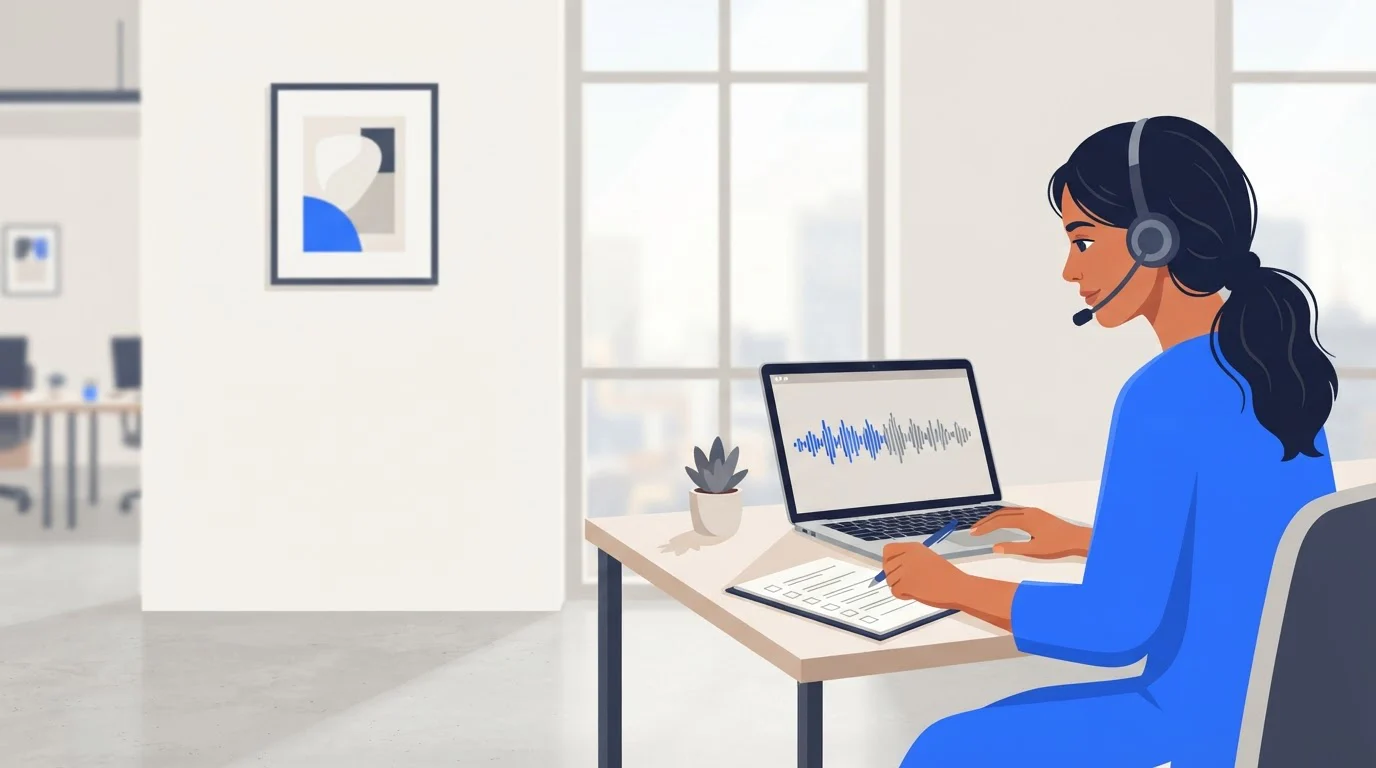
- Pick the ten calls.Open your call history and choose ten recent calls, mixing enquiries and cold calls. Everyone on the team uses one business number, so a manager can pick calls from any rep.
- Read the summary.
Read the AI call summary, which appears within a couple of minutes of a call ending: it lists the objections raised and the follow-up, so you can see which calls have an objection or no next step before you replay them. AI Call Insights flags objections and follow-ups across recordings, which speeds up scoring Checks 5 to 7.
- Time and score.Play the middle two minutes of each call with a stopwatch for check 3, and score the other six checks from the recording and your sent messages.
- Pick calling hours.The call analytics reports show answer rates, missed calls, average talk time and peak hours, and you can download them. Use them to find the best slot inside 10 am to 9 pm.
Our Pro plan is ₹999 + GST a month with three hours of talktime a day; extra talktime is ₹49 + GST an hour, as of October 2026, and you can cancel any time. Managers who want to turn the scores into coaching can read how to coach telecallers using call recordings.
Score ten calls from one shared call history with TalkEasy
Frequently asked questions
Sources
- 1.TRAI: Telecom Commercial Communications Customer Preference Regulations, 2018, consolidated text dated 21 May 2026. The consolidated document is prepared for ease of reference; the gazetted text prevails if the two differ.
- 2.TRAI: Telecom Commercial Communications Customer Preference (Second Amendment) Regulations, 2025, released 12 February 2025
- 3.MediaNama, July 2026: TRAI releases clarification on designated promotional and transactional number series
- 4.WION, 7 May 2026: 41.68 billion spam calls in India, 66 per cent of unknown numbers on Truecaller were spam