
Turn Call Recordings Into Sales Coaching With a Weekly Recheck
A repeatable weekly coaching record that links a selected call, scorecard evidence, one practice behaviour and a follow-up review.
- Time
- Weekly review
- Difficulty
- Moderate
- Cost
- Existing call-recording setup
- Steps
- 5
Before you start, have
- Access to recorded sales calls and their summaries or transcripts
- A shared scorecard covering opening, discovery and next step
- Manager and rep access to the calls selected for review
- An established recording notice, privacy process and access policy
- A weekly slot for reviewing calls and agreeing coaching actions
Heads up: Do not treat an AI summary as final evidence for a disputed commitment, customer detail or coaching judgement.
Heads up: This workflow is not designed for real-time call rescue or exhaustive quality assurance across every call. It needs a manager who can review source evidence and give focused feedback.

By Tej Pandya, Founder · Reviewed 21 Sept 2026
In brief
Use a weekly loop: choose calls from summaries, score the opening, discovery and next step, verify the source, coach one behaviour, and recheck it the following week. This turns recordings into evidence-backed practice instead of a library no one revisits.
- 1
Choose the week’s calls from summaries
Open the week’s call summaries and select calls that show a useful mix of customer requirements, objections, outcomes or follow-up commitments. Label each selected call with the rep and call type. When this is complete, you have a short review list that links directly to the source recordings.
- 2
Score the opening, discovery and next step
Use the same scorecard for each selected call. Record whether the opening established the purpose of the conversation, whether discovery surfaced the customer’s needs and questions, and whether the next step has a clear action and owner. Write an observation for every score so the review is based on what happened in the call.
- 3
Verify the summary against the source call
Use the summary to orient yourself, then listen to the relevant part of the recording or read the transcript before deciding on feedback. Capture the moment that supports the observation, such as a timestamp or transcript line. You should finish with evidence that the rep can recognise and discuss.
- 4
Agree one behaviour to practise
Discuss the evidence with the rep and choose one observable behaviour for the next set of calls. State what the rep will do differently and what the reviewer will look for. Finish with a written coaching action tied to the relevant scorecard criterion.
- 5
Recheck the behaviour in the next weekly sample
At the next review, start by looking for the agreed behaviour in newly selected calls. Note whether it appeared and whether the scorecard evidence changed. Then either keep practising the same behaviour or choose the next coaching priority.
You'll know it worked when
You can point to a selected call, its scorecard observations, the rep’s single practice behaviour and the next weekly review where that behaviour will be checked.
Keep the review loop visible
A short scorecard makes the conversation specific. A summary helps select and scan calls, while the recording or transcript supplies the evidence when context matters. NIST's 2023 AI RMF recommends defined human-oversight processes for AI systems.
From call record to next check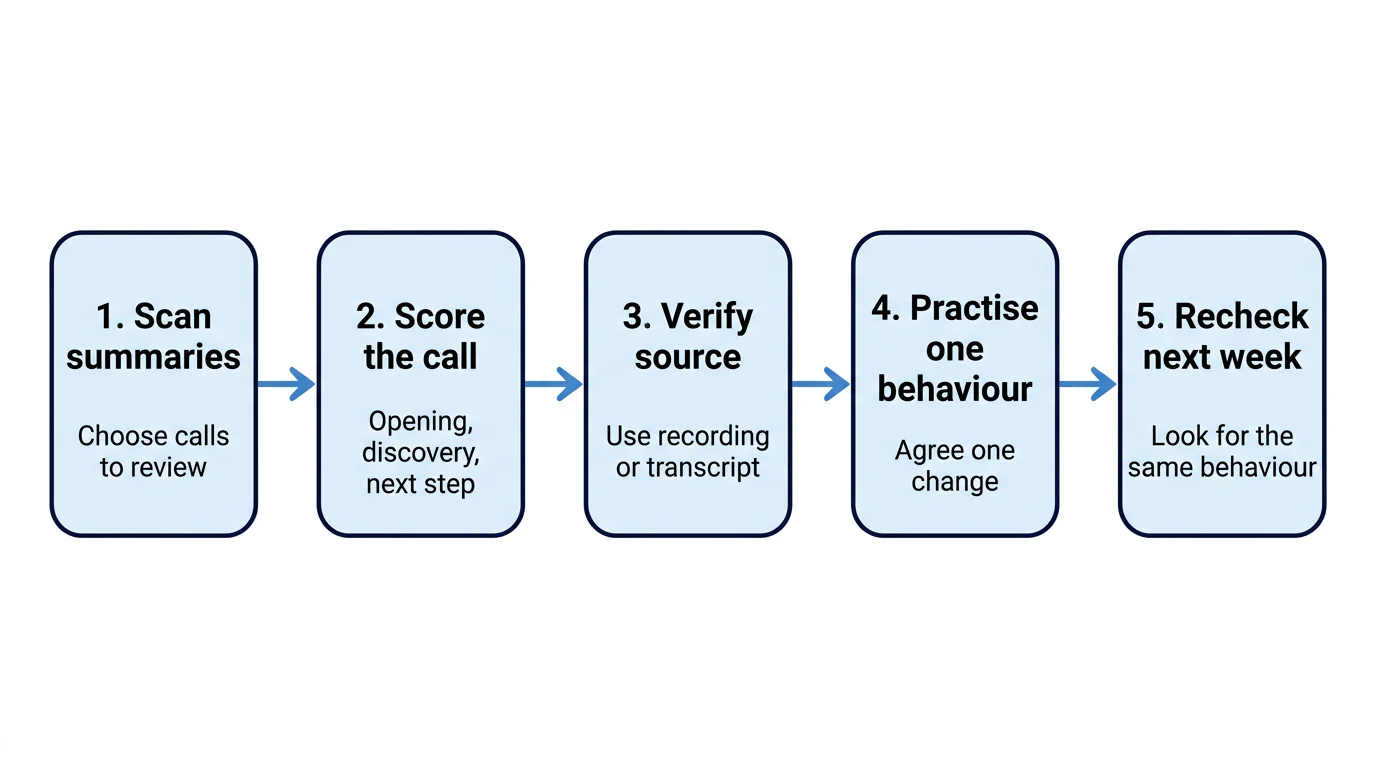
For example, TalkEasy lists call recording, summaries, and team-level call insights that can support this provider-neutral workflow. Use an AI call summary to narrow the review list, then return to the source call before giving feedback. For related setup guidance, see business call recording for teams and how AI summaries support coaching.
Keep reading



Frequently asked
Choose a sample your manager can review consistently and that gives each rep a fair chance to show the behaviour being coached. A smaller repeatable sample is more useful than a larger collection of recordings that never receives specific feedback.
No. Use an AI summary to find relevant calls and scan requirements, objections, outcomes and follow-up suggestions. Review the recording or transcript when you need to verify wording, context, a customer commitment or the evidence behind a coaching observation.
Start with the opening, discovery and next step. Define each criterion as an observable action, then capture the evidence that supports the review. Keep the scorecard focused on the call type so it guides practice instead of producing a vague personality rating.
Yes. Set your organisation's recording notice, privacy process, access rules and retention practice before starting the review cycle. Recording and using calls can involve customer and employee information, so follow the laws, contracts and sector requirements that apply to your business.
Set up a repeatable call-review routine
Talk through a call-management workflow for your sales team.
Talk to Our Expert