

AEO
Set up HVAC Missed-Call Automation Without Code
TL;DR
We help three-person HVAC crews set up HVAC missed-call automation without replacing their public number or hiring a developer. This guide covers conditional forwarding, approved text replies, after-hours emergency routing, shared ownership, consent controls, launch tests and a manual rollback so missed calls become accountable customer conversations.
Set up HVAC Missed-Call Automation Without Code
India had 1,330.58 million telephone subscribers in March 2026, according to the TRAI dashboard. For a small HVAC crew, a missed call can arrive while every technician is driving, diagnosing a fault or speaking with another customer.
For a three-person HVAC crew, HVAC missed-call automation can keep the current number active by forwarding busy, unanswered or after-hours calls to a no-code workflow. That workflow logs the event, sends one approved text, opens a shared conversation, alerts the on-call technician, suppresses duplicates and keeps a human callback route available.
We cover the exact setup choices, message logic, number-retention rules, safety controls and launch tests that make the workflow dependable.
How Can a Three-Person HVAC Team Launch No-Code Automation?
Start with ownership, not software. Choose one person who owns the missed-call queue during business hours, one after-hours technician and one backup. The automation should acknowledge the caller immediately, but a named person must still own the next decision.
Our AI Missed Call Agent explains how call events can become tracked follow-up work instead of private notifications on one technician’s phone. The aim is a simple, repeatable system that the whole crew can use while they are on the road.
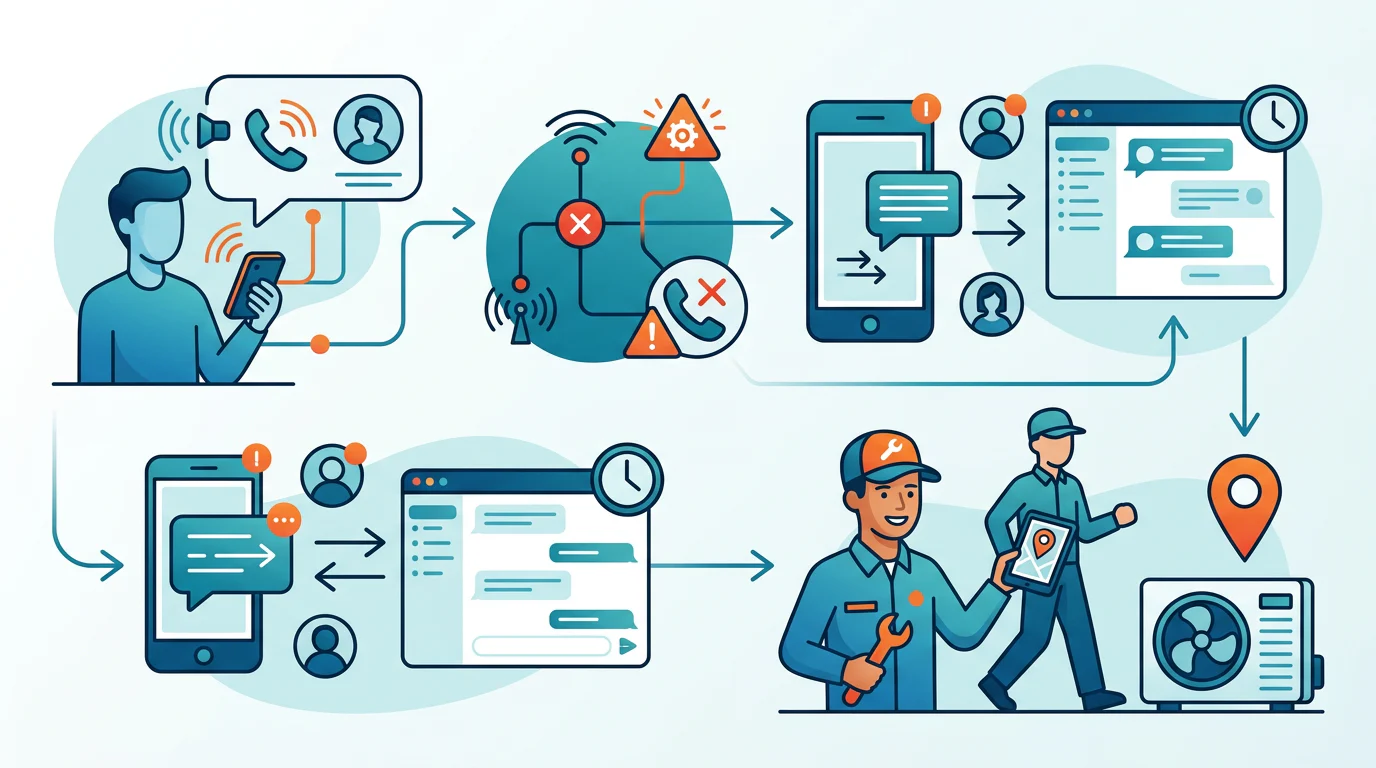
Choose the Trigger Conditions
Configure three conditions separately:
- Unanswered: Let the business number ring for 15 to 20 seconds, then trigger the workflow.
- Busy: Trigger the same workflow when the technician is already on another call.
- After Hours: Route directly to the on-call path, without first ringing an unavailable team member.
Do not start with unconditional forwarding unless every call should bypass the original phone. Conditional forwarding is usually the safer option because customers can still reach an available technician before the fallback begins.
Set the Minimum Working Configuration
| Setting | Starting Configuration |
|---|---|
| Business hours | Match the hours published to customers |
| Ring duration | 15 to 20 seconds, then test |
| Unanswered calls | Create one missed-call event |
| Busy calls | Create one missed-call event |
| After-hours calls | Alert the named on-call technician |
| Duplicate control | One acknowledgement per caller within 20 minutes |
| Reply ownership | One assignee, one backup |
| Manual fallback | Callback from the business number |
Build the Eight-Step Quick Start
- Record your business hours, after-hours rota and backup owner.
- Choose conditional forwarding, native business-number automation or a no-code phone-system event workflow.
- Set the unanswered ring time and busy condition.
- Connect an SMS-capable business sender and shared inbox.
- Add one approved first-response message.
- Create separate branches for emergencies, service requests and estimate requests.
- Turn on technician alerts and shared assignment status.
- Run the test sheet before enabling the workflow for live callers.
A shared queue only works when everyone sees the same ownership status. Use Team Collaboration to keep new, assigned and closed conversations visible, rather than leaving a caller’s reply in one technician’s private inbox.
Can You Keep Your Current Number with HVAC Missed-Call Automation?
Usually, yes. Your public number can remain the number customers dial while conditional forwarding sends only unhandled calls to the response workflow. Porting becomes relevant when you need calls and texts to use one fully managed business number, or when the current carrier cannot support the required forwarding behaviour.
The important distinction is between the number that receives the call and the number that sends the reply. Before launch, confirm that the SMS sender is approved, recognisable and able to accept two-way replies. Our guide, Can Missed-Call Automation Keep Your Existing Number?, helps teams separate those two decisions.
| Situation | Recommended Route | Result For The Existing Number |
|---|---|---|
| Carrier supports busy and unanswered forwarding | Conditional forwarding | Keep the published number |
| Business phone system captures missed-call events | Native automation or no-code event workflow | Keep the published number |
| Messaging sender differs from call number | Forward calls, then disclose the reply number clearly | Keep voice number, verify SMS identity |
| One unified calling and messaging identity is essential | Port after a successful pilot | Porting may be required |
| Carrier rules cannot be tested safely | Use a new business-number workflow | Do not promise number retention |
For Indian businesses sending commercial messages at scale, compliance is not a footer detail. TRAI says senders may need Principal Entity registration, headers, registered content templates and consent records depending on the message type and sending route. Review the TRAI sender rules before treating a missed-call reply as a general marketing sequence.
What Should Happen After Hours and During an HVAC Emergency?
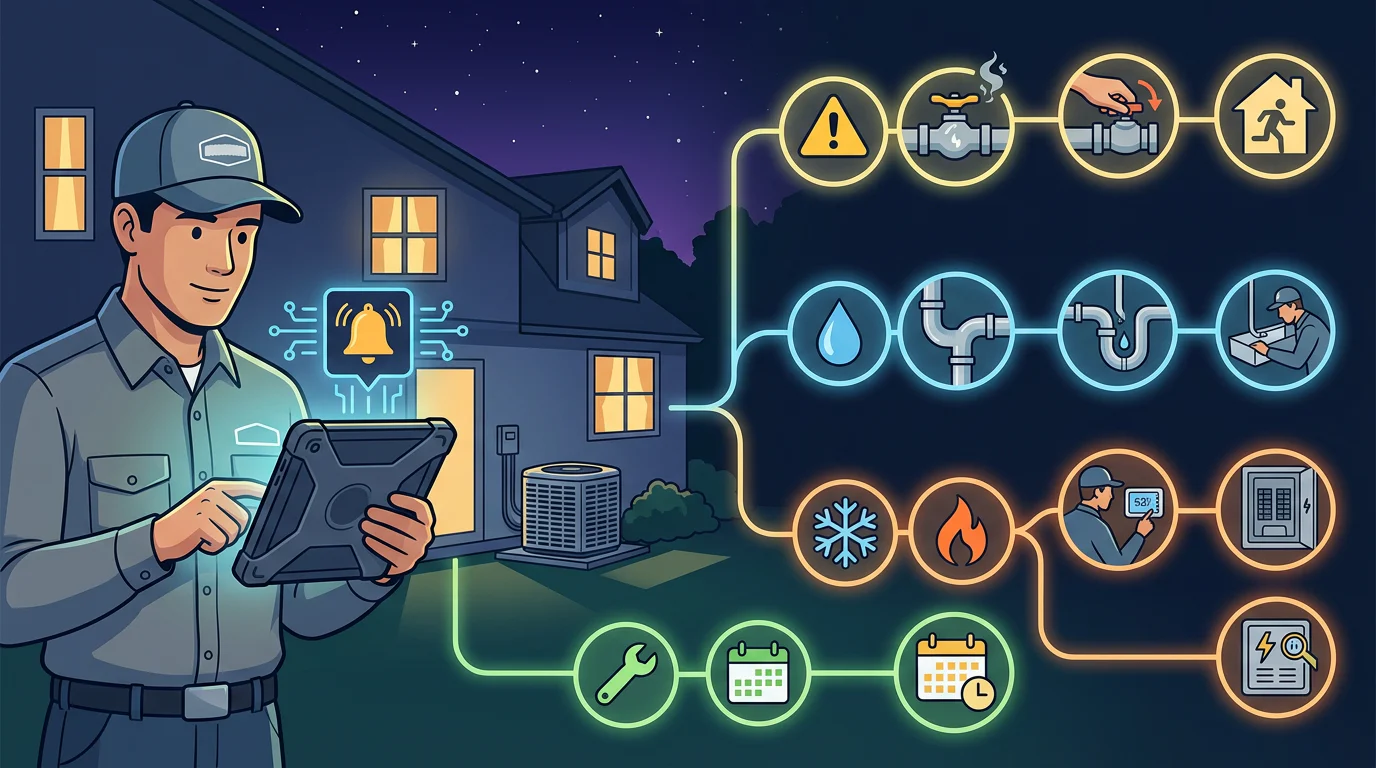
After-hours automation should sort urgency, not pretend to diagnose a fault. The first reply needs to identify the business, invite a useful response and make the safety boundary clear. It should never promise arrival times, give gas-safety advice beyond immediate emergency direction or allow an AI flow to override a technician’s judgement.
Use a Simple After-Hours Logic Tree
Missed after-hours call
├─ Suspected gas or immediate danger
│  └─ Emergency message, then alert on-call technician
├─ Water leak or active flooding
│  └─ Collect address and safety status, then alert on-call technician
├─ No cooling or no heat
│  └─ Collect postcode, occupancy and preferred callback time
├─ Maintenance or estimate request
│  └─ Create next-business-day follow-up task
└─ STOP or opt-out reply
   └─ Mark opt-out and stop automated promotional follow-up
Use Six Editable HVAC Reply Templates
- No Cooling: “We missed your call about cooling. Reply with your suburb, whether anyone vulnerable is affected and your preferred callback time. Our on-call technician will review it.”
- No Heat: “We missed your call about heating. Reply with your suburb, the property type and whether this affects anyone vulnerable. We will route your request to the right technician.”
- Suspected Gas: “We missed your call. If you suspect a gas leak or there is immediate danger, move to safety and contact emergency services or your gas provider. Reply when safe with your location.”
- Water Leak: “We missed your call about a water leak. Reply with your suburb, whether water is isolated and whether the leak is active. Our on-call technician will review the details.”
- Maintenance: “We missed your maintenance enquiry. Reply with your suburb, system type and preferred appointment window, and we will arrange the next available follow-up.”
- Estimate Request: “We missed your estimate request. Reply with your suburb, equipment type and a short description of the work. We will confirm the next step.”
Keep Replies Human-Controlled
Give every conversation one visible status: new, acknowledged, assigned, technician replied, booked or closed. The first technician to take the conversation becomes the owner. If no action occurs within your chosen window, alert the backup technician rather than sending another automatic customer message.
This is where an AI Voice Agent can complement text-back, especially when a caller needs immediate information or transfer rather than a message after the call ends. Keep the shared history clear so no technician has to ask the caller to repeat their problem.
TRAI’s 2025 changes include a 90-day restriction on asking again for consent after an opt-out, which is one reason to separate essential service responses from promotional follow-ups. Review the 2025 TRAI amendment with your messaging provider before enabling recurring campaigns.
When a team needs a shared customer identity rather than a chain of forwards from personal SIMs, a Virtual Business Number gives technicians a more consistent way to receive, return and track calls.
How Do You Test, Launch and Roll Back Safely?
Launch during staffed business hours, never at the start of an after-hours period. The first goal is not volume. It is verifying that the right person sees the right caller, at the right time, without duplicate messages or a stranded reply.
Use a second mobile phone for every test. Record the result in a shared sheet, then make one person responsible for changing forwarding rules if the pilot fails.
| Test Call | Expected Outcome | Pass Condition |
|---|---|---|
| Answered on first ring | No text sends | No missed-call event appears |
| Unanswered call | One text and shared conversation | Delivery, owner and status are visible |
| Busy call | Same fallback path as unanswered | Caller receives one acknowledgement |
| After-hours no cooling | On-call branch triggers | Correct technician receives alert |
| Suspected gas | Emergency language appears | No booking promise is sent |
| Repeat call within 20 minutes | Duplicate suppression applies | No second acknowledgement sends |
| Customer reply | Shared inbox receives reply | One technician takes ownership |
| Automation outage | Manual fallback works | Team can return calls from business number |
Before activating a new line, follow Set Up A Virtual Business Number and confirm that each technician can answer, return and review a call using their own device. Then test the original public number, not just the destination number.
For recording, message retention and personal details, set a written policy that limits access and defines when records are removed. India’s data-protection law gives individuals the right to withdraw consent and requires consent-based processing to stop within a reasonable time unless another legal basis applies. Read the data-protection act alongside your own legal advice.
A dependable launch also needs consistent records after the first reply. Reliable CRM call logging can help the team preserve the caller’s issue, owner and next action when conversations move from a missed call into booked work.
Build the Workflow with TalkEasy
At TalkEasy, we built our calling workflow for Indian teams that need one accountable place for business conversations while technicians are on the move. We help you separate customer calls from personal SIM activity, route enquiries by availability, keep recordings and history visible, and give the next owner enough context to respond without asking a caller to repeat everything. Our AI Call Assist, Team Centre and call analytics support the human decisions that matter after a missed call: who owns it, what the customer needs and whether a follow-up happened. Start by mapping your existing number, peak call periods and after-hours rota with us. Then test the workflow with real devices before relying on it during a busy season. We can also help define routing, permissions and escalation before your team goes live. Book a practical setup conversation with TalkEasy AI Biz Number
FAQs on HVAC Missed-call Automation
These questions cover the choices a small HVAC crew should settle before it sends its first automatic reply. The safest workflow is the one the whole team can test, understand and reverse.
Can I Keep My Existing HVAC Number?
Usually, yes. Conditional forwarding lets your existing number ring first, then sends only busy or unanswered calls to the workflow when your carrier supports those conditions.
What Ring Time Should We Start With?
Start with 15 to 20 seconds, then test it with real technician availability. A longer delay slows acknowledgement, while a shorter delay can interrupt ordinary answered calls.
Should Suspected Gas Calls Receive an Automatic Booking Link?
No. Use a safety-first message that directs callers to emergency services or their gas provider when appropriate, then alert the on-call technician for human review by phone.
How Do We Stop Duplicate Missed-Call Texts?
Create one acknowledgement rule per caller within a defined period, such as 20 minutes. Also disable overlapping automations that could send competing SMS or WhatsApp replies.
What Happens If the Automation Stops Working?
Keep a documented rollback route, test it before launch and assign one authorised person to disable forwarding. Technicians should still see missed calls and return them manually.