
Best Time to Call Customers: Find Your Window From Your Own Call Data
The best time to call customers depends on your own leads, because published windows disagree. A 14-day test on your call log, with enough dials per hour, shows which hours to staff for new calls and which to keep for follow-ups.

By Tej Pandya, Founder · Updated 29 Oct 2026

Key takeaways
- The best time to call customers is the hour your own leads answer most often, once that hour has enough dials. Published windows contradict each other.
- Plan at least 100 dials per hour before reading its answer rate, and 200 to 300 before trusting a gap of 8 to 10 points (our guideline).
- An answered call is not a productive call: check talk time and outcomes before giving an hour to your best callers.
- Test only between 10 AM and 9 PM IST for cold and promotional calls, and repeat the test each quarter.
In this article
- 1When is the best time to call customers, according to published figures?
- 2Why might your leads answer at different hours?
- 3Customer type and city
- 4Who is calling and what you sell
- 5What should you measure before you test?
- 6Answer rate = answered calls ÷ dials, by hour and weekday
- 7How many dials per slot you need
- 8How do you run a 14-day calling-time test?
- 9How do you read the result?
- 10Compare slots against the sample-size check
- 11Where do you find the numbers in TalkEasy?
- 12Is an answered call the same as a good call?
- 13How do you turn the best window into a shift plan?
- 14Which calling-hours rules apply in India?
- 15What should you do this week?
- 16Frequently asked questions
Two published Indian datasets disagree on when customers answer. Callyzer’s 2026 analysis of 5 crore calls puts 3 to 5 PM first, while ViveLead’s 2026 log of 7,989 outbound calls has 3 PM tied for the lowest answer rate among its busier hours. A published hour reflects someone else’s leads, so it may not fit yours. Your own call log answers this better, provided each hour has enough calls behind it. The check takes two weeks of ordinary dialling.
Here, customers means both leads and existing customers that a sales or follow-up team calls. The measure to use is answer rate (also called connect or pickup rate): answered calls divided by dials, where a dial is one outbound call attempt. Our inbound vs outbound calls guide defines outbound calls.
Our lead response time guide covers how fast to call back a new lead, while this page covers which hours to schedule calls. The two decisions are separate, and mixing them muddies both.
When is the best time to call customers, according to published figures?
Published figures give no single best time to call customers in India. The best time for sales calls and telecalling is no clearer: one Indian vendor points to 3 to 5 PM on weekdays, another’s 2026 data peaks at 12 PM, and a US/global survey puts late morning first. Treat each as a hypothesis. If you must start before testing, begin with the 3 to 5 PM weekday window Callyzer (Indian vendor-reported) reports, with equal dials in every other hour (our recommendation).
We publish this page and sell call analytics. Callyzer and ViveLead are Indian vendors of call or CRM software, and TalkEasy is not part of the data compared; each figure below carries its scope.
| Source | Scope | Finding | Checkable? |
|---|---|---|---|
| Callyzer | Indian vendor-reported; 5 crore (50 million) calls, 24 months | 3 to 5 PM on weekdays strongest, with 61.79% answered at 5 PM; 11 AM to 12 PM lowest; Monday weakest | No: the vendor holds the data |
| ViveLead | Indian vendor-reported; 7,989 outbound calls (14,264 calls in total) from 9 teams, 10 June to 27 September 2026 | Hourly answer rate 40.5% to 48.4% among hours with at least 300 calls; best 12 PM; lowest 1 PM and 3 PM; Wednesday 42.4%, Sunday 49.7% on 304 calls | No: the vendor holds the data, and one team is 73.7% of calls |
| US/global; 2025 survey of 379 sales professionals | 51% of regular cold callers found late morning (10 AM to 12 PM) most productive; 6% to 11% found 3 to 5 PM productive | No: opinions, not a call log |
ViveLead’s own conclusion is that answer rate was flat across the day: 40.5% to 48.4% by hour among hours with at least 300 of its 7,989 outbound calls. So the rest of this page is a method. A time is your best time only when your own call log, with enough dials per hour, produces it.
Why might your leads answer at different hours?
Leads answer at different hours because their days differ: what they do, where they live and how they came to you. A shopkeeper and a salaried buyer are free at different times, so one team-wide hour rarely fits every list. That is our inference; the test checks it.
Customer type and city
Callyzer (Indian vendor-reported) reports that 6 to 7 PM works better for real estate prospects, and that 1 to 2:30 PM is weak for them. Our inference is that salaried buyers are in meetings by day and free in the evening.
Tag each lead before the test, using the tags in our warm vs cold lead guide, plus city and source. Test one segment at a time, largest list first, because each needs its own 100 or more dials per hour.
Who is calling and what you sell
Our inference is that whether the lead asked for your call and which number you call from can change answer rates, so test those who asked for a call and cold-list leads separately, and keep the calling number the same.

What should you measure before you test?
Measure answer rate by hour and by weekday, and count the dials behind every slot. The count matters as much as the rate, because a rate built on 30 dials can swing by about 18 points either way.
Answer rate = answered calls ÷ dials, by hour and weekday
Calls that ring out count as dials. Answered means a person picked up; missed and rejected calls are not answered. A slot is the hour in which the dial started, in IST (Indian Standard Time). Count each retry as its own dial and mark it. Our follow up call script guide covers what to say on a retry.
Log lead ID, dial time, answered (yes or no), talk time, outcome, retry number and number used for every dial. Our Business Dialer logs each call made through it with the contact, time, duration and outcome; a spreadsheet works too.
How many dials per slot you need
A slot needs at least 100 dials before you read its answer rate, and 200 to 300 before you trust a gap of 8 to 10 points between two slots. This is our guideline, not an industry standard.
| Dials in the slot | Margin on one slot | Margin on the gap between two slots | How to use it |
|---|---|---|---|
| 30 | ±18 points | ±25 points | Too thin to read |
| 50 | ±14 points | ±20 points | Too thin; keep dialling |
| 100 | ±10 points | ±14 points | Minimum to read a slot |
| 200 | ±7 points | ±10 points | Gaps above 10 points count |
| 300 | ±6 points | ±8 points | Gaps above 8 points count |
| 400 | ±5 points | ±7 points | Gaps above 7 points count |
Our calculation: one slot = 1.96 × √(0.5 × 0.5 ÷ dials); gap between two slots = 1.96 × √(2 × 0.25 ÷ dials), assuming answer rates near 50%, independent calls and 95% confidence. Retries and mixed lead sources add noise, so the real margin is wider.
Worked example (made-up inputs, our calculation): five callers make 40 dials each a day, so 200 a day, or 2,400 over 12 calling days (Monday to Saturday for two weeks). Across eleven hourly slots from 10 AM to 9 PM, that is 2,400 ÷ 11 ≈ 218 dials a slot. The margin on the gap between two slots is 1.96 × √(0.5 ÷ 218) ≈ 9 points, so a smaller gap is a tie. Each hour-and-weekday cell holds 2,400 ÷ (11 × 6) ≈ 36 dials, a margin of 1.96 × √(0.25 ÷ 36) ≈ 16 points, so read hours across all days, never single cells.
How do you run a 14-day calling-time test?
To find the best time to call leads, spread the same number of dials across every hour slot for 14 days, hold lead mix and script constant, then compare answer rate by hour. Test only inside lawful hours (10 AM to 9 PM IST for cold and promotional calls); see which calling-hours rules apply in India.
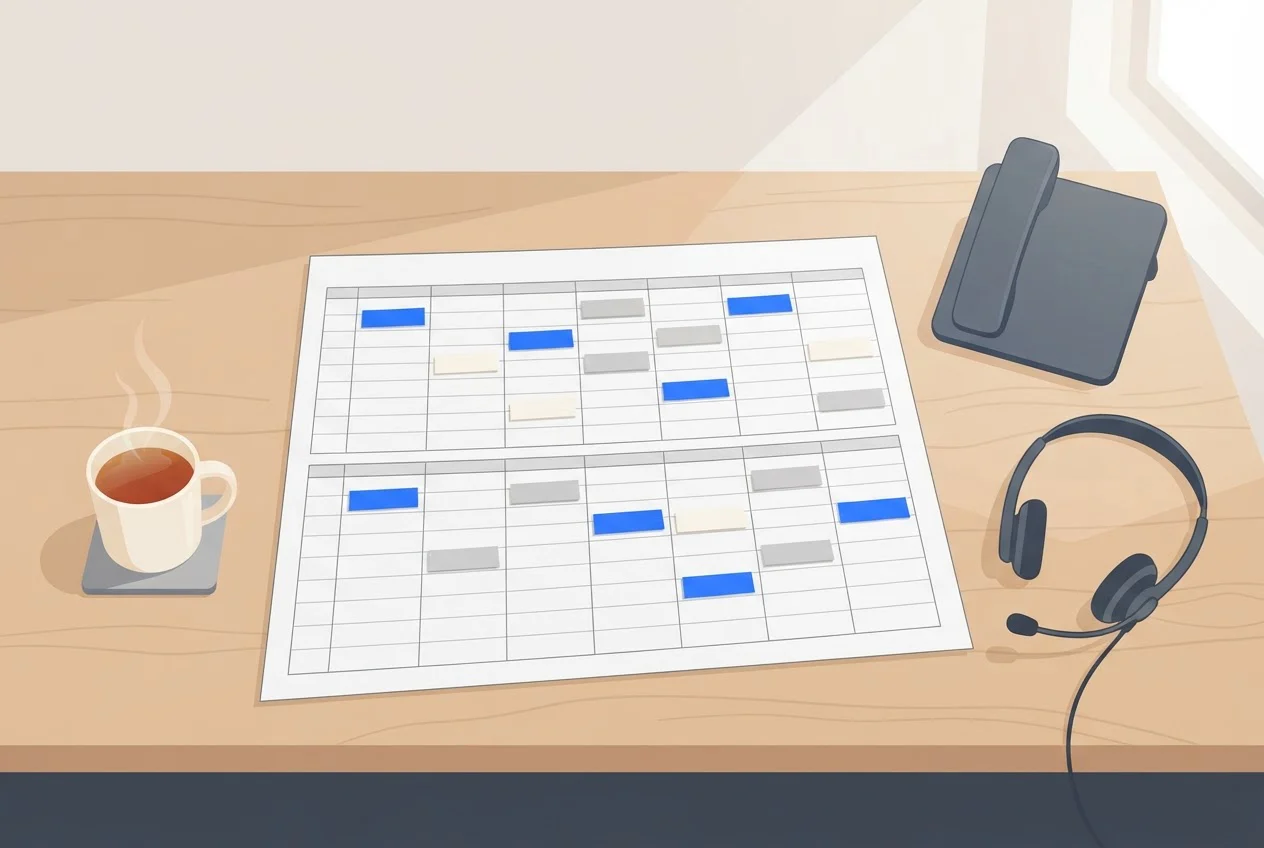
- Fix the list and the scriptKeep both the same for all 14 days, with no new campaign or opener halfway.
- Set eleven slotsOne-hour slots from 10 AM to 9 PM, with Monday to Saturday as columns.
- Give every slot equal dialsShuffle each day's list, split it into equal batches, and rotate callers between slots.
- Log every dialUse the columns above. Keep one calling number and note the date of any change, as a number recipients start rejecting pulls down later slots.
- Count dials per slot after 14 daysFourteen days hold two of each weekday, so read hours first. If any slot has too few dials to pass the sample-size check, extend the test to four weeks rather than reading a thin slot.
Template: write dials and answered calls in each cell, for example 40 / 18.
| Hour slot | Mon | Tue | Wed | Thu | Fri | Sat |
|---|---|---|---|---|---|---|
| 10 to 11 AM | ||||||
| 11 AM to 12 PM | ||||||
| 12 to 1 PM | ||||||
| 1 to 2 PM | ||||||
| 2 to 3 PM | ||||||
| 3 to 4 PM | ||||||
| 4 to 5 PM | ||||||
| 5 to 6 PM | ||||||
| 6 to 7 PM | ||||||
| 7 to 8 PM | ||||||
| 8 to 9 PM |
If you would like a second pair of eyes on your test sheet before you start, talk to our expert.
How do you read the result?
Work out answer rate for each hour across all days, and call a gap real only if it is larger than the margin for your dial count. Anything smaller is a tie.
Compare slots against the sample-size check
- Add dials and answered calls for each hour across all days, then divide. Fail any hour under 100 dials as too thin to read.
- Subtract the answer rate of the hour you would drop from the hour you would prefer, and look up the two-slot margin for the smaller dial count in the table above.
- Pass: the gap is larger than the margin, so the difference is real. Fail: the hours are tied, so schedule them by capacity.
- Repeat by weekday, pooling all hours, with the same rule.
Pro Tip: With eleven hourly slots, the best and worst hours often look far apart by chance alone, because you are picking the extremes. If the gap only just clears the margin, treat it as a lead to re-test next quarter, not as proof.
Where do you find the numbers in TalkEasy?
Our Sales Call Analytics dashboard shows Answer Rate, Missed Calls and Peak Calling Hours in daily and monthly reports that you can download, and paid plans include it. The hourly split for this test comes from an exported call list or from counting by hand.
See the Sales Call Analytics page for the reports. Our guide to tracking your sales team’s calls gives the weekly report, though it counts incoming calls, not dials.
Is an answered call the same as a good call?
No. An answered call shows only that someone picked up. The slot with the highest answer rate can still produce short calls with no next step, so check talk time and outcomes before you give it to your best callers.
A productive call ends with an agreed next step, such as a site visit, a demo or a confirmed callback time. For each hour, add average talk time, which Sales Call Analytics reports and our average call duration guide explains, and productive calls. Then work out:
productive calls per 100 dials = 100 × answer rate × productive share of answered calls (with both as fractions). Example with made-up inputs: 100 × 0.45 × 0.20 = 9.
Use it as a veto and a tie-breaker: if the highest-answer hour has clearly shorter talk time and fewer productive calls per 100 dials than neighbouring hours, do not give it your best callers. Productive calls are fewer than dials, so their margin is wider; do not decide on outcomes alone unless the gap is large.
How do you turn the best window into a shift plan?
Put your strongest callers on the hours that cleared the sample-size check with the best answer rate and productive calls per 100 dials, and use weak hours for follow-ups and admin. Keep a few dials in every hour to allow re-testing.
| Block | Which hours | Use |
|---|---|---|
| Fresh-dial block | Hours that beat the rest by more than the margin | New-list dials and cold calls, strongest callers |
| Steady block | Hours tied within the margin | Mixed dialling and scheduled follow-up calls |
| Weak block | Hours clearly below the rest | Follow-up notes, outcome updates, list cleaning, admin and a few test dials |
| Callback block | A fixed slot inside the best hours | Calls back to customers who missed your call |
Build the callback block from our missed call callback workflow, which covers when to create a callback task.
Which calling-hours rules apply in India?
Unsolicited commercial calls are closed from midnight to 10 AM and 9 PM to midnight IST, so cold and promotional calls belong between 10 AM and 9 PM, as our sales call tips guide sets out. As of October 2026, the Telecom Regulatory Authority of India's consolidated regulations, 21 May 2026 version, Schedule II, Note-1 under the time-band table, keep the 00:00 to 10:00 and 21:00 to 24:00 time bands switched off by default, unless a customer has registered a preference and switched them on. That consolidated copy is for reference; the gazetted notification prevails. Promotional calls differ from calls to people who asked for the call and to existing customers.
This page covers when to schedule calls, not whether you may call a given number.
What should you do this week?
Count your last 30 days of dials by hour this week, then start the 14-day test on Monday. Keep the list, script and calling number steady, spread dials evenly from 10 AM to 9 PM, and read each hour only once it has enough dials. Then check talk time and outcomes, and set the shift plan only from hours that clear the margin. Repeat the test each quarter.
Once the call connects, our cold call opening lines guide covers what to say. To see answer rates, missed calls, talk time and peak calling hours for your team, open Sales Call Analytics or install the TalkEasy app on Google Play. If you would like help turning your first results into a shift plan, talk to our expert.
See answer rates and peak calling hours for your team
Frequently asked questions
Sources
- 1.Telecom Commercial Communications Customer Preference Regulations, 2018, consolidated 21 May 2026 version, Telecom Regulatory Authority of India
- 2.The best time to make a sales call (2025 survey of 379 sales professionals; US/global), HubSpot
- 3.Best Time to Call Customers in India: Data from 5 Crore Calls (Indian vendor-reported; read October 2026; not linked), Callyzer
- 4.Best time to call leads India (Indian vendor-reported; read October 2026; not linked), ViveLead