
Glossary
Business dialer app
Also called: business phone dialer · sales dialer

By Tej Pandya, Founder · Reviewed 18 Sept 2026
Definition
A business dialer app is software that lets a sales or service team place business calls while keeping the contact, call record and follow-up context together. A business dialer may use click-to-call, preview, power or auto-dialling, so the calling mode matters as much as the app category.
In practice
- Click-to-call gives the rep control over when each saved contact is called.
- Preview, power and auto diallers are different operating modes, not interchangeable names.
- A shared call record helps a team continue a customer conversation without relying on one person’s memory.
- Automatic list progression can improve outreach volume, but it is a different trade-off from context-led follow-up.
The dialling mode changes the work
| Mode | What happens | Best fit |
|---|---|---|
| Click-to-call | A rep starts one call from a contact record. | Researched follow-ups, account work and callbacks. |
| Preview dialling | The rep sees contact details before deciding to dial. | Calls that need preparation or personal context. |
| Power dialling | Contacts are worked one at a time from a queue. Provider behaviour varies on who initiates each attempt. | Structured list work where pacing matters. |
| Auto dialling | The system calls numbers from a predesignated list before connecting an agent or presenting a prompt, as described in G2’s auto-dialler category definition. | High-volume outreach with a controlled list. |
A business dialer app is not automatically an auto dialler. The practical question is whether a rep should choose each call, or whether the system should advance the contact list.
Context is the reason to choose click-to-call
Click-to-call is useful when the next conversation depends on what happened in the last one. The rep can start from a saved contact, make one call, record the outcome and leave a note before the next follow-up.
This approach is not designed for automatic list progression. Teams that need multi-level IVR, deep integrations or a combined WhatsApp suite may need a more specialised calling platform.
Keep safeguards beside speed
A team should keep the contact, time, duration, outcome, recording and next-step context with each call. That record makes hand-offs and follow-up review more practical.
For commercial-message programmes in India, TRAI’s TCCCPR 2018 guidance describes a framework built around recipient preference. TRAI’s sender guidance separately sets registration and consent requirements for bulk commercial messages.
Worked example: a researched callback
In 2026, a sales team using TalkEasy Pro has 3 hours/day of included talktime. When the team needs a clear record after each researched callback rather than automatic list progression, a rep opens a saved contact, starts one call, lets the dialler save the call details and recording, then adds a note for the next follow-up.
From call to usable follow-up
Five connected stages keep a customer conversation usable after the call ends. The flow below shows the context-preserving workflow that suits researched follow-ups and shared team ownership.
A call record that survives hand-offs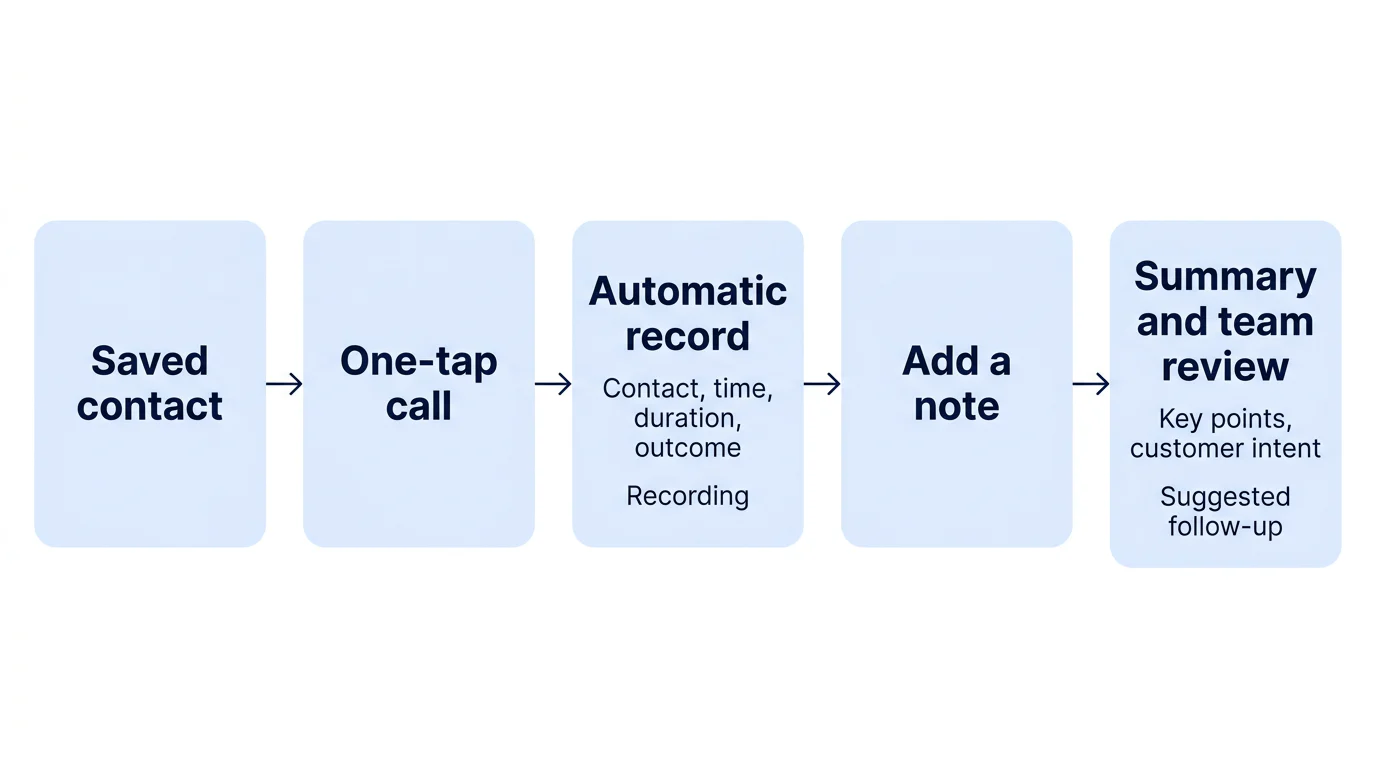
Related terms
Keep reading



Frequently asked
No. A business dialer app is a broad category for team calling and call records. An auto dialer is a specific mode that automatically calls numbers from a predesignated list before connecting a live agent or presenting a prompt.
A sales team should use click-to-call when the rep needs to review the contact, choose when to start the conversation, and preserve notes and outcomes for the next follow-up. It suits researched callbacks and relationship-led sales work.
Preview dialling gives the rep contact information before the call decision. Power dialling works through contacts one at a time, but providers differ on whether the rep starts each attempt or the system advances the queue automatically.
A usable business call record should keep the contact, time, duration, outcome, recording and rep notes together. A summary with key points, customer intent and the suggested follow-up helps another team member continue the conversation.
Click-to-call dialers are not the best fit when a team needs automatic progression through large, clean prospect lists. Power or auto dialling may better suit volume outreach, while click-to-call prioritises control and follow-up context.
Put every follow-up in one shared call record
Talk through the calling workflow your sales team needs.
Talk to Our Expert