


TL;DR
At TalkEasy, we recommend a managed AI agent when a real estate team needs faster deployment and less technical ownership, and a configurable voice platform when it needs deeper control. This guide supplies the qualification fields, integration checks, recovery rules and 36-call test that make booking and handoff safe.
Managed AI Agent or Voice Platform for Realtors?
India had 1,265.73 million wireless subscribers in March 2026, according to TRAI subscriber data. For a real estate agency, every inbound property call can therefore be the first and only chance to earn a viewing.
A managed AI agent or voice platform for real estate solves the same first-call problem, but ownership differs. Choose a managed agent for rapid deployment and less technical upkeep. Choose a configurable platform when your team can own custom logic, integrations and tests. In either case, capture intent, property type, budget, location, timeline and finance status before booking or transferring.
This guide explains how to make that decision without buying a feature list. We cover the qualification fields, conversation logic, CRM handoff, failure recovery and practical test criteria that determine whether automation will help agents, rather than create more follow-up work.
How Does a Managed AI Agent or Voice Platform for Real Estate Compare?
The important choice is not whether an automated caller sounds impressive in a demo. It is who owns the workflow after launch, who changes it when listings or teams change, and who is accountable when a qualified buyer reaches the wrong agent.
A managed route works best when an agency needs a defined inbound process working quickly. A configurable route suits teams that have someone ready to maintain logic, integrations and regression tests as part of normal operations.
Choose a Managed Agent When Speed and Ownership Matter
Choose a managed agent when your qualification questions are stable and your team does not want to run a voice-AI build programme. We recommend this route for teams that want to define outcomes, approve scripts and review calls, while leaving technical implementation with the provider.
Your agency should still own the non-negotiables: required lead fields, escalation rules, approved listing information and the definition of a qualified appointment. An AI voice agent should make those decisions easier to enforce, not hide them behind a black box.
Choose a Configurable Platform When Control Creates Value
A configurable platform is justified when your workflow depends on custom CRM objects, changing listing feeds, specialised routing or detailed experimentation. It gives your team greater control, but also makes your team responsible for prompt changes, integration failures, tests and ongoing supervision.
This is often the right choice for a large multi-location agency with technical support. It is usually the wrong choice if the team has not assigned a named owner for call quality and workflow maintenance.
Use the Matrix as a Procurement Gate
Ask every shortlisted solution to complete the same evidence-based matrix. “Supported” should mean the supplier can demonstrate the exact workflow in a test account, not that it can display an integration logo.
| Route | Deployment Model | Real Estate CRM Support | Qualification Control | Scheduling | Transfer Method | Latency Evidence | Pricing | Compliance | Concurrency |
|---|---|---|---|---|---|---|---|---|---|
| Managed AI Agent | Provider-led build and upkeep | Require mapped write fields | Approved fields and rules | Demonstrate booking flow | Warm transfer or callback | Require measured results | Quote or usage model | Review notices and retention | Confirm in test |
| Configurable Voice Platform | Agency-led configuration | API and webhook dependent | Deep conditional control | Build and maintain workflow | Custom queues and rules | Require measured results | Platform, usage and build costs | Agency configures controls | Confirm in test |
| TalkEasy | AI call-management workflow, Enterprise customisation | Enterprise integration scope, demonstrate target write | Approved call flow, with Enterprise customisation | Callback or transfer, prove calendar booking in test | Listing or territory-based routing | Measure median and p95 response time | ₹999 + GST/month for Pro | Review consent, recording and retention workflow | Confirm in test |
Latency should be measured, not assumed from a vendor claim. ITU delay guidance notes that conversational interaction can be affected by delay below 150 milliseconds, although an AI agent’s response time includes more than network delay alone.
Which Fields Should Qualify Every Real Estate Inquiry?
A useful agent does not collect a generic “lead”. It identifies what the caller wants, captures only the information needed for that intent, and sends a human a structured record they can act on immediately.
The question set should be short enough for a natural call and firm enough to prevent a poor handoff. Our rule is simple: the system may ask follow-up questions, but it must never invent a listing fact, promise availability or force a booking when critical fields remain unclear.
| Inquiry Type | Required Fields | Booking Or Transfer Rule |
|---|---|---|
| Buyer | Area, property type, budget, timeline, finance status, viewing availability | Book only after location and viewing slot are confirmed |
| Renter | Area, property type, monthly budget, move-in date, occupants, viewing availability | Send policy-sensitive screening questions to a human owner |
| Seller | Property area/type, expected price range, sale timeline, valuation availability | Route valuation and pricing discussions to the assigned agent |
| Landlord | Property reference, vacancy, letting intent, maintenance urgency, preferred contact path | Bypass sales flow for urgent maintenance or safety issues |
Qualify Buyer Calls Without Over-Questioning
Start with the property or area the buyer is calling about, then establish property type, budget range, timeframe and financing or pre-approval status. Ask for viewing availability only after the core need is clear.
Budget capture must handle Indian usage naturally, including lakh and crore amounts. If the caller gives an unclear amount, the agent should repeat the interpreted figure and wait for confirmation before saving it.
Qualify Renter Calls with a Separate Path
Rental calls need a different sequence because a buyer’s finance questions are often irrelevant. Prioritise preferred area, monthly budget, move-in date, occupants and the requested viewing window.
Keep agency policy questions distinct from conversational screening. If a caller asks about an exception, a sensitive requirement or a dispute, the agent should create an owned follow-up instead of improvising an answer.
Qualify Seller and Landlord Calls for the Right Owner
Seller calls should establish the property, expected price range, timing and valuation availability, then reach the agent responsible for that territory. The goal is a useful valuation appointment, not an automated price opinion.
Landlord calls need clear separation between new letting enquiries and existing-property issues. Urgent maintenance, safety, tenancy disputes and payment issues should reach a human escalation route immediately.
Publish the Conversation Logic
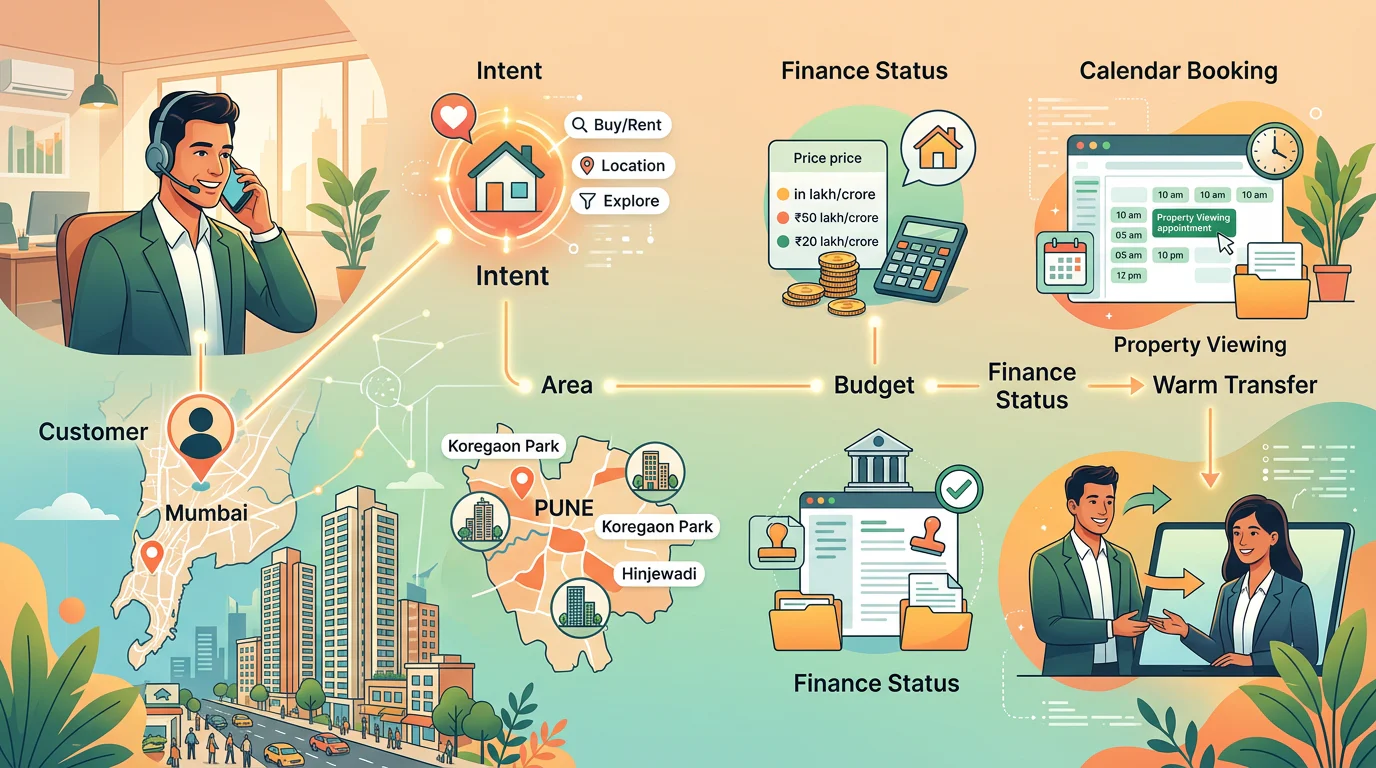
Use a visible logic tree so every agent, manager and implementation partner can audit the same rules.
- Start: Identify whether the caller is a buyer, renter, seller, landlord, existing customer or another enquiry.
- Identify Context: Capture the listing, project or target area before discussing availability.
- Capture Required Fields: Use the intent-specific field set and confirm uncertain budget, address or timeline details.
- Escalate: Transfer human requests, safety issues, disputes, legal questions, pricing exceptions and unverified listing questions.
- Book: Create a viewing only when required fields are complete and a valid slot is available.
- Follow Up: Assign a named owner and callback window when the lead is qualified but not ready to book.
- Recover: Save partial information after two failed clarification attempts, then create a human callback instead of guessing.
Our real-estate teams workflow is designed to preserve the enquiry context while the agency decides how each intent should move through the team.
How Should the System Book, Route and Record the Call?
A real estate AI caller with CRM integration should not merely create a note after the call. It should match or create the right contact, write structured fields, assign an owner, record the outcome and preserve enough context for the receiving agent to continue naturally.
Treat integrations as four layers: capture, context, action and recovery. A missed write, duplicate contact or unassigned callback is not a minor technical detail. It is a lead-management failure that removes the very speed automation was meant to create.
Treat Integration as Four Layers
| Layer | What The System Must Do | Failure Condition |
|---|---|---|
| Capture | Match or create a contact using approved deduplication rules | Duplicate lead or missing phone number |
| Context | Read permitted listing, agent, territory and availability data | Agent answers from stale or unverified information |
| Action | Write fields, notes, owner, task and appointment outcome | Booking exists without a CRM record |
| Recovery | Retry safely, alert an owner and reconcile failed writes | Failed webhook disappears without review |
For Follow Up Boss, test secure webhook delivery, contact updates, appointment events and retries. Its webhook documentation says recipients should acknowledge events within 10 seconds and that retries can continue for up to eight hours.
For HubSpot, test caller matching, engagement creation and the exact field map your agency uses. For kvCORE, verify account-level API access, object permissions and write capability before treating an integration as available. A CRM phone integration is only complete when the assigned agent can use the data without retyping it.
Make the Handoff Useful to an Agent
A warm transfer should give the agent context before the caller speaks again. The handoff payload should include caller identity, intent, property or area, budget, timeframe, financing status, requested slot, unresolved question and recording or transcript link.
- Warm Transfer: Connect the caller to an available agent with a short context summary.
- Round-Robin Ownership: Assign the next eligible agent, but preserve territory and listing rules over simple rotation.
- Showing Booking: Confirm property, date, time and attendee details before creating the event.
- Structured Notes: Save fields separately from the transcript so reporting and follow-up do not depend on free text.
We use AI call summaries to preserve action items and conversation context after the call, while the agency keeps control of what counts as a completed qualification.
What Must an Agency Test Before Launching Its Voice Agent?
Production readiness is not a polished demo. It is proof that the agent behaves correctly when people interrupt, speak over traffic noise, give incomplete addresses or ask for a human during a busy period.
Run a 36-call acceptance test before switching real inbound enquiries to automation. That means testing each of the 12 scenarios below three times, recording the outcome and correcting the workflow before launch.

Run a 36-Call Acceptance Test
- Buyer Qualification: Capture area, budget, property type, timeline and finance status.
- Renter Qualification: Capture monthly budget, move-in date and viewing availability.
- Seller Routing: Send valuation requests to the designated territory owner.
- Landlord Escalation: Bypass sales intake for urgent maintenance or safety issues.
- Barge-In Handling: Stop speaking and respond when the caller interrupts.
- Address Recognition: Confirm Indian addresses, landmarks and unclear local pronunciation.
- Currency Recognition: Confirm lakh, crore and monthly-rent amounts before saving.
- Repetition Recovery: Simplify the question after a second failed clarification.
- Voicemail Handling: Record the result and follow the approved callback policy.
- Warm Transfer: Pass full qualification context to an available agent.
- Calendar Conflict: Prevent double booking and handle a reschedule.
- CRM Failure Recovery: Retry safely, avoid duplicates and alert a named owner.
Score Outcomes That Affect Revenue
Track completion rate, required-field completeness, warm-transfer success, booking success, CRM-write success and recovery success. Also require median and p95 response-time reporting with a stated measurement point, such as from the end of the caller’s utterance to the start of the answer.
Review calls with call insights and investigate every failed record through a reliable logging process. A system that books a showing but loses the owner assignment has not completed the workflow.
Test Consent, Recording and Retention
Inbound answering and outbound follow-up are different compliance cases. For outbound commercial communication, TRAI consent guidance says promotional voice calls require explicit consent and businesses must meet the prescribed sender-registration requirements.
Ask who gives the recording notice, where recordings and transcripts are stored, how long they are retained and how a deletion or withdrawal request is handled. Make the answer part of the supplier’s test evidence, alongside pricing components, implementation support and concurrent-call limits, with a call-logging owner named for every failed handoff.
TalkEasy Keeps Real Estate Calls in Team Hands
At TalkEasy, we work with real-estate teams using call analytics that need one shared number while agents are showing property, travelling, or speaking with another buyer. We give your team a practical call-management foundation: a virtual business number, routing, recordings, call history, team controls and analytics in one mobile-first workflow. Our AI can capture the first enquiry and preserve the context your agent needs, while your team retains judgement over pricing, availability, negotiation and exceptions.
Start with the calls you already receive. Bring us your intake questions, assignment rules, calendar process and CRM requirements, then run the 36-call acceptance test before treating automation as production-ready. We will help you make ownership explicit, map escalation rules and see whether a managed route fits your agency better than a configurable build. When you are ready to keep every property enquiry in team hands, TalkEasy AI Biz Number
FAQs on Managed AI Agent or Voice Platform for Real Estate
These answers address the choice, implementation and compliance questions that usually arise before a real estate agency puts an automated voice workflow in front of live enquiries.
What Is the Difference Between a Managed Agent and a Configurable Platform?
Managed agents run an approved workflow with less technical ownership. Configurable platforms give your team deeper design control, while making it responsible for testing, maintenance and recovery.
Can an AI Voice Agent Book Property Showings?
Yes, if it reads approved availability, captures every booking prerequisite, prevents conflicts and sends confirmation. Otherwise, it should create a callback task with a named owner.
Which CRM Tests Matter Before Launch?
Test contact matching and duplicate prevention first. Then test required-field writes, ownership, recording links, calendar changes, webhook retries and a human recovery queue before launch.
How Should Indian Teams Handle Consent and Call Data?
Use clear notices and purpose-limited data handling. The DPDP Act requires consent to be free, specific, informed, unambiguous and given through clear affirmative action when consent applies.