Voice of Customer: How to Capture It From Phone Calls
Voice of customer from phone calls means counting what callers say: tag each recorded call with seven theme tags, count the calls per tag in a seven-day plan, and rank the results.

By Tej Pandya, Founder · Updated 9 Nov 2026

Key takeaways
- Capture voice of customer from calls by tagging every connected call from a fixed list of seven tags, counting calls per tag in a seven-day plan, and ranking the counts.
- Count calls, not mentions: a call that raises the same objection three times counts once for that tag.
- A small sample gives a wide range, so treat early rankings as a list to watch, and act at once only on changes that are cheap to reverse.
- Announce recording at the start of each call. Under the Digital Personal Data Protection Rules, 2025, notice and consent duties apply from 13 May 2027.
In this article
- 1Why capture voice of customer from phone calls in an Indian small business?
- 2Which seven tags should you use on every call?
- 3How does the 7-day method work: record, summarise, tag, count?
- 4Day-by-day plan
- 5Weekly count sheet
- 6How many calls before you act
- 7Should you do call recording analysis by hand or with AI Call Insights?
- 8How do you turn call themes into changes?
- 9What do consent and data handling need when you record calls?
- 10What are the common mistakes in voice of customer analysis?
- 11Next step: How do you start with your own calls?
- 12Frequently asked questions
Your pricing page answers the questions you expected customers to ask. Your recorded calls hold the ones they actually asked, and few teams have a way to count them.
A manager who listens to a few calls remembers the loud ones: the long argument, the rude caller, the big deal that slipped. A tally across a week of ordinary calls shows what came up most, which is rarely the same thing.
This guide is written for owners and customer experience leads who run a team on phones in India. It gives you a seven-tag list, a day-by-day plan, a count sheet and a table that shows how far a small sample can mislead you. It also sets out when software can do the first pass and what to tell callers about recording.
Replies to objections and complaints are not scripted here. Our guides on those are linked where they apply.
Why capture voice of customer from phone calls in an Indian small business?
Voice of customer (VoC) is the practice of capturing what customers say about your business, in their own words, and acting on it. Phone calls are a rich source of it because most customers in India say they prefer the phone, and on a call they raise what matters to them. The Truecaller and Tata Tele Business Services report The State of Business Calling 2026, researched by Kantar, found that 76% of consumers in India prefer voice calls over digital alternatives as a way to engage with businesses.
That preference is why customer feedback from call recordings is worth the effort. On a call, the customer chooses the subject. They ask the price before you mention it, name the shop down the road, or say why they are not ready to decide. A form or a message template only collects what it was built to ask.
The same report suggests most businesses do not measure what callers say. In Kantar’s survey of more than 500 B2B businesses for The State of Business Calling 2026, 72% judge their voice calls by response rate, 57% by time to resolution and 53% by cost per interaction. Those measures show how fast and how cheaply calls are handled, not what callers raised.
Only connected calls carry this material. A call that rang out or reached a wrong number holds nothing to tag, so the method below counts connected calls only.
How does the 7-day method work: record, summarise, tag, count?
Record connected calls, read the summary or transcript of each, give it up to three tags, and on day 7 count the calls per tag and rank them; the count covers the calls from days 1 to 5, and recording carries on into the next week. The method reads what was said in the calls. How many calls connect and how long they run are covered in our guide to call volume and talk-time checks.
Day-by-day plan
Keep one row per connected call with these columns: date, outcome code, up to three tags, the caller's words copied exactly (up to 15 words), competitor name, and follow-up promised with the time. Review calls in the order they happened, and include won, lost and undecided calls, not only the ones that stood out.
- Day 1: switch on recording and the announcement. Pass: a test call to your own number plays the announcement before the conversation starts. Fail: it plays late or not at all.
- Day 2: fix the tag list and the one-line definition of a connected call on one page. Pass: two people tag the same call independently and agree on every tag. Fail: they disagree on any tag, so rewrite that tag's test line.
- Day 3 to Day 6: log and tag the calls. On Day 3, log the calls from Day 1 and Day 2; on each later day, log the previous day's calls. Read the summary or transcript of each connected call, open the recording only when the summary leaves doubt, and give each call between one and three tags, or the word "none". Pass: by the end of each day, every connected call from the day before has a row and tags; by the end of Day 6, every connected call up to the end of Day 5 has a row and tags. Fail: any connected call has no row, or any row is untagged.
- Day 7: count, rank and choose. Fill in the count sheet below, sort it, and check the top theme against your lost deals using the funnel sheet in our guide to lead conversion rate. The count covers calls up to the end of Day 5, and calls after that go into next week's sheet. Pass: you finish with one change, one named owner and one date to recount. Fail: the list ends the day with no owner.
Weekly count sheet
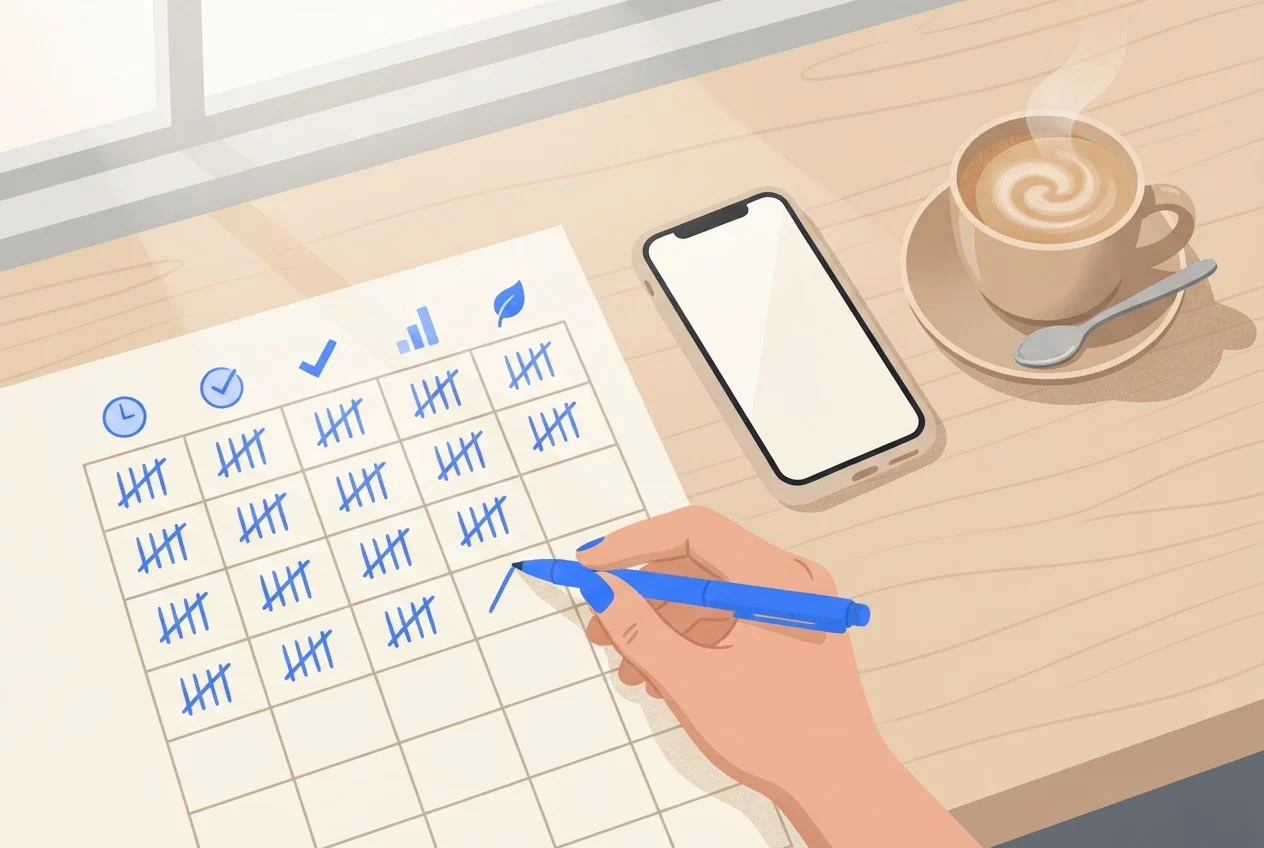
Copy this table into a spreadsheet. Because a call can carry up to three tags, the shares can add up to more than 100%.
| Tag | Number of calls | Share of calls reviewed |
|---|---|---|
| Objection | Calls with this tag | Number of calls ÷ calls reviewed × 100 |
| Price question | Calls with this tag | Number of calls ÷ calls reviewed × 100 |
| Competitor mention | Calls with this tag | Number of calls ÷ calls reviewed × 100 |
| Repeat question | Calls with this tag | Number of calls ÷ calls reviewed × 100 |
| Follow-up promise | Calls with this tag | Number of calls ÷ calls reviewed × 100 |
| Buying intent | Calls with this tag | Number of calls ÷ calls reviewed × 100 |
| Complaint | Calls with this tag | Number of calls ÷ calls reviewed × 100 |
| Calls reviewed | All connected calls in the sample | 100 |
Sort by number of calls, highest first. The top row is your theme for the week, and the next two rows are the ones to watch.
How many calls before you act
A share measured on a small sample is a rough estimate, and the table shows how rough. It is an illustration of a theme seen in 20% of the calls reviewed, worked out with the Wilson score method for a 95% range. Read each range as the likely spread of the true share across all your calls, assuming the calls you reviewed are a fair sample of them. It is not TalkEasy's data.
| Calls reviewed | Calls with the theme (20%) | 95% range for the true share |
|---|---|---|
| 10 | 2 | 5.7% to 51.0% |
| 20 | 4 | 8.1% to 41.6% |
| 30 | 6 | 9.5% to 37.3% |
| 50 | 10 | 11.2% to 33.0% |
| 100 | 20 | 13.3% to 28.9% |
A small sample gives a wide range. With 10 calls, a theme seen twice could be rare or could come up in about half of all your calls. With 100 calls the same 20% narrows to 13.3% to 28.9%. Wait until the range is narrow enough that you would make the same decision at either end of it.
For a team with few calls, that means three things. Keep the tags unchanged and add each week's calls to one sheet, so the range narrows as the weeks pass. Treat the first weeks as a ranking to watch, not a verdict. Act straight away only on changes that cost little and are easy to undo, such as a line on a pricing page, and wait for a narrower range before changes that are expensive.
Pro Tip: To get the range for your own tag, put the calls with the tag in cell A1 and the calls reviewed in B1, then type this in C1 for the lower end: =((A1/B1)+1.96^2/(2B1)-1.96SQRT((A1/B1)(1-A1/B1)/B1+1.96^2/(4B1^2)))/(1+1.96^2/B1). For the upper end, change the minus before 1.96*SQRT to a plus. Format the cells as percentages.
Should you do call recording analysis by hand or with AI Call Insights?
By hand works from the first call and costs only your time. Software does the first pass faster, and you still decide which themes matter and what to change.
Our AI Call Insights lists six things it picks out of your recordings, and each maps onto a tag or a column in your sheet:
| What you want to find | By hand | With AI Call Insights |
|---|---|---|
| Customer objections | Tag Objection as you read each summary. | Flags customer objections. |
| Competitor mentions | Write the name in the competitor column. | Flags competitor mentions. |
| Buying intent | Tag Buying intent. | Flags buying intent. |
| Pricing discussions | Tag Price question. | Flags pricing discussions. |
| Follow-up commitments | Tag Follow-up promise and note who and by when. | Flags follow-up commitments. |
| Compliance issues | Note any call a manager should look at. | Flags compliance issues. |
Reading is the slow part of days 3 to 6, and our AI Call Summaries give a transcript, a summary, the caller's intent, and follow-up information within a couple of minutes of a call ending. For the wider picture of general AI call analysis, see our guide to analysing sales calls with AI.
How do you turn call themes into changes?
Pick the top-ranked theme, change the one place it points to, and recount next week. Changing one thing at a time is what lets you see whether the count moved.
| If this ranks first | Change this first |
|---|---|
| Price question | Put the answer on your pricing page and in the opening of price calls. |
| Objection | Rewrite the part of your pitch that comes just before the objection is raised. |
| Competitor mention | Add a short, factual comparison where callers are likely to look. |
| Repeat question | Answer it on your website and in your first message to a new enquiry. |
| Follow-up promise | Give every promise a time and a named owner, and check them daily. |
| Complaint | Fix the cause, then tell the callers who raised it. |
Did you know? In The State of Business Calling 2026, nearly 49% of consumers said being able to schedule a callback at a convenient time would significantly increase their willingness to engage with business calls. That is one reason the table asks for a time and a named owner on every follow-up promise.
The replies themselves are not part of this method. Replies to objections live in our guide to cold call objection handling, and handling a complaint while the caller is on the line is covered in handling customer complaints. This method only counts them. A weekly coaching routine built from summaries is in our guide to coaching sales reps with AI call summaries.
When you recount, compare ranges, not single figures. A small move in share on a small sample sits well inside the range in the table above and is not proof that the change worked.
What do consent and data handling need when you record calls?
Announce at the start of each call that it is being recorded; that is good practice now. Under the Digital Personal Data Protection Rules, 2025, made under the Digital Personal Data Protection Act, 2023, the notice and consent duties apply from 13 May 2027. Wording for the announcement is in our call recording announcement guide.
What are the common mistakes in voice of customer analysis?
The three that matter most are acting on too few calls, listening only to lost deals, and leaving the list without an owner.
- Acting on a small sample as if it were exact. A ranking from 10 calls can reorder itself next week. Use the range table before you spend money on a change.
- Listening only to lost deals. Every theme then looks like a reason for losing. Include won and undecided calls, so you can see which themes also appear in calls that ended well.
- No owner. A ranked list that nobody owns changes nothing. Name one person, one change and one recount date on day 7.
Scoring how well a rep handled a call is a different job, covered in our sales call tips scorecard. This method records what customers said, whatever the rep did.
Next step: How do you start with your own calls?
Start this week: put the seven tags and the count sheet in one spreadsheet, switch on recording, and announce it at the start of each call. At the end of the week, let the ranges guide you. If the top theme’s range sits clearly above the next one, make the one change that theme points to and recount next week.
If the ranges overlap, make only a change that is cheap to undo and keep adding calls to the same sheet, so the picture firms up. Before any change that costs real money, listen to five recordings carrying the top tag and check the tag still fits what the callers meant.
If you would rather have software read the recordings first, our team can show you how AI Call Insights and AI Call Summaries fit this method. Talk to Our Expert.
Let software do the first pass on your calls
Frequently asked questions
Sources
- 1.The State of Business Calling 2026, Truecaller and Tata Tele Business Services, research by Kantar, as reported by Business Standard, 7 July 2026
- 2.Digital Personal Data Protection Rules, 2025, Ministry of Electronics and Information Technology, 13 November 2025
- 3.Digital Personal Data Protection Act, 2023, Ministry of Electronics and Information Technology
- 4.TalkEasy AI Call Insights
- 5.TalkEasy AI Call Summaries