
Missed-Call Handling Alternatives for Indian Teams
Compare missed-call handling alternatives for Indian teams by alerts, SMS recovery, number setup, compliance checks and complete monthly cost.

Missed-Call Handling Alternatives for Indian Teams
At the end of March 2026, India had 1,330.58 million subscribers across wireless and wireline services. For a small team, an unanswered enquiry is therefore not a reporting problem to review later. It is a live ownership problem.
Missed-call handling alternatives work best when they do three things without adding a call centre: detect an unanswered call, alert one accountable teammate, and send a compliant reply from the right number. Compare forwarding, message delivery, shared ownership and the complete cost of users, numbers, messages, setup and tax before choosing.
This comparison shows what to remove from a large phone-suite requirement, how to compare lighter approaches, and how to prove the workflow before customers depend on it.
Which Requirements Matter in Missed-Call Handling Alternatives?
A missed-call-only buyer needs a recovery workflow, not every capability of a large call operation. The essential question is simple: when a caller does not reach a person, can the team see it, acknowledge it, assign it and follow up without confusion?
Start with the workflow your team can actually run at peak time. Our AI Missed Call Agent page is useful for mapping the gap between an unanswered call and a human response. The features below separate operational requirements from nice-to-have platform features.
| Keep On The Shortlist | Remove Unless You Use It Weekly |
|---|---|
| Missed-call detection with a timestamp and caller identity | Multi-level IVR menus |
| A named owner and escalation path | Large call-centre supervisor controls |
| Mobile, SMS, email or task alerts | Broad campaign and reputation tools |
| A compliant first-reply route | Deep integrations and custom APIs |
| Shared history for the next teammate | Complex CRM administration |
| Existing-number compatibility | Automated booking when staff already schedule jobs |
A shared number still matters when calls should belong to the business rather than a staff member’s personal SIM. Read our Virtual Business Number guide before deciding whether the new workflow needs a new public number, forwarding from an existing number or a later migration.
Define the Missed Call
Agree on what counts as missed before comparing products. A caller who hears one ring, a caller sent to voicemail and a caller who abandons quickly may create different events. Your chosen system should expose that rule rather than hiding it.
Define the Owner
Every recovered enquiry needs one accountable person. A team inbox without assignment can notify everyone and still result in nobody responding. Use a named owner, a visible callback action and a backup responder.
Define the Response Window
Set a practical service target for your own operating hours. The right target is one your team can meet and audit, not an unmeasured claim that every alert is immediate.
Which Missed-Call Handling Alternatives Fit a Small Team?
The useful comparison is not “which platform has the most features?” It is “which approach matches how this team answers, texts and follows up today?” A basic responder can be enough when one owner calls back. A shared business-number workflow is stronger when several people must see the same enquiry.
| Approach | Alert Model | SMS And Reply Model | Number Route | Best Fit |
|---|---|---|---|---|
| Our Shared Business-Number Workflow | Test mobile alerts and team ownership in the trial | Confirm the intended missed-call response path before launch | Virtual number, with forwarding or migration assessed separately | Teams needing shared records, calling visibility and follow-up accountability |
| Basic SMS Responder | Usually one owner and one alert route | Often a simple acknowledgement, with limited follow-up controls | Commonly conditional forwarding | Owner-led businesses that call back personally |
| Shared Virtual-Number App | App and team notifications | May provide a shared conversation inbox | New number or forwarding | Small teams answering one public business line |
| AI Reception And Booking Layer | Multi-channel routing and escalations | Two-way conversation or automated qualification | May answer before staff | Teams with a genuine after-hours or booking requirement |
Our published plan includes unlimited users and contacts, 3 hours of daily talktime, call history, recording, team management and analytics for ₹999 + GST per month. Additional talktime is published at ₹49 + GST per hour. Compare that published cost with the full amount you will spend, using TalkEasy Pricing, not a headline subscription alone.
Compare the Workflow, Not the Label
Some tools are built around one automated acknowledgement. Others combine a business number, shared call records and a broader AI calling workflow. Neither approach is automatically better. The correct choice depends on who answers, whether the team needs shared context and whether a customer reply needs immediate human ownership.
Treat Missing Documentation as a Test Item
Do not fill an unknown cell with a generous assumption. If a provider does not document delivery reporting, retry behaviour, forwarding requirements or shared inbox ownership, make that a trial test. “Not demonstrated” is more useful than an unsupported yes.
Price the Whole Month
Include subscription, number rental, message usage, extra users, talktime, setup, forwarding charges and GST. A lower entry price can cost more once every responder and every reply is added.
How Should Alert Behaviour Work After a Missed Call?
An alert is only useful when it reaches the person who can act. The system should record the missed-call event first, then notify the assigned responder through a primary channel and a fallback channel if the team considers that necessary.
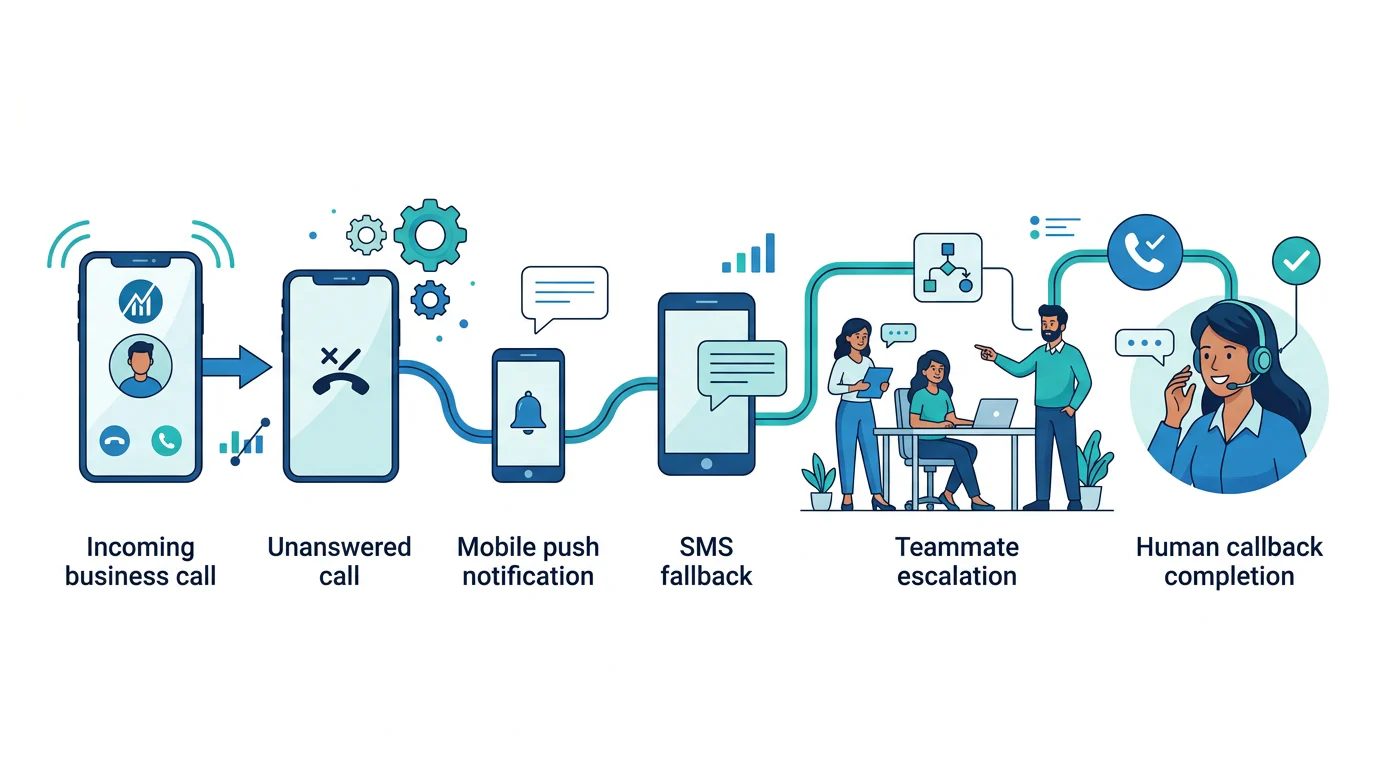
A push notification alone is not enough for every situation. Android 13 and later requires the app’s notification permission for non-exempt notifications, according to Android guidance. Test the workflow on a real staff phone with notifications denied, poor connectivity and the app closed.
Alert records should also reveal patterns that staff cannot see from individual handsets. Use Call Analytics to review missed-call timing, ownership and follow-up gaps, then adjust the escalation rules around real operating conditions.
Use a Clear Escalation Sequence
Start with one owner. If that person does not acknowledge or act within your chosen response window, send the event to a second responder or team queue. Stop escalation when the caller receives a response or a teammate explicitly takes ownership.
Make Every Channel Auditable
A good event record shows the incoming call, missed-call rule, alert attempts, assigned owner, follow-up status and any reassignment. This prevents duplicate alerts from becoming duplicate customer messages.
Separate Urgency from Noise
Mobile push, SMS, email, CRM task and webhook can all be useful alert channels. They should not all fire indiscriminately. Choose a primary action channel, define the fallback and measure whether the team actually sees it. Our Team Collaboration workflow can help teams keep ownership visible after the initial alert.
What Should a Missed-Call SMS Workflow Do?
The first message should acknowledge the caller, identify the business and make the next step clear. It should not pretend a human has already reviewed the enquiry, and it should not launch an open-ended sequence that the team cannot supervise.
In India, commercial messaging has formal sender, header, content-template and consent requirements. TRAI’s sender guidance says commercial communications require sender registration, a registered header, a registered content template and applicable customer consent. Build those checks into the buying process rather than leaving them to a last-minute launch task.
Time the First Reply from the Actual Event
Measure the interval from the missed-call event, not from when a dashboard refreshes. Then distinguish message sent, carrier accepted, delivered, failed and replied. Each state tells the team something different.
Assign Two-Way Replies to a Person
A customer response should enter a shared workflow with one owner, visible hand-off and a clear follow-up action. If the business uses a simple one-way acknowledgement, say so plainly and make the callback responsibility visible elsewhere.
Define Retries and Opt-Outs Before Launch
Decide whether the workflow sends one reminder, multiple reminders or none. Stop follow-ups after a reply, respect opt-outs and retain the relevant message, delivery and ownership records. For teams that also need dependable call records beside messaging, see Reliable CRM Call Logging.
How Do You Check Compliance, Numbers and Migration?
Messaging compliance, existing-number routing and migration are connected. A technically working auto-reply is still a poor launch if the customer receives it from an unfamiliar number, the forwarding route fails or the business cannot show how consent and templates are managed.
The Digital Personal Data Protection Act requires consent to be free, specific, informed, unambiguous and withdrawable with comparable ease. Use the DPDP Act as a reason to document what data is collected, why it is used, who can access it and how a customer can withdraw consent.
Check the India Messaging Route
Confirm the Principal Entity, sender header, approved template, consent approach, opt-out handling and delivery-report access. Also ask the provider which party owns each task. Do not assume a first response to an incoming call removes those obligations.
Choose the Number Route Deliberately
Conditional forwarding keeps the published number in place but needs testing for busy and no-answer scenarios. Porting can preserve a mobile number when changing access providers, while a separate number may activate faster but asks customers to recognise a new contact point. Our Existing Number Guide explains the trade-offs in more detail.
Run a Controlled Migration
Inventory every published number, current forwarding setting, message template and staff responder. Pilot with two people, retain a rollback method and test both business-hours and after-hours calls. If portability is part of the plan, prepare the transition before changing any published number.
Use this worksheet before approving any contract:
| Cost Item | What To Confirm |
|---|---|
| Subscription | Monthly charge, billing frequency and annual commitment |
| Users | Included responders, extra-seat charge and admin access |
| Number Rental | New-number fee, number type and replacement cost |
| Calling | Included talktime, overage and forwarding charges |
| Messaging | Per-message charge, automated reply charge and human reply charge |
| Setup | Onboarding, template registration, configuration and porting costs |
| Tax | GST treatment and invoice total |
TalkEasy Helps Teams Recover Missed Calls
At TalkEasy, we help Indian teams move from a personal-phone scramble to a shared call workflow. Our app gives your team a virtual business number, call history, recordings, team management and analytics, so missed enquiries do not vanish with an individual handset. Start by mapping the number customers already dial, choosing the accountable responder and testing the missed-call path under real conditions. We will help you decide whether a virtual number, forwarding setup or a broader calling workflow is the better fit for your team. Bring your current number, peak call times and SMS requirements to the conversation. We can then identify the tests that matter, including alert receipt, staff ownership and compliance checks, before you change customer-facing details, and agree a low-risk rollout. For a practical walkthrough of the workflow, talk to our expert through TalkEasy AI Biz Number.
FAQs on Missed-call Handling Alternatives
What Are Missed-Call Handling Alternatives?
Missed-call handling alternatives are lighter phone workflows that detect unanswered calls, alert a responsible teammate and support a prompt customer response, without requiring a full call-centre platform.
Can We Keep Our Existing Business Number?
Usually, yes. Test conditional forwarding first, then assess porting if it is needed. Confirm caller experience, forwarding charges, SMS sender identity and fallback behaviour before publishing changes.
Which Alert Channel Is Best for Small Teams?
Mobile push is useful for speed, but it needs a fallback. Pair a named owner with SMS, email, task or escalation routing that matches daily team habits.
How Should We Test SMS Auto-Replies?
Test timing, templates, delivery, reply ownership, retries, opt-outs and failures. Launch only after staff can see each result, take ownership and complete the required follow-up promptly.