
From AI Call Summary to Faster Customer Follow-Up
A confirmed customer follow-up record with one owner, a deadline and a logged outcome.
- Time
- Within a couple of minutes, plus review
- Difficulty
- Easy
- Cost
- ₹999 + GST/month with TalkEasy Pro (2026)
- Steps
- 5
Before you start, have
- An AI-generated customer call summary and access to the related recording or call history
- The customer record where your team tracks follow-up work
- A person authorised to own the next action
- Your team's deadline and escalation rule
Heads up: Do not treat generated text as final when customer details, dates, prices or commitments are involved. Validate those details against the recording or call history first.
Heads up: Keep the owner, deadline and outcome in the customer record your team uses for follow-up.

By Tej Pandya, Founder · Reviewed 21 Sept 2026
In brief
An AI call summary speeds customer follow-up only when a person reviews it, validates the details, assigns one owner, sets a deadline and logs the outcome. Use the summary as the starting record for the next action, not as a substitute for accountability.
- 1
Review the summary
Open the summary after the call and read the customer requirement, key points, questions, objections, suggested follow-up and outcome. Separate the items that require action from background context. The step is complete when you can state the next customer-facing action in one sentence.
- 2
Validate the customer details
Check names, dates, prices, requested actions and commitments against the recording or call history. Correct the customer record where the summary omitted or misread a material detail. The step is complete when the record matches the call on the details that affect the next action.
- 3
Assign one owner
Name one person responsible for the next action in the customer record. If more than one task is needed, give each task its own owner rather than assigning the whole call to a group. The step is complete when every promised action has one accountable person.
- 4
Set a follow-up deadline
Add the agreed or internally required deadline beside the assigned action. If the customer gave a date or time, use that commitment; otherwise apply your team's deadline rule. The step is complete when the owner can see when the action is due.
- 5
Log the outcome
After the follow-up, update the same customer record with what happened, such as completed, awaiting a customer reply, rebooked or escalated. Add the next action only when one remains. The step is complete when the next person can see both the original commitment and its current result.
You'll know it worked when
The customer record shows a validated summary, one owner for each open action, a visible deadline and the latest follow-up outcome.
Make the summary accountable
As of September 2026, TalkEasy says its summaries appear in call details within a couple of minutes and capture key points, customer intent, a suggested follow-up and the call outcome. That gives the team a usable starting record, but the customer promise still needs a named person and a due date.
NIST's 2024 research on machine-generated reports says generated reports should be complete, accurate and verifiable. Use the recording or call history to confirm details before the follow-up becomes part of the customer record.
A five-step handoff after every customer call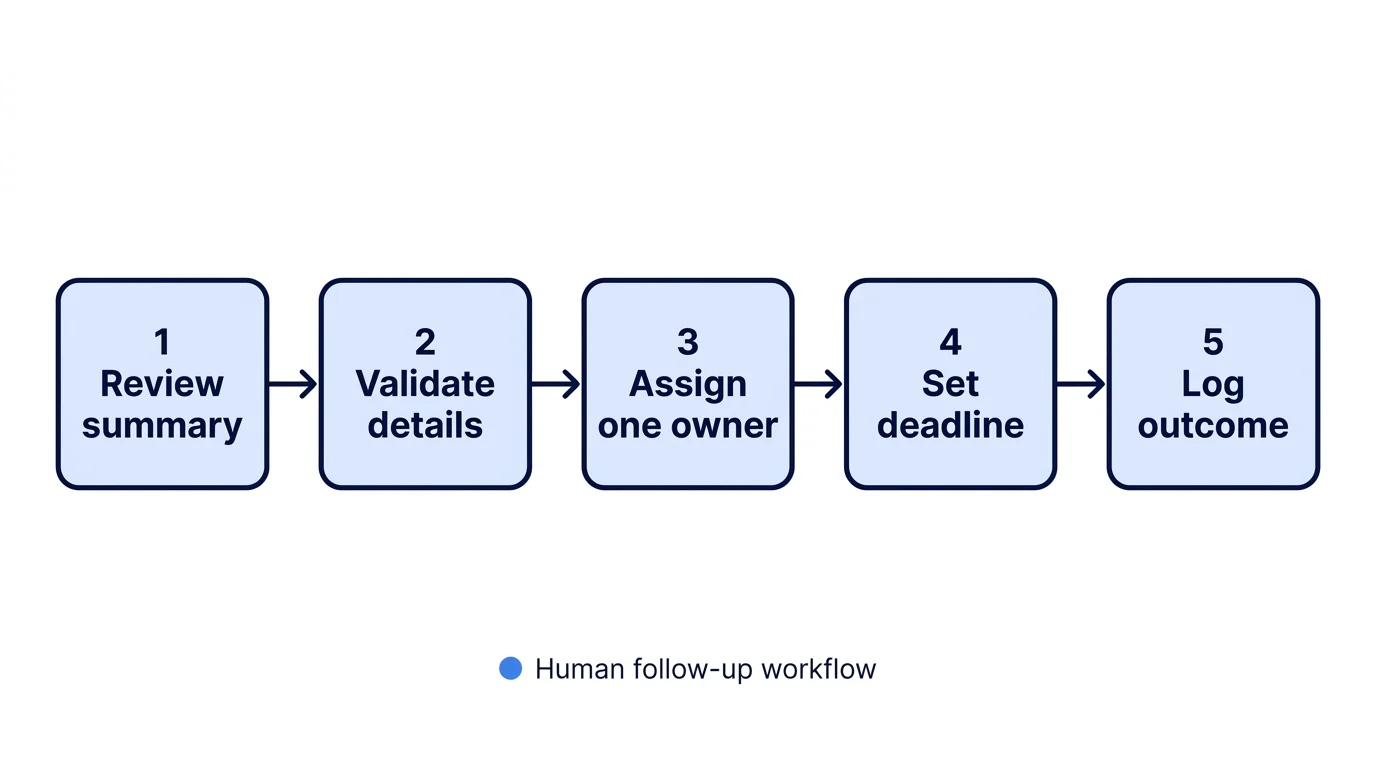
Keep the next conversation in context
A summary is more useful when the next caller can see the confirmed action and its result without rebuilding the previous conversation. Read A Transcript Records the Call, an AI Summary Shapes Follow-Up for the distinction, then use Keep Follow-Ups in Context With a Business Dialer App and Turn Call Recordings Into Sales Coaching With a Weekly Recheck when your team also needs review routines.
Keep reading



Frequently asked
A follow-up-ready AI call summary should capture the customer requirement, key discussion points, questions, objections, the suggested next follow-up and the call outcome. The person reviewing it should confirm the details that affect what the team promises to do next.
Set a review rule that matches the importance of the call. A manager can review summaries involving customer commitments, complaints, deadlines, prices or escalations, while the assigned owner can validate routine follow-ups against the available call record.
This workflow does not require CRM automation. After validating the summary, record the owner, deadline and outcome in the customer record your team uses so the next person can find the confirmed follow-up context.
Assign one owner as soon as the summary has been validated and before the call is considered complete. A named owner prevents a customer commitment from becoming a shared assumption that nobody is responsible for completing.
Put every customer call into a follow-up routine
Install TalkEasy on Android to manage business calls, summaries and call history in one app.
Install on Google Play